Planetary defence
Hera thermal images track Dimorphos cooling in shadow
JAXA’s November 6 release shows heat observations of the asteroid pair and confirms Hera’s November 4 arrival. Surface-temperature analysis remains under way.
Add us as a preferred source on Google Add us as a preferred source on Google
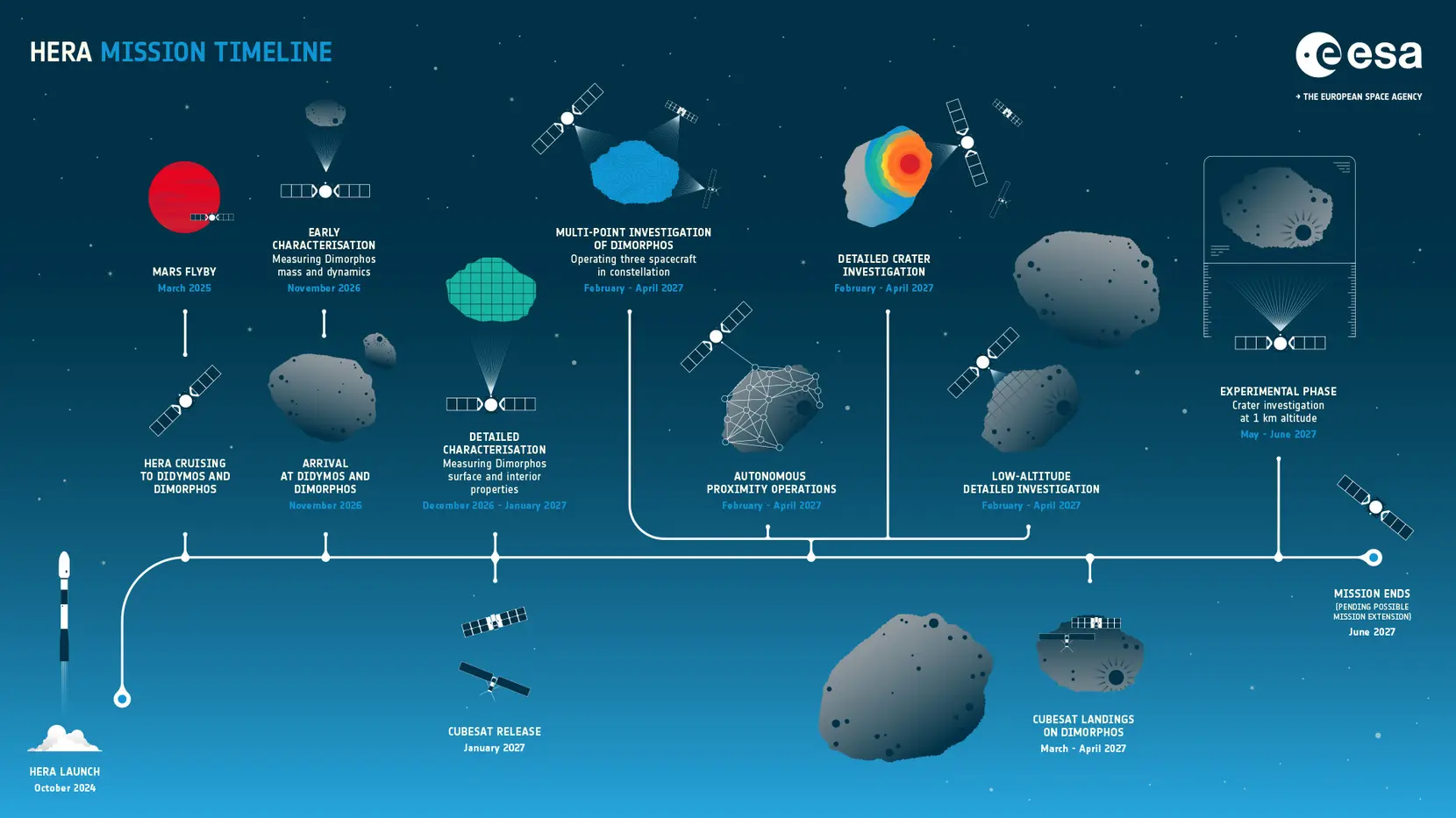
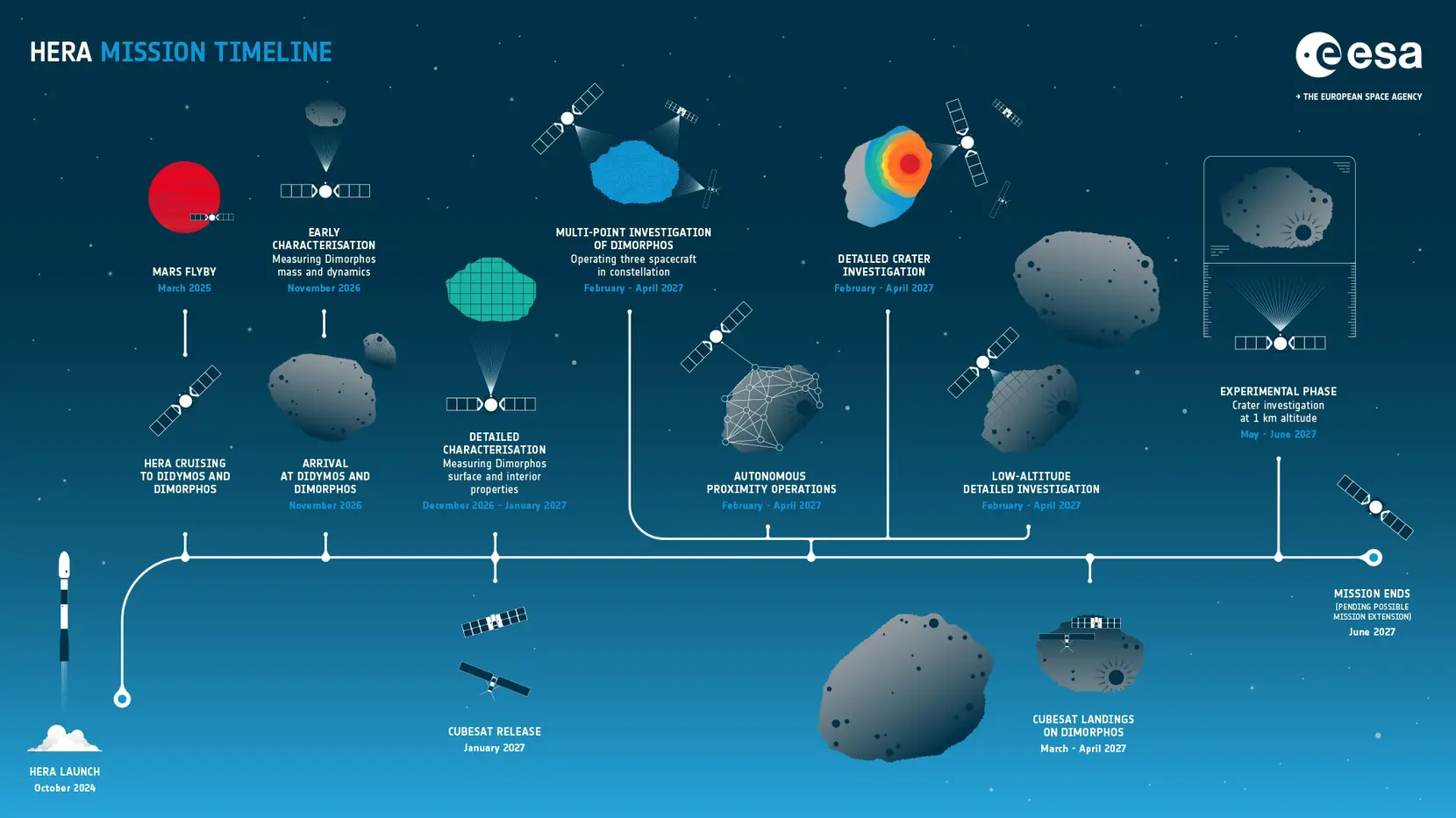
Newly released thermal observations from Europe’s Hera spacecraft show the asteroid moon Dimorphos cooling as it passes into the shadow of its larger companion, Didymos. Japan’s space agency JAXA published the results on November 6, adding heat measurements to the mission’s close-up investigation of the site of NASA’s asteroid-deflection test.
JAXA’s Thermal Infrared Imager recorded the cooling sequence on October 28–29, Japan Standard Time. A separate image taken on October 31 at 20:19:52 JST shows both asteroids from 57 kilometres away. These observations preceded Hera’s arrival at the binary system on November 4 JST, which JAXA now confirms.
The instrument detects heat emitted by the surface, including on the night side. JAXA says temperature changes can help estimate thermal inertia — how readily material heats and cools — and constrain whether surfaces contain fine grains or large boulders. Analysis of Didymos’s surface temperature is still under way.
ESA separately released a visible-light view of the pair on November 5, taken from 60 kilometres away. It shows a side of Didymos that NASA’s Double Asteroid Redirection Test, or DART, did not see shortly before striking Dimorphos on September 26, 2022.
The broader objective is to understand the outcome of that impact. ESA says Hera’s investigation should help turn the kinetic-impact method of changing an asteroid’s motion from a single experiment into a better-understood, potentially repeatable technique for protecting Earth. The first thermal observations do not yet provide that full assessment.
This follows our November 5 report on Hera’s observing plan, which left arrival unconfirmed. The new JAXA release establishes that arrival occurred and reports the initial thermal observations. ESA plans to unveil detailed images of both asteroids on November 25.
Reporting trail
Primary sources
Hera-JAPAN / JAXAFirst Thermal Imaging of a Binary Asteroid Systemhera.isas.jaxa.jp
European Space AgencyHera’s first close-up view of Didymos asteroidsesa.int
Space Exploration .INHera-JAPAN publishes observing plan for two asteroidsspaceexploration.in
European Space AgencyHera operationsesa.int
Creative CommonsCC BY-SA 3.0 IGO image licencecreativecommons.org
For an image post, download the card and copy this suggested caption.
JAXA’s November 6 release shows heat observations of the asteroid pair and confirms Hera’s November 4 arrival. Surface-temperature analysis remains under way. Read the full report: https://www.spaceexploration.in/news/hera-first-thermal-images #SpaceExplorationNews #SpaceNews #SpaceScience