Lunar exploration
China postpones Chang’e-7 lunar south-pole mission beyond 2026 window
The lunar probe and its Long March 5 rocket had reached Wenchang’s launch area, but China says a launch-condition assessment means the planned window will not be used. No reason or replacement date has been disclosed.
Add us as a preferred source on Google Add us as a preferred source on Google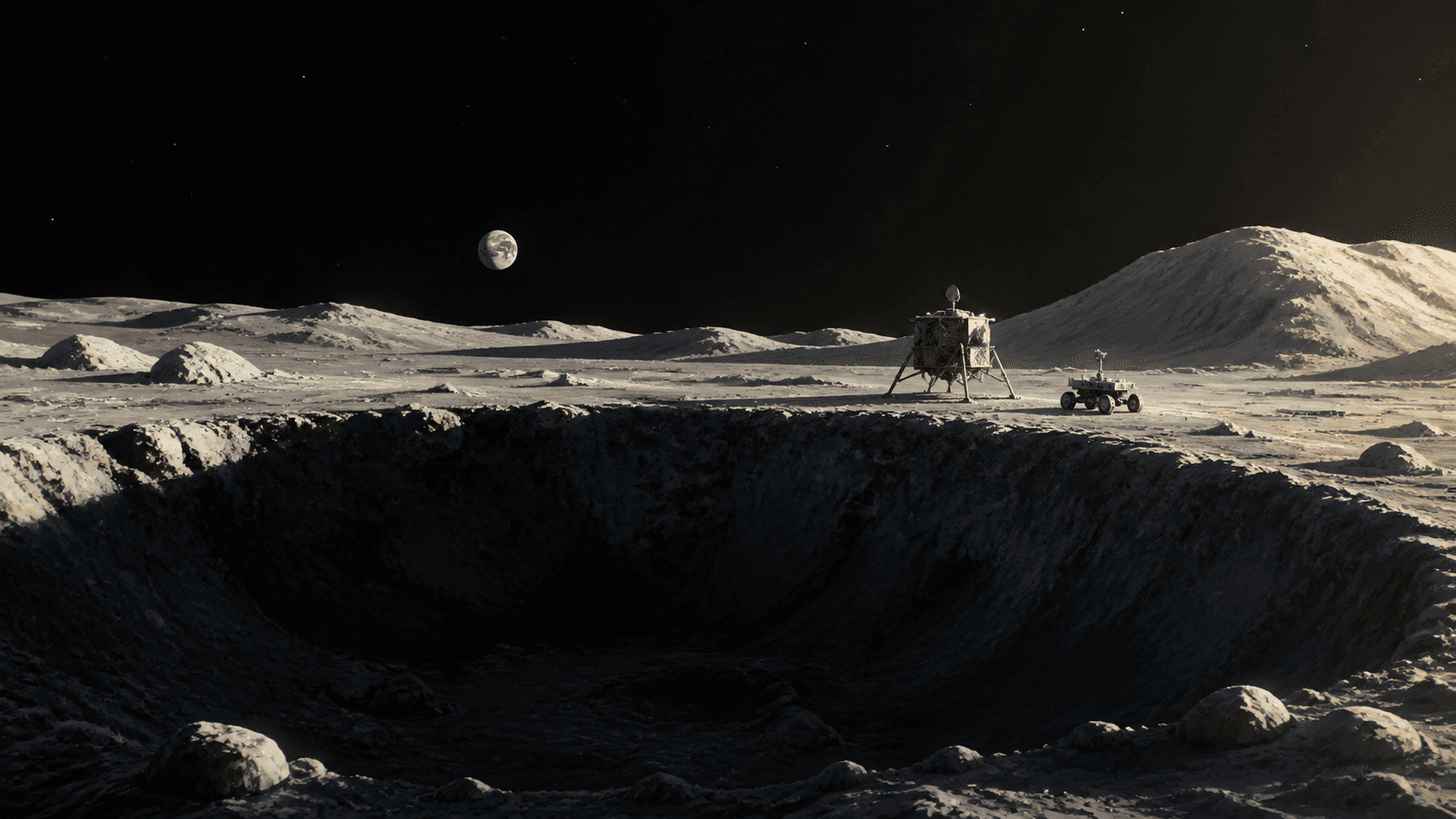
China has postponed its Chang’e-7 lunar mission beyond its planned 2026 launch window after determining that the probe did not meet launch conditions. The brief August 23 statement, carried by Xinhua and published by People’s Daily Online on August 24, said the decision followed an assessment guided by prudence, reliability and mission success. It did not give a technical reason, identify a subsystem or announce a replacement launch date.
The decision stopped a campaign that had already moved hardware into launch-site operations. A photograph released by Xinhua and carried by the Associated Press showed the Chang’e-7 spacecraft and Long March 5 Y14 rocket being transferred vertically to the launch area at the Wenchang Spacecraft Launch Site in Hainan on August 19. Space.com had reported an August 24 target, Beijing time, while a Hainan government report described the mission as preparing to launch soon from Wenchang.
The published record supports the postponement, not an explanation for it. The statement says only that launch conditions were not met and that the planned window this year cannot be used. It does not say whether the assessment concerned the spacecraft, the Long March 5, ground systems, weather or another factor. It also does not state whether the stack will remain at Wenchang, return for further work or receive a new launch opportunity in 2027.
A lunar south-pole mission put on hold
Chang’e-7 is China’s next planned robotic mission to the Moon’s south-pole region. China’s National Space Administration has said the mission is intended to survey the lunar surface environment, water, ice and volatile elements in south-polar soil. The official description calls for environmental and resource surveys, while AP reported that the mission was to examine permanently shadowed craters as part of its search for water ice.
The planned architecture is more than a single lander. Pre-launch accounts describe an orbiter, lander, rover and a small hopping robot. The rover and hopper are intended to extend exploration around the landing area, and the hopping vehicle was expected to enter permanently shadowed pits that a conventional rover may not reach. That operational plan is why the project has been presented as combining orbiting, landing, roving and hopping rather than as a one-point surface mission.
Space.com reported that the lander’s planned destination was near the edge of Shackleton Crater and that, after a lunar-orbit phase, the lander was expected to attempt a south-pole touchdown near the end of 2026. The report also said the hopper was designed to move from sunlit terrain into shadowed craters in search of ice. Those were pre-launch plans, not completed operations; the postponement means none of those mission steps has begun.
International instruments remain part of the planned payload
The mission also carries instruments developed through international cooperation. CNSA said in 2024 that the orbiter would carry a Swiss-Chinese Earth-radiation spectrometer to monitor radiation arriving at and leaving Earth’s climate system from a lunar vantage point. Space.com listed instruments from Russia, Italy, Bahrain, Egypt, Thailand, the United States and partners in Hong Kong. The postponement announcement did not say whether the launch-condition assessment changed the status, schedule or readiness of any of those payloads.
The south-pole focus gives the delay a specific scientific consequence: a planned attempt to collect both remote-sensing and in-situ observations of terrain and materials in a region where sunlight and shadow are unusually consequential for exploration. China’s previously published description includes searching for water ice and volatile elements, but it does not establish that Chang’e-7 would find them. The mission’s measurements, landing and hopper operations remain prospective until a launch is rescheduled and completed.
What the announcement does and does not change
Chang’e-7 is the seventh mission in China’s Chang’e lunar-exploration programme. Its immediate predecessor, Chang’e-6, returned rock and soil from the Moon’s far side in 2024, a result AP described as a first. That earlier accomplishment is programme context, not evidence about the current launch assessment: the August 23 announcement does not connect Chang’e-7’s postponement to any previous lunar mission.
For now, the confirmed change is narrow but consequential: Chang’e-7 will not launch in the window China had planned for 2026, despite the spacecraft and rocket reaching the Wenchang launch area. The next meaningful official update would be a new launch opportunity or further disclosure about the assessment. Until then, assigning a cause to the postponement or predicting when the lunar south-pole campaign will resume would go beyond what China has published.
Reporting trail
Primary sources
People’s Daily OnlineChina’s Chang’e-7 launch will not proceed in planned window this yearen.people.cn
Associated PressChina abruptly postpones ambitious Chang’e-7 lunar mission launchapnews.com
Hainan Provincial People’s GovernmentChang’e 7 lunar probe set for launch soon from Wenchangen.hainan.gov.cn
Space.comChina’s Chang’e 7 moon probe will launch this weekend on the most ambitious lunar mission in historyspace.com
China National Space AdministrationChang’e-7 lunar mission to carry instruments developed through international cooperationcnsa.gov.cn

For an image post, download the card and copy this suggested caption.
The lunar probe and its Long March 5 rocket had reached Wenchang’s launch area, but China says a launch-condition assessment means the planned window will not be used. No reason or replacement date has been disclosed. Read the full report: https://www.spaceexploration.in/news/change-7-launch-postponed #SpaceExplorationNews #SpaceNews #SpaceMissions