Science
Helix Nebula’s 22 bow shocks trace stellar debris breaking apart
The arcs’ changing geometry supports progressive stripping and a roughly 10,000-year coherence time, not a direct clock for every stage of interstellar mixing.
Add us as a preferred source on Google Add us as a preferred source on Google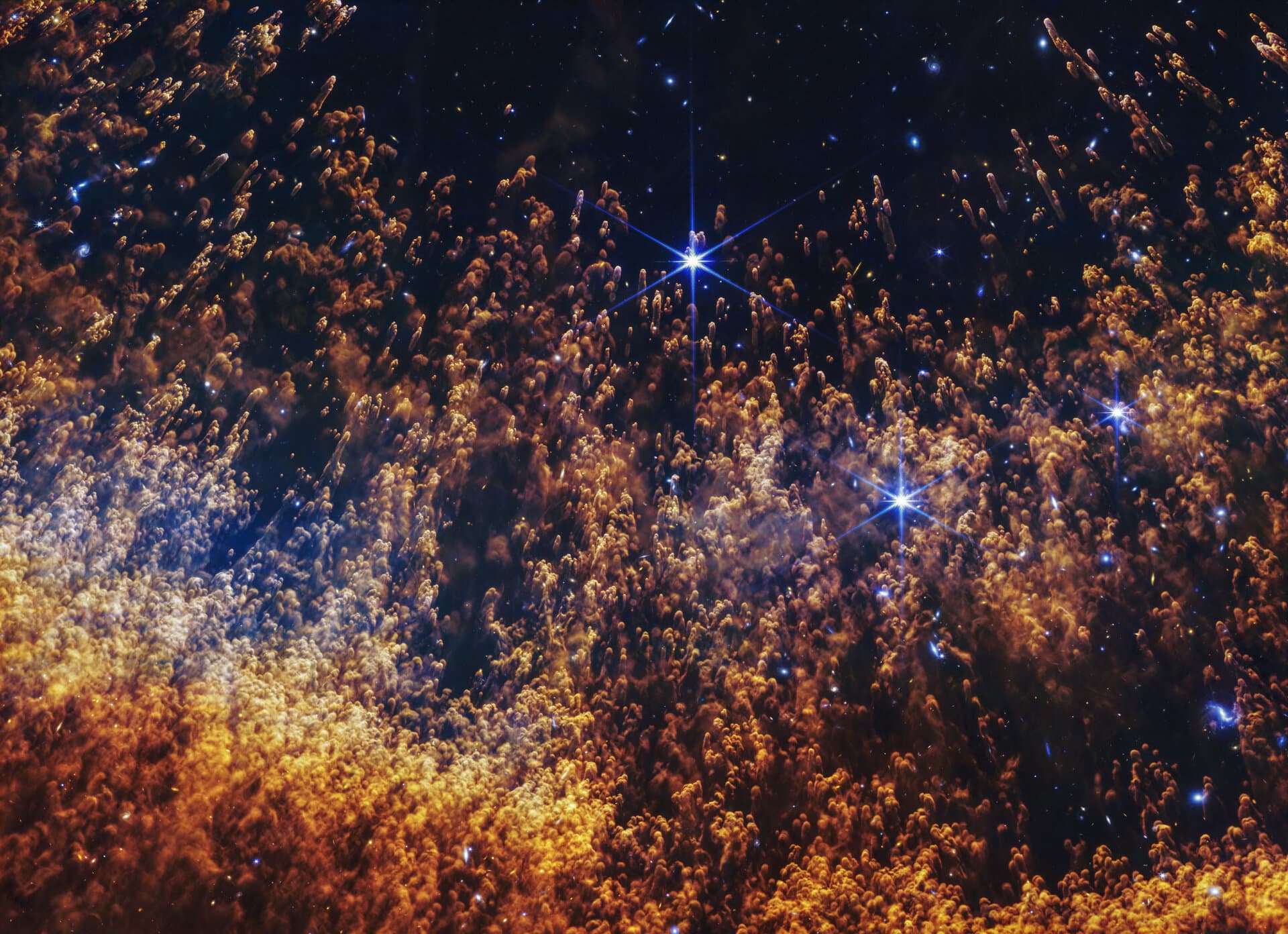
Twenty-two compact arcs in the outer Helix Nebula have given astronomers a way to follow stellar debris as it loses its coherent shape. In an open-access study published in Nature on August 12, researchers report that the arcs become sharply smaller and less orderly with increasing distance from the nebula’s central white dwarf. They interpret that progression as dense fragments being stripped and broken up while moving into the surrounding interstellar gas.
The images do not record one clump changing through time. They capture different clumps at different distances in a single view, and the researchers treat those positions as an evolutionary sequence. That distinction is central to the result: the observed geometry is direct, while the proposed stripping process and its timescale come from combining the spatial trend with an inferred expansion speed.
A faint forest beyond the familiar ring
The Helix, also catalogued as NGC 7293, lies about 199 parsecs, or 650 light-years, away. Its bright inner nebula contains thousands of dense comet-like knots, but the new work examined a much fainter outer halo. The team observed it in November 2025 with the partly completed Modular Optical Telephoto Hyperspectral Robotic Array, or MOTHRA, at El Sauce Observatory in Chile.
MOTHRA uses banks of telephoto lenses and narrow filters to isolate faint emission over a wide field. Only its first five mounts were operating for the Helix observations. The hydrogen-alpha exposure amounted to 172.5 single-lens hours, equivalent to about 20 minutes with the 504 hydrogen-alpha lenses planned for the completed array. In that commissioning data, the researchers identified at least 22 complete or partial arcs on the eastern side of the nebula; most had not previously been reported, although several can be picked out in older images.
A bow shock forms when an object moves through surrounding material faster than waves can travel through that medium, producing a curved front analogous to the wake piled up ahead of a boat. Here the visible arcs are not the fragments themselves. The team found no hydrogen-alpha, doubly ionised oxygen or singly ionised nitrogen emission at most of the fitted shock foci, where the obstacles should sit. That absence is consistent with the underlying clumps being largely neutral and detectable mainly through the shocked gas around them.
The brighter eastern shocks also fit the Helix’s motion. The paper gives the nebula a speed of about 45 kilometres per second relative to the local interstellar medium. Models of the measured emission-line ratios put the eastern shock speeds at 80–90 kilometres per second. Subtracting the nebula’s motion gives an ejecta expansion speed of roughly 35–45 kilometres per second. At about one parsec from the white dwarf, that speed corresponds to a clump age of 20,000–30,000 years, older than the roughly 12,000-year age assigned to the planetary nebula itself. The authors therefore associate the fragments with material expelled during the star’s preceding asymptotic-giant-branch phase.
What changes from one bow to the next
To compare incomplete and irregular arcs, the researchers fitted each one with several mathematical profiles, including parabolas, hyperbolas and ellipses. They used parabolas for the main analysis because the shape provided a practical, projection-tolerant way to measure curvature. The paper explicitly avoids assigning direct dynamics to that fitted form: some shocks are partial, their wings can look more hyperbolic, and the brightest arc breaks into a network of smaller shocks near its apex.
One geometric signal nevertheless remained strong. Between about 0.4 and 1.4 parsecs from the white dwarf, the bows’ characteristic radius of curvature fell by roughly a factor of 100. The fitted relation has an e-folding length of 0.27 parsecs. The appearance changed with it: inner bows were large, thin and sharply bounded, whereas farther-out structures were smaller, broader, patchier and increasingly clumpy.
Taken together, the study says, those changes are consistent with progressive ablation and fragmentation. In this interpretation, a dense fragment drives a curved shock as it meets the ambient flow. Material is stripped from the obstacle, the surviving head becomes smaller and more porous, and more of the hydrogen-alpha glow comes from gas loaded into the mixed flow instead of a clean, thin shock front. The bows are therefore evidence of interactions that can destroy the fragments, but the images do not separately measure every transfer of mass or momentum within them.
Where the 10,000-year estimate comes from
The team converted the distance trend into a time estimate by assuming that farther-out clumps represent later stages of the same outward evolution. Dividing their radial positions by an expansion speed of about 40 kilometres per second turns the 0.27-parsec e-folding length into a curvature e-folding time of about 7,000 years. From that characteristic decline, the authors infer disruption on the order of 10,000 years.
That number is not the age of the Helix, and it is not a direct clock for all the gas to become uniformly mixed with interstellar space. The paper defines it more narrowly as the survival time of the coherent dense fragment-and-bow system. It also does not derive a specific mass-loss rate or momentum-transfer rate from the curvature alone. The estimate depends on reading projected radial position as time and on the expansion speed derived from the shock analysis.
The researchers propose two checks. The mostly line-dark clumps might be detected directly in carbon-monoxide or molecular-hydrogen emission, which would test whether neutral obstacles occupy the inferred shock foci. A completed MOTHRA could also search other planetary nebulae for similar compact bows. The authors expect the features to be easiest to see when a nebula moves through its surroundings faster than about 40 kilometres per second, because hydrogen-alpha brightness rises steeply with shock speed.
What the Helix supplies now is a benchmark, not a complete movie of stellar recycling. The measured progression shows coherent bow-forming structures shrinking across the outer halo; the roughly 10,000-year figure expresses the modelled lifetime of that coherence. Further observations will be needed to determine how the timescale changes with shock conditions and how quickly the stripped material completes its assimilation into interstellar gas.
Reporting trail
Primary sources

For an image post, download the card and copy this suggested caption.
The arcs’ changing geometry supports progressive stripping and a roughly 10,000-year coherence time, not a direct clock for every stage of interstellar mixing. Read the full report: https://www.spaceexploration.in/news/helix-nebula-22-bow-shocks #SpaceExplorationNews #SpaceNews #SpaceScience