Satellite communications
Lynk and Omnispace complete merger to form Elveo Mobile
The combined company joins Lynk’s direct-to-phone platform with Omnispace’s S-band spectrum and SES’s multi-orbit infrastructure, but its deployment and funding plans are still ahead.
Add us as a preferred source on Google Add us as a preferred source on Google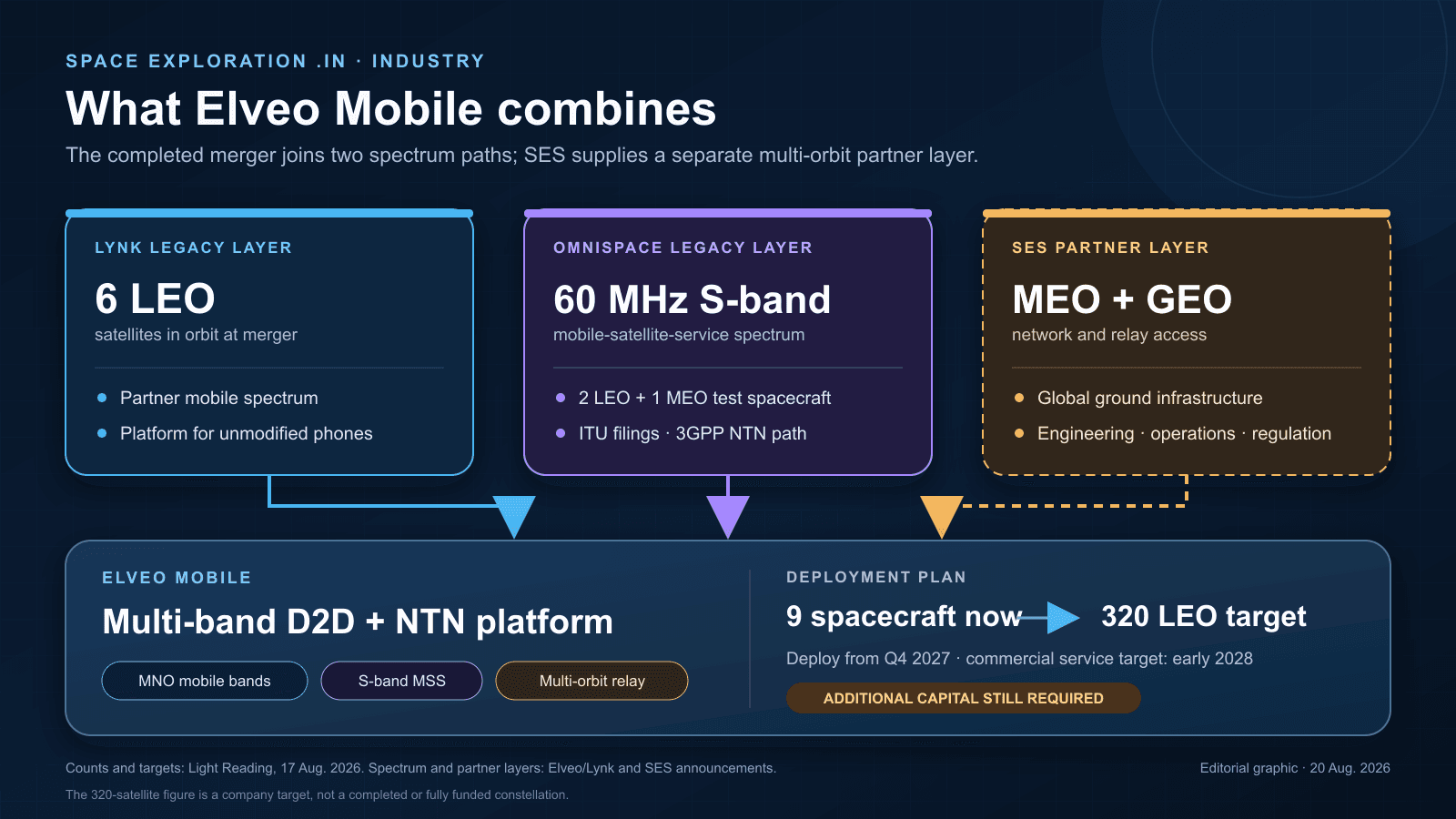
Lynk Global and Omnispace completed their merger on August 14 and announced the combined business on August 17 as Elveo Mobile. The deal puts Lynk’s direct-to-phone satellite platform and mobile-operator relationships in the same company as Omnispace’s coordinated S-band spectrum. SES extends the system with access to its medium- and geostationary-orbit networks and ground infrastructure. The companies did not publish the transaction terms, a valuation or the post-merger ownership split.
Elveo describes the result as a multi-band direct-to-device, or D2D, provider. D2D connects a phone or other device to a satellite without a separate user dish. The company says its planned service will work with the eight billion phones and devices people already own, while also supporting newer 5G and non-terrestrial-network equipment. That is a company compatibility claim: the merger announcement does not provide a supported-device list, independent test data or a list of markets where Elveo service is active.
Two spectrum paths now sit inside one company
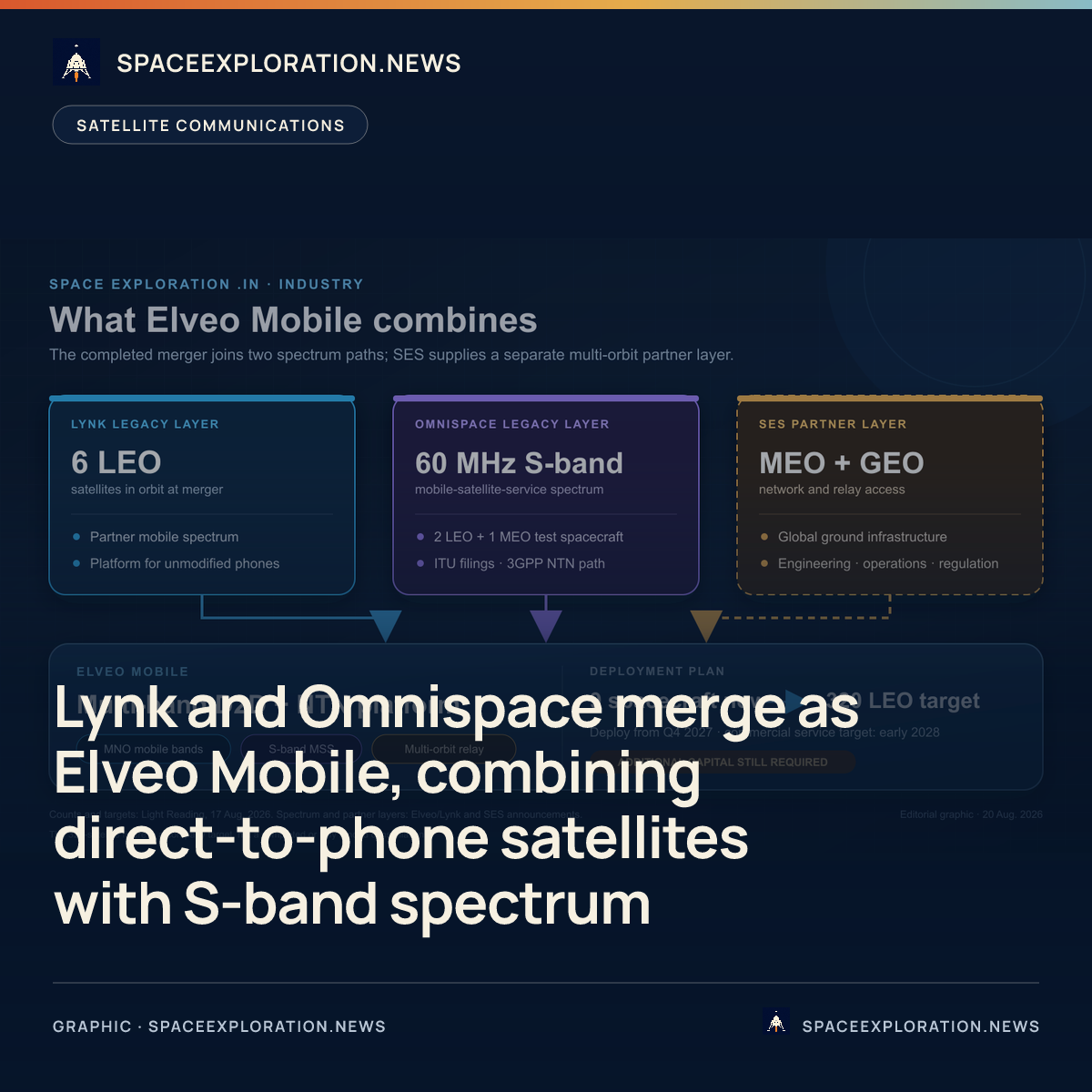
Lynk supplies the route designed around mobile operators’ terrestrial spectrum. Its satellites can use an operator’s licensed frequencies so unmodified phones see a cellular signal outside tower coverage. The 2025 merger announcement said Lynk had relationships with more than 50 mobile network operators across more than 50 countries. Light Reading reported that six Lynk low-Earth-orbit satellites were in orbit when Elveo was formed. Those assets give the combined company an existing platform and partner base, not continuous global coverage.
Omnispace supplies a second route: 60 megahertz of coordinated S-band mobile-satellite-service spectrum and high-priority filings with the International Telecommunication Union. The companies said in 2025 that this spectrum supports 3GPP specifications for non-terrestrial networks, or NTN. Light Reading counted two Omnispace test spacecraft in low Earth orbit and one in medium Earth orbit at the merger. Global coordination and spectrum holdings do not remove the need for market-specific authorisations, and the announcements do not provide a country-by-country approvals ledger.
The multi-band proposition is therefore more than a larger combined satellite count. Mobile-operator frequencies offer a path to legacy handset radios, while S-band gives Elveo its own mobile-satellite capacity for standards-based devices. Chief executive Ramu Potarazu told Light Reading that the payload is intended to support multiple frequencies and waveforms and to be reconfigured in orbit. Elveo has not published the throughput, capacity or device-performance data needed to compare those modes.
Nine spacecraft are in orbit; the 320-satellite network is a target
Elveo starts with nine spacecraft in orbit: six Lynk satellites in low Earth orbit, plus Omnispace’s two low-Earth-orbit spacecraft and one medium-Earth-orbit spacecraft, according to Light Reading. The company is targeting 320 low-Earth-orbit satellites for persistent global coverage. Potarazu said deployment of the new satellites is expected to begin in the fourth quarter of 2027, finish around mid-2028 and support commercial services from early 2028. Those dates were not included in the merger release.
The build-out is not yet a fully funded deployment programme. Potarazu said Elveo still needs to raise capital for the satellites and launches, without giving an amount or fundraising date, and that global manufacturing is among the company’s next steps. No launch provider, signed launch schedule, next-generation satellite design or unit cost was disclosed. The corporate combination is complete; most of the constellation needed for the stated coverage goal is not.
Light Reading reported that the first commercial services are planned as narrowband offerings, with more data-intensive applications to follow. Elveo also promotes advanced on-board processing that can change network functions and perform computing in orbit. The August 17 release gives no benchmark for that processing, and it does not say which of the nine existing spacecraft are operational, how much capacity they provide or what coverage they can sustain.
SES adds the multi-orbit layer without taking control
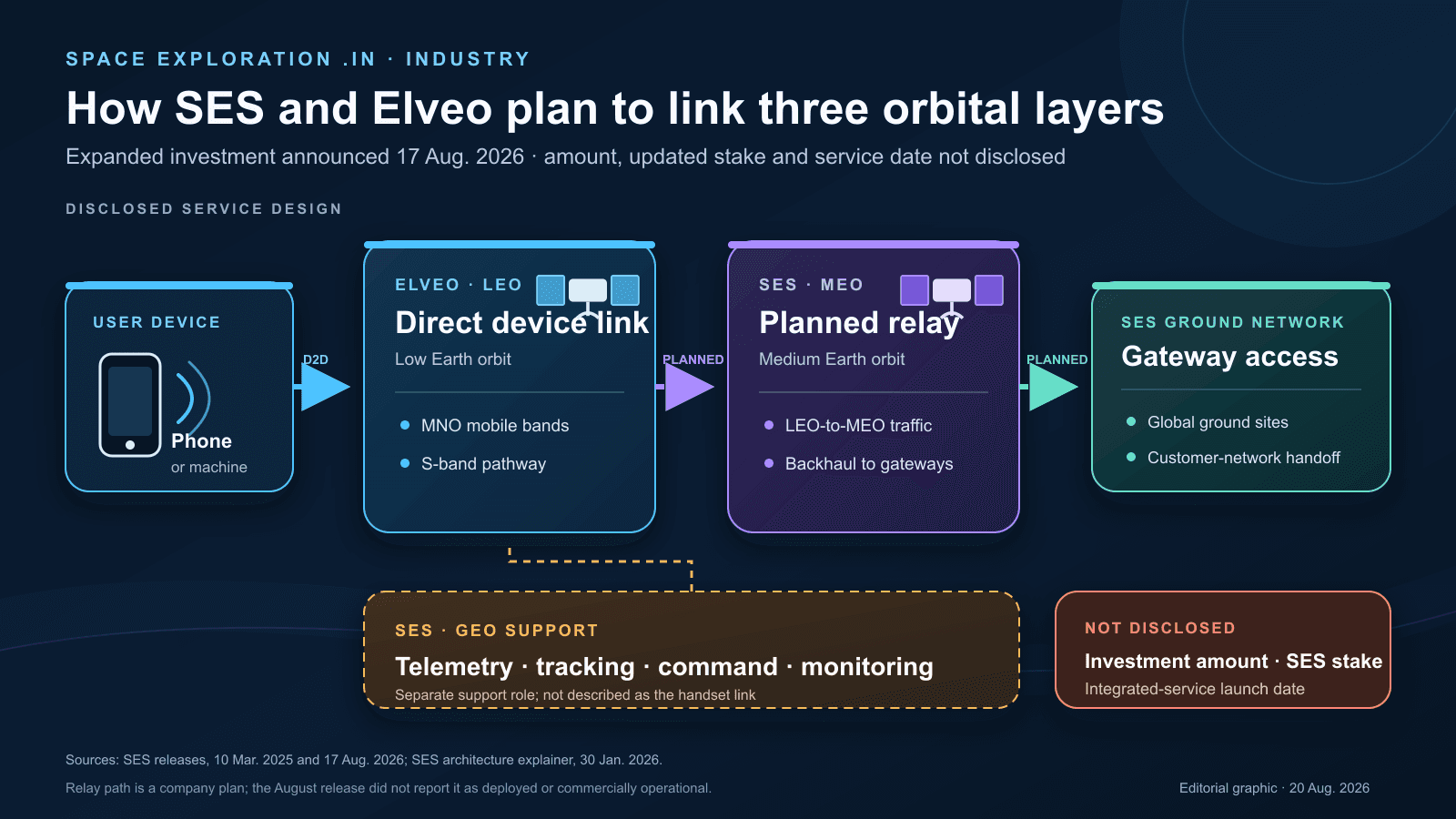
SES announced an expanded strategic investment and collaboration with Elveo on the same day as the merger news. It will provide access to medium- and geostationary-orbit capacity and ground infrastructure, and support spectrum work, sales, engineering, operations and regulation. Potarazu told Light Reading that Elveo’s low-Earth-orbit satellites will be able to link through SES spacecraft, reducing dependence on a dense Elveo ground network. He also said SES is a significant shareholder but does not control Elveo, its satellites or its operations. The investment amount and exact holding were not disclosed.
The commercial starting point also needs qualification. Elveo’s release says the company has agreements with more than 50 mobile network operators and distribution partners in more than 60 countries. Light Reading reported 56 contracts and tests with ten operators, but said neither predecessor had a commercial service running before the merger. Elveo intends to act as a wholesale or roaming partner rather than own the end customer. Agreements and tests show access to potential markets; they are not the same as launched, generally available service.
The merger has resolved which company will carry the combined technology, spectrum and partner relationships. It has not resolved the financing and execution questions behind global service. Evidence of the next phase will be capital raised, production satellites shipped and launched, national approvals secured, and named operators offering service on specified devices. Until those milestones arrive, Elveo’s advantage is a wider set of spectrum and orbit options, not a completed global network.
Reporting trail
Primary sources
Elveo MobileLynk and Omnispace Launch Elveo Mobile with Merger Completionprnewswire.com
Lynk Global and OmnispaceLynk and Omnispace Announce Plans to Merge to Deliver Next-Generation Global Direct-to-Device Connectivitylynk.world
SES / Business WireSES Expands into Global Direct-to-Device Services through Strategic Collaboration with Elveo Mobilefinance.yahoo.com
Light ReadingLynk and Omnispace merger creates D2D challenger Elveo Mobilelightreading.com
For an image post, download the card and copy this suggested caption.
The combined company joins Lynk’s direct-to-phone platform with Omnispace’s S-band spectrum and SES’s multi-orbit infrastructure, but its deployment and funding plans are still ahead. Read the full report: https://www.spaceexploration.in/news/lynk-omnispace-merger-elveo-mobile #SpaceExplorationNews #SpaceNews #SpaceIndustry