Satellite communications
GSA counts 283 operator–satellite partnerships; 23 phone services have launched
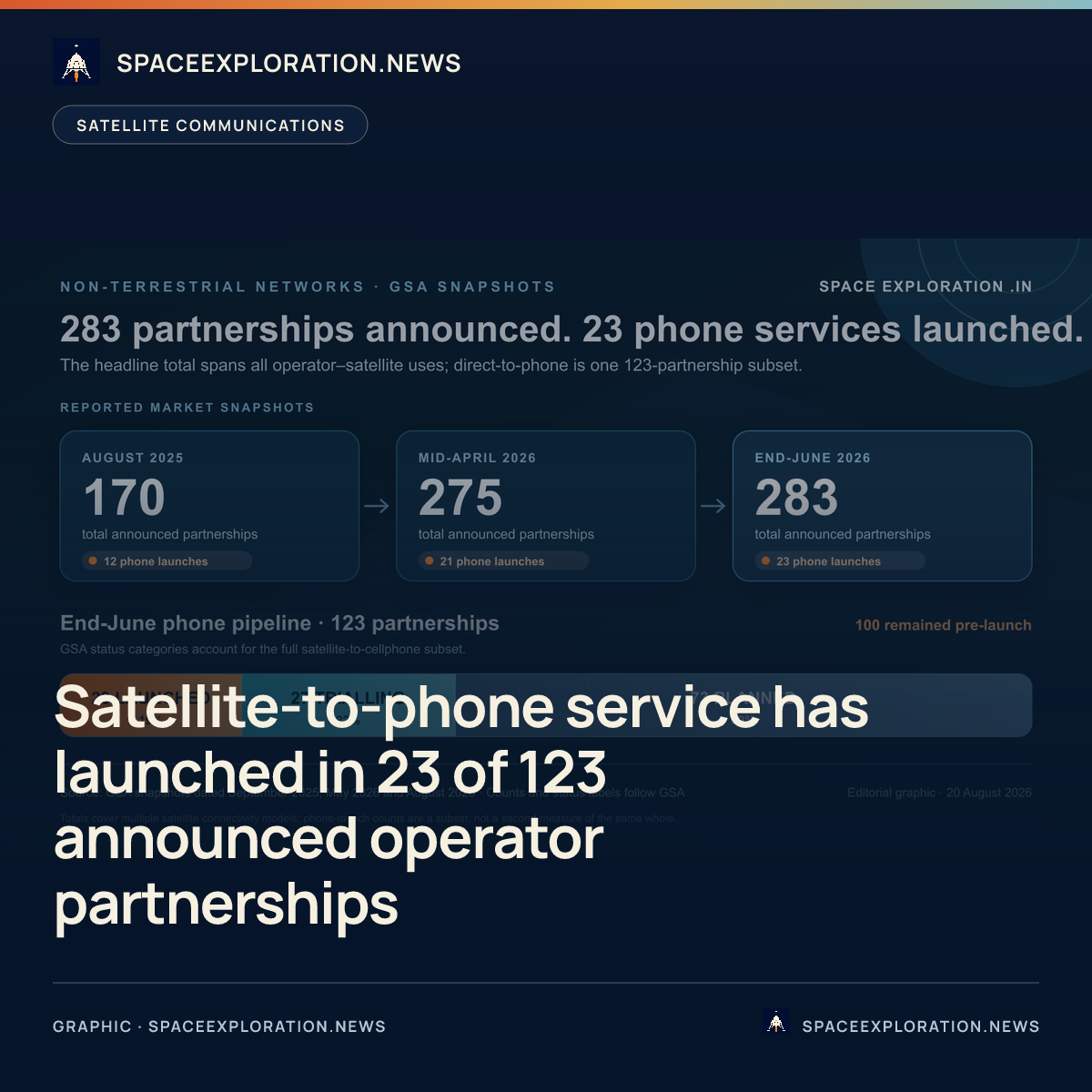
The June snapshot puts satellite-to-cellphone activity at 123 announced partnerships: 23 launched, 27 trialling and 73 planned. The figures show commercial movement, but announcements still dominate.
Add us as a preferred source on Google Add us as a preferred source on Google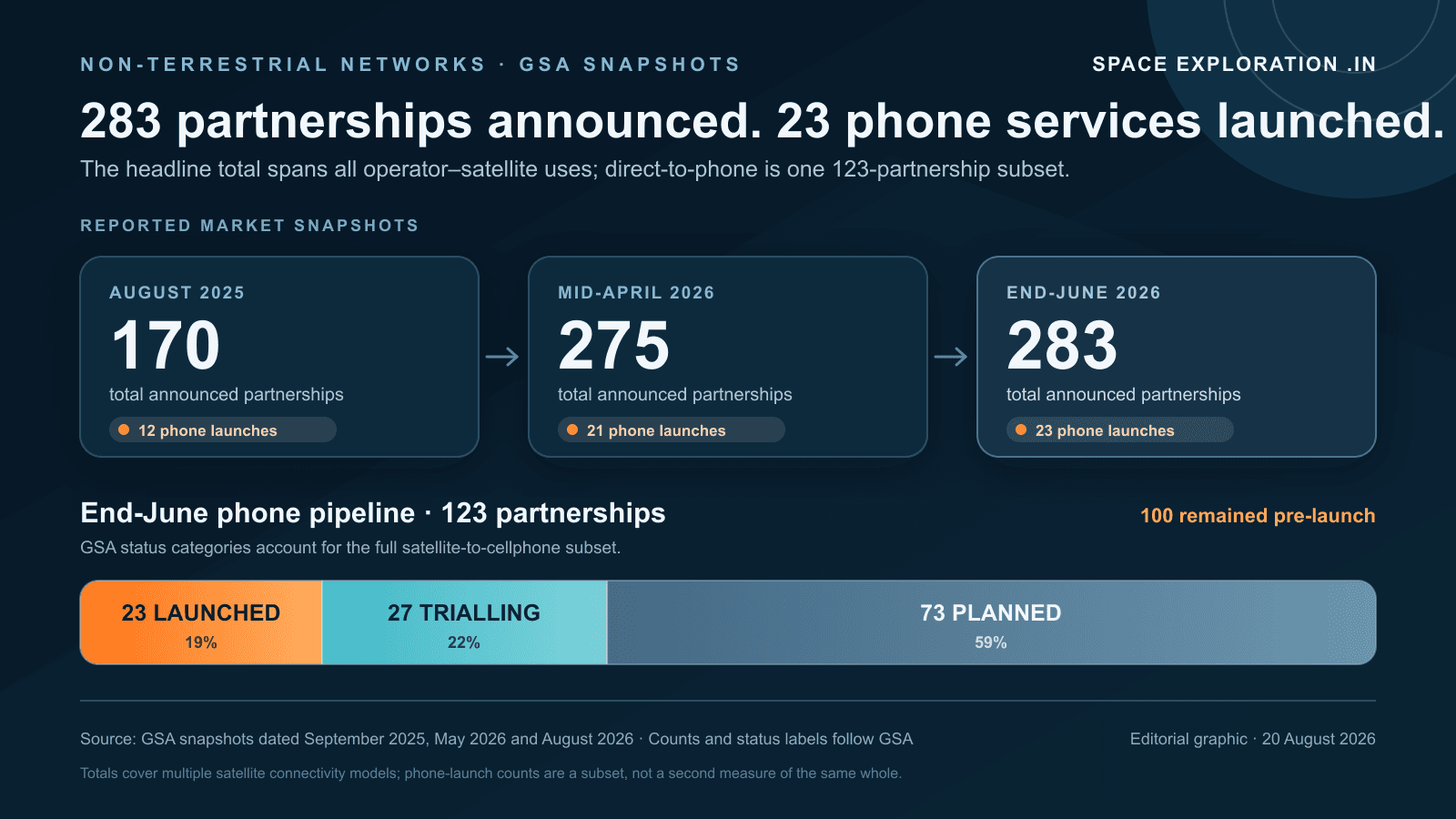
GSA’s latest non-terrestrial-network data counts 283 publicly announced operator–satellite partnerships across more than 100 countries and territories at the end of June 2026. The satellite-to-cellphone subset was smaller: 123 announced partnerships, of which 23 had launched a service. The remaining 100 were trialling or planned. That split shows a market moving beyond agreements, while also showing that launched phone services are still the minority of the relationships GSA tracks.
The dates need to travel with the numbers. GSA dates its August report to August 10, and the associated key-data page labels its industry data as of August 10, but the central partnership counts are explicitly current only through the end of June. iTechGuides published its account of the update on August 18. GSA says its underlying GAMBoD databases are refreshed monthly or quarterly; the detailed partnership annex is restricted to members and associates, so the public pages provide aggregate counts rather than a partnership-by-partnership ledger.
Launches are rising inside a much larger pipeline
Earlier GSA snapshots show the expansion of the announcement pool. Its September 2025 release counted 170 partnerships in 80 countries and territories using data through August 2025, including 12 launched satellite-to-cellphone services. By mid-April 2026, GSA reported 275 partnerships across 101 countries and territories and 21 phone-service partnerships launched in 17 countries. The end-June update raised those figures to 283 total partnerships and 23 phone-service launches.
GSA’s count rose from 170 partnerships in August 2025 to 283 in June 2026, a gain of 113; its launched phone-service count rose from 12 to 23. From mid-April to end-June, the partnership total moved from 275 to 283 and phone launches from 21 to 23. GSA described activity during the preceding three months as comparatively small, identifying new operator-service launches in the Philippines and Japan.
The June phone pipeline accounts for all 123 announced relationships: 23 launched, 27 trialling and 73 in planning. In percentage terms, about 19% had reached launch, while about 81% remained pre-launch. This is a stronger commercial signal than a partnership total alone, because a launched status records a service crossing a deployment threshold. It is not, however, a measure of subscriber take-up, geographic reach, capacity or service quality.
The 283 total covers more than phone links
The 283 headline is broader than direct-to-phone connectivity. GSA’s August report says community and enterprise broadband accounts for 38% of all announced operator–satellite partnerships. It also tracks satellite backhaul and internet-of-things or machine-to-machine services alongside phone links. In its May snapshot, GSA put IoT and M2M at 8.3% of the recognised partnership pool. The 160 partnerships outside the June phone subset therefore should not be treated as one uniform category.
GSA describes community and enterprise broadband partnerships as a way for satellite companies to add operator sales channels to their direct-customer businesses. For backhaul, it points to resilience and to connecting terrestrial towers in places where fibre would be too costly or difficult to deploy. Those models may use dedicated terminals rather than a consumer handset. Their inclusion explains why the total partnership count can grow without producing an equal number of satellite-to-cellphone launches.
A launch does not mean every handset gets service
A launched status also does not describe one uniform consumer service. GSA says only a limited but growing set of devices supports narrowband NTN standards from the 3rd Generation Partnership Project, or 3GPP, while other devices are modified for particular constellations. It adds that some satellite-to-cellphone systems use mobile spectrum that could, in theory, work with any 4G or 5G smartphone. The difference between standards-based compatibility, a modified device and theoretical spectrum compatibility matters when assessing who can actually connect.
iTechGuides cautions that direct-to-device service can mean emergency messaging, two-way text, location sharing or low-rate data rather than terrestrial-style voice and broadband. It also notes that GSA’s partnership total is not a count of operating networks, paying subscribers, active satellites or universal coverage. Market-specific approvals, handset bands and modems, carrier provisioning, satellite visibility and the offered service tier can all separate an announced relationship from broadly usable connectivity.
The vendor ranking measures agreements, not service
Starlink leads GSA’s June partnership table with 99 announced relationships, up from 59 in January 2026. AST SpaceMobile follows with 44, Amazon Leo with 30, Eutelsat Group with 29 and Lynk with 21. GSA also says mobile operators are pursuing multiple satellite vendors in different markets. The ranking therefore measures disclosed relationships, not unique operators, revenue, subscribers or network performance; one operator can contribute to more than one vendor’s count.
Taken together, the snapshots support a narrower conclusion than the headline total might imply. Non-terrestrial connectivity has entered an early commercial phase: satellite-to-cellphone launches have risen from 12 to 23 since the August 2025 snapshot, and two services were added after mid-April. Yet 100 of the 123 phone partnerships remained in trials or planning at the June cutoff. The next measure of maturity is not another agreement alone, but evidence of market-level availability, supported devices, regulatory clearance and customer use. For now, 283 shows how widely satellite connectivity features in operator plans; 23 shows that conversion to phone service has begun and remains incomplete.
Reporting trail
Primary sources
GSA5G Non-Terrestrial Networks (NTN)gsacom.com
GSANTN & Satellite Connectivity – August 2026gsacom.com
GSA275 operator–satellite NTN partnerships in 101 countries and territories, GSA data showsgsacom.com
GSA170 operator–satellite NTN partnerships in 80 countries and territories, GSA data showsgsacom.com
iTechGuidesGSA: NTN Partnerships Reach 283 Across More Than 100 Countries and Territoriesitechguides.com
For an image post, download the card and copy this suggested caption.
The June snapshot puts satellite-to-cellphone activity at 123 announced partnerships: 23 launched, 27 trialling and 73 planned. The figures show commercial movement, but announcements still dominate. Read the full report: https://www.spaceexploration.in/news/gsa-283-operator-satellite-partnerships #SpaceExplorationNews #SpaceNews #SpaceIndustry