Science
Indian-built ProtoPol surveys polarization changes across 45 stars
Two accepted studies use repeated spectra to separate variable Hα behaviour in Herbig stars from steadier Be signatures and continuum changes in evolved systems.
Add us as a preferred source on Google Add us as a preferred source on Google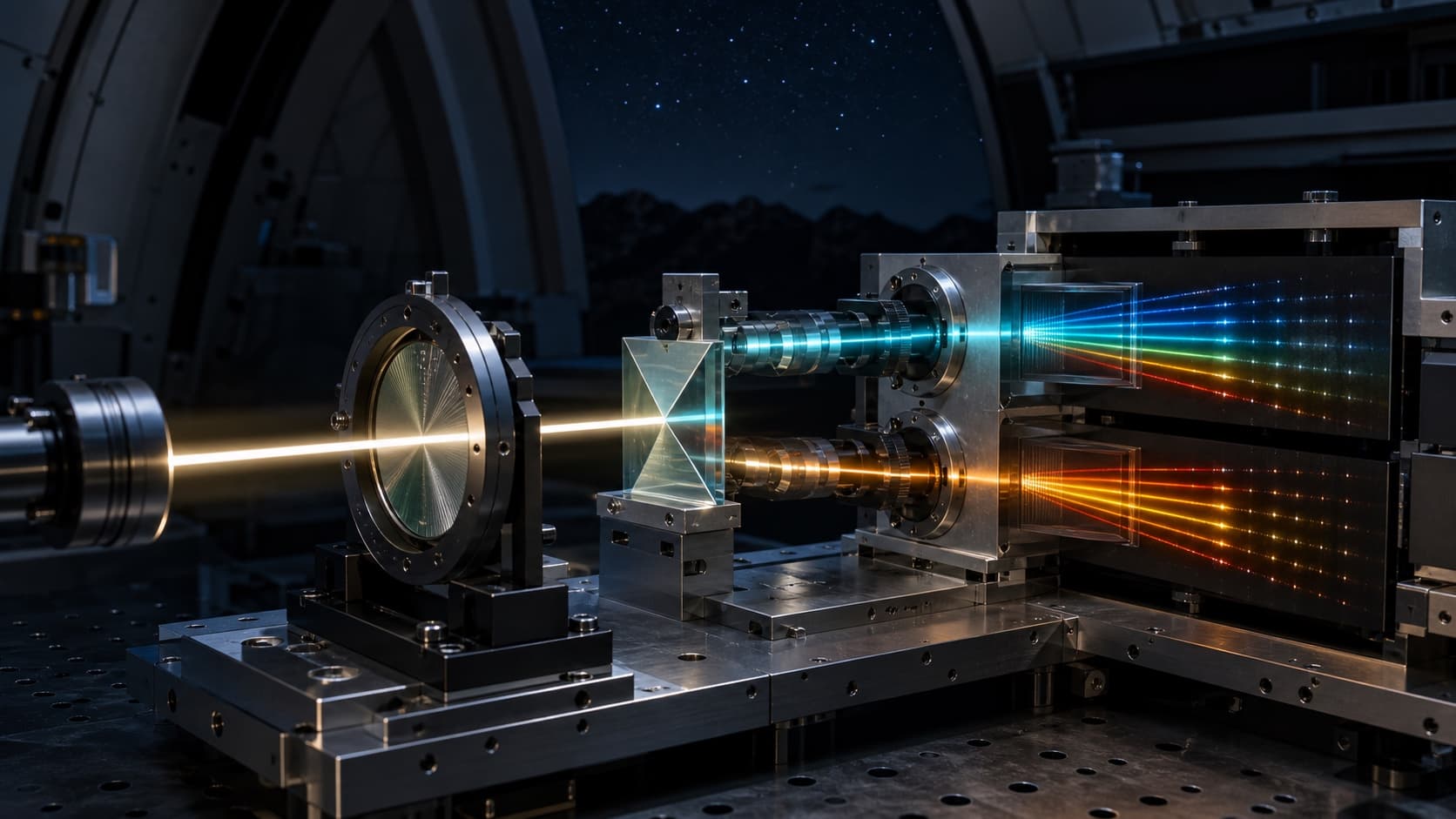
Two studies accepted by The Astronomical Journal report more than two years of repeated polarization spectra for 45 stars observed with ProtoPol, an instrument developed at India’s Physical Research Laboratory and used on its 2.5-metre telescope at Mount Abu. Posted to arXiv on August 11, the paired papers use the same instrument and method across four stellar groups, but find different kinds of change: Hα line polarization varied strongly in many young Herbig stars, remained more stable in classical Be stars, and gave way to line-specific and continuum variability in the symbiotic and red-giant samples.
The first paper covers 11 Herbig Ae/Be and 10 classical Be stars observed on 60 nights from December 2023 to March 2026, a span of about 28 months. The second covers six symbiotic systems and 18 red giants from March 2024 to May 2026, with at least two observations per target over about 26 months. Initial exposures came from ProtoPol’s commissioning and performance-verification work; the teams then returned to the same stars to test whether their polarization spectra changed with time.
What repeated polarization spectra reveal
Polarization records the preferred orientation of light waves. Scattering can produce linear polarization, but the vectors from a perfectly spherical unresolved envelope largely cancel one another. A net signal therefore carries information about departures from that symmetry, including discs, winds, clumps or interacting binary regions. The papers note that some relevant structures project to sub-milliarcsecond scales, below what direct imaging can ordinarily resolve, so the polarization spectrum acts as an indirect geometry probe.
ProtoPol combines a half-wave plate and Wollaston prism with an echelle spectrometer. It separates incoming light into two orthogonally polarized beams and records them across multiple spectral orders. Four half-wave-plate orientations allow the reduction pipeline to derive the Stokes q and u parameters, the degree of linear polarization and its position angle as a function of wavelength. The instrument covers 4,000 to 9,600 angstroms at a wavelength resolution of roughly 0.4 to 0.75 angstrom, enough to follow changes across broad optical emission features while collecting the surrounding continuum.
The comparison across a spectral line is as important as the absolute polarization level. Hα photons and nearby continuum photons can form or scatter in regions with different sizes and geometries, producing a rise, drop or rotation in polarization across the line. Interstellar polarization changes only slowly with wavelength and can be treated as effectively constant across one emission feature. For continuum measurements, however, the papers caution that the absolute signal can contain both interstellar and intrinsic components; epoch-to-epoch changes are the stronger evidence for an evolving circumstellar contribution.
Herbig stars changed; classical Be patterns mostly held
Ten of the 11 Herbig stars showed a detectable Hα spectro-polarimetric signature in at least one epoch. The sample included depolarization, intrinsic line polarization, enhanced polarization in a blue-shifted absorption trough and non-detections, with profiles sometimes changing even when the intensity spectrum changed little. In individual cases, AB Aur went from no reported line effect in the first ProtoPol epoch to a detection in the second, while MWC 147 showed a polarization increase about 2–3 percentage points above the continuum in the first epoch and no detection in the later one. HD 58647 changed from an almost negligible line signal to a peak near 4.5% across its absorption component.
The 10 classical Be stars supplied a steadier comparison. Half showed a depolarization signature across Hα and the rest showed little or no line change; although amplitudes shifted slightly for some targets, each star’s line-effect category generally persisted between epochs. The authors contrast that relative stability with the Herbig sample’s changes in amplitude, position angle and profile shape. Their data establish a sample-level difference, not a claim that every Herbig star varies or that classical Be environments never change.
Symbiotic lines and red-giant continua told a different story
In the six symbiotic systems, continuum polarization was detected throughout the sample, but most did not show a notable polarization feature across Hα. UV Aur was an exception: its Hα enhancement was stronger in the later epoch. Other lines carried separate information. AG Dra’s Raman-scattered oxygen features at 6,830 and 7,088 angstroms showed a clear polarization enhancement in the first epoch and little or none in the second; Z And showed a rotation of polarization angle across those Raman features without a comparable rise in polarization degree. Those distinctions indicate that Hα, Raman-scattering regions and the continuum need not share one geometry.
All 18 red giants had measurable continuum polarization, ranging from below about 0.5% in weak cases to roughly 2–3% in several stronger ones. The paper identifies LQ Her, Omega Vir, ST UMa, SW Vir, U Her and X Her among the clearest epoch-to-epoch changes, while BQ Gem, CU Dra, G Her, Psi Vir and V636 Her were weaker and less variable. The authors interpret the changing signals as evidence that at least part of the polarization is intrinsic to non-spherical, evolving envelopes, but they do not assign one mechanism to the whole sample: pulsation, shocks, dust formation and episodic mass loss can operate on overlapping timescales.
What the paired papers do—and do not—establish
Taken together, the two studies do not place all 45 stars on a single variability scale. The hot-star paper measures changes mainly across Hα and compares two physically related groups; the evolved-star paper separates continuum behavior from Hα and Raman-line effects in binaries and cool giants. Their common result is methodological: repeated, wavelength-resolved polarization can distinguish a stable line effect from an evolving one even when an unresolved source looks similar in total intensity.
The arXiv manuscripts publish the observation logs, derived measurements and multi-epoch plots used for the analyses, and state that the papers have been accepted by The Astronomical Journal. The reviewed postings do not yet provide the journal versions of record or identify a separate archive for the raw exposures. Many targets have only two widely separated epochs, so a change can be detected without revealing whether it follows an orbit, pulsation, outburst or irregular process. Absolute continuum values also remain harder to interpret where the interstellar contribution is uncertain.
For ProtoPol, the studies extend an instrument programme that began with commissioning on PRL’s 1.2-metre telescope in December 2023 and its 2.5-metre telescope in February 2024. The same performance-verification observations became the first epoch of a time-domain survey, demonstrating how a medium-resolution instrument on a smaller telescope can build a long-baseline sample. The next test is cadence: the authors call for more frequent observations linked to orbital and pulsation phases to separate repeating cycles from one-off changes in circumstellar structure.
Reporting trail
Primary sources
arXivExploring the long-term temporal variability in polarization through multi-epoch optical spectro-polarimetry — Part I: A sample of Herbig Ae/Be and classical Be starsarxiv.org
arXivExploring the long-term temporal variability in polarization through multi-epoch optical spectro-polarimetry — Part II: A sample of symbiotic and red-giant starsarxiv.org
arXivDevelopment of ProtoPol — Part I: The design, development and laboratory characterizationarxiv.org

For an image post, download the card and copy this suggested caption.
Two accepted studies use repeated spectra to separate variable Hα behaviour in Herbig stars from steadier Be signatures and continuum changes in evolved systems. Read the full report: https://www.spaceexploration.in/news/protopol-multi-epoch-polarization-45-stars #SpaceExplorationNews #SpaceNews #SpaceScience