Launch
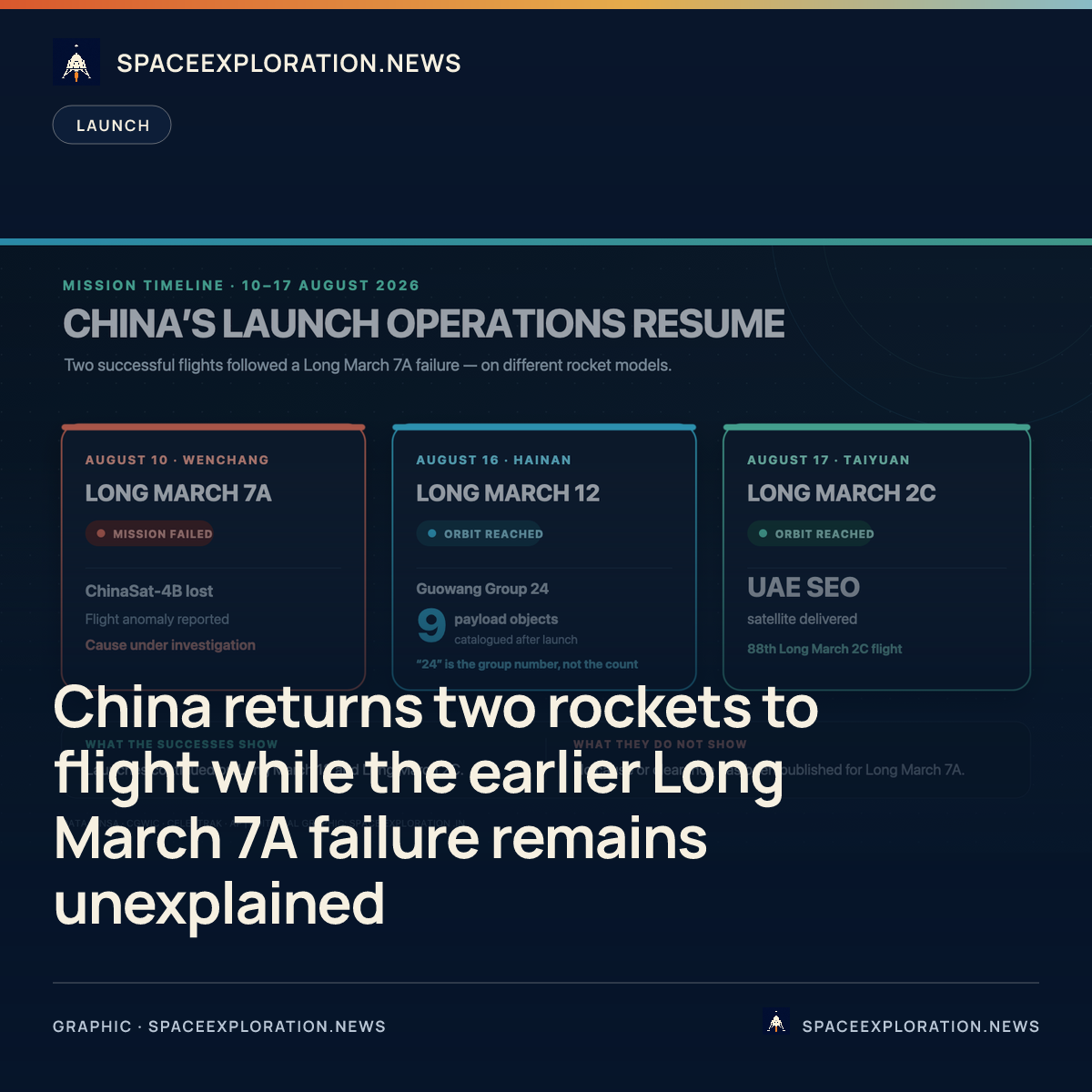
China resumes launches on two rockets after Long March 7A failure
Long March 12 carried nine catalogued spacecraft in the 24th Guowang batch, and Long March 2C placed the UAE’s SEO satellite into orbit; the earlier failure remains unexplained.
Add us as a preferred source on Google Add us as a preferred source on Google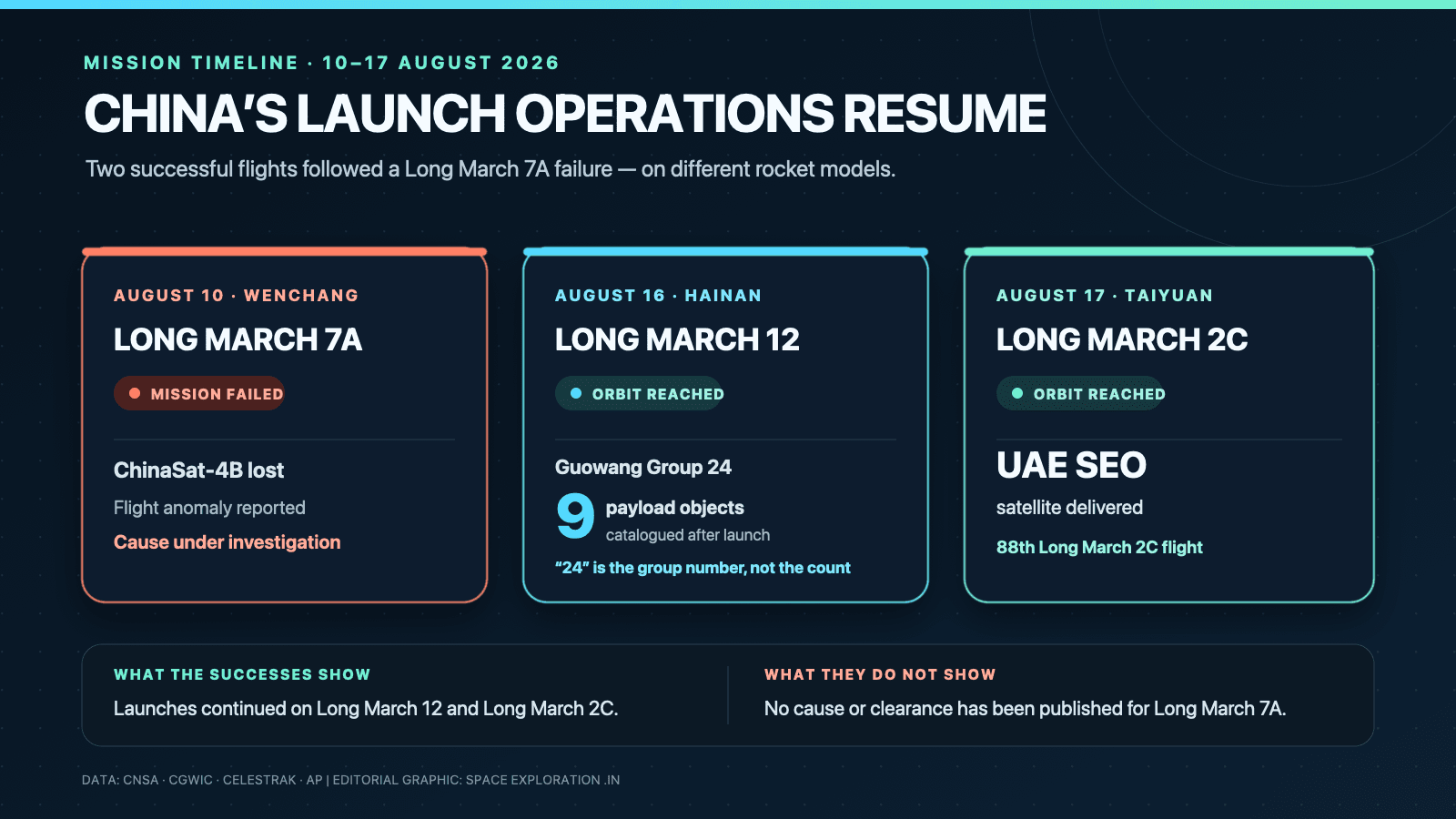
China completed two successful orbital launches on August 16 and 17, the first missions reported after a Long March 7A failed on August 10. A Long March 12 carried a group of low-orbit internet satellites, followed 22 hours and 52 minutes later by a Long March 2C carrying the United Arab Emirates’ SEO satellite. The flights show that launch operations resumed on two other rocket models; neither success announcement says the Long March 7A has been cleared to fly again.
The first rocket lifted off from the Hainan commercial spacecraft launch site at 12:10 p.m. Beijing time, or 04:10 UTC, on August 16. The China National Space Administration said the Long March 12 placed “low-orbit internet satellite Group 24” into its planned orbit. CNSA did not state a spacecraft count. Space.com described the payload as 24 satellites, but that reading conflicts with the official group designation and the public orbital catalogue.
Nine payloads, not 24
CelesTrak’s satellite catalogue listed nine payload objects from the launch under the names GUOWANG 24 OBJECT A through H and GUOWANG 24 OBJECT J, plus a separate Long March 12 rocket body. The nine payload entries were in orbits of roughly 913 to 929 kilometres at an inclination near 50 degrees when the catalogue was checked on August 19. The record supports a nine-spacecraft batch; “24” identifies the Guowang group rather than its payload count.
The available records still leave important payload details undisclosed. CNSA did not publish individual satellite names, masses, design lives or a commissioning status, while CelesTrak used generic object labels rather than spacecraft identities. The catalogue can confirm that nine payload objects were tracked from the mission, but it cannot substitute for an operator’s report that the satellites have completed checkout or entered service.
The Long March 12 is itself distinct from the rocket that failed six days earlier. The Shanghai Academy of Spaceflight Technology describes it as a two-stage, four-metre-diameter vehicle with capacity for at least 12 tonnes to low Earth orbit and at least six tonnes to a 700-kilometre sun-synchronous orbit. SAST called a June 17 mission the vehicle’s sixth flight, making the August 16 launch its seventh. That result extends the Long March 12’s own flight record; it is not a Long March 7A return-to-flight test.
SEO enters orbit on a Long March 2C
At 11:02 a.m. Beijing time, or 03:02 UTC, on August 17, a Long March 2C lifted off from the Taiyuan Satellite Launch Center in Shanxi province. CNSA and China Great Wall Industry Corporation said the SEO satellite entered its planned orbit. CGWIC identified the mission as the 88th Long March 2C flight, while CNSA counted it as the 664th launch of the wider Long March family. Neither announcement reported the satellite’s health after separation.
SEO is a project of the National Space Science and Technology Center at United Arab Emirates University, undertaken with the UAE Space Agency and Chinese partners. A July account from the UAE’s WAM news agency said Emirati engineers, researchers and students had participated across satellite development and operations. The mission is intended to provide data for environmental protection, natural-resource management, planning and decision-making. Public releases reviewed for this report did not expand the initials “SEO” or disclose the spacecraft’s mass, instruments, design life or commissioning schedule.
The launcher was another separate design. CNSA describes the Long March 2C as a two-stage rocket using nitrogen tetroxide and unsymmetrical dimethylhydrazine propellants, with a low-Earth-orbit capacity of 4,000 kilograms and a flight history dating to 1982. Its 88th flight therefore demonstrates continuity on a long-serving low-orbit launcher, not validation of the newer high-orbit Long March 7A.
The failed flight remains unresolved
The August 10 mission lifted off from the Wenchang Spacecraft Launch Site at 8:02 p.m. Beijing time, or 12:02 UTC, carrying the Zhongxing-4B, also called ChinaSat-4B, communications satellite. Xinhua reported that the Long March 7A experienced a flight anomaly and that investigators were analysing the cause. Space.com reported that video showed the vehicle breaking apart about 85 seconds after liftoff. It was the model’s 18th launch and its second failure, after an unsuccessful debut in March 2020.
The Long March 7A is a three-stage, 60.13-metre rocket developed by the China Academy of Launch Vehicle Technology for high-orbit missions, with a stated capacity of seven tonnes to geostationary transfer orbit. The Long March 12 is managed by SAST and is optimized for low and sun-synchronous orbits; the Long March 2C has different propulsion and more than four decades of flight history. Their common Long March name does not make either successful mission a repeat of the failed vehicle’s configuration.
Because no official cause has been released, the two successes cannot show whether the August 10 problem was confined to the Long March 7A or whether any shared components, suppliers or procedures require action elsewhere. The reviewed statements also do not set out the scope of any post-failure stand-down. Claims that the entire Long March fleet has been cleared would therefore go beyond the published evidence.
As of August 19, the public record supports two narrower conclusions: nine catalogued payloads in Guowang’s 24th group and the UAE’s SEO satellite reached their planned orbits on other rocket types. The next evidence for the failed vehicle will be an investigation result, disclosed corrective action or a new Long March 7A flight. Until then, the weekend missions mark a resumption of launch operations, not a Long March 7A recovery.
Reporting trail
Primary sources
China National Space AdministrationChina successfully launches low-orbit internet satellite Group 24cnsa.gov.cn
CelesTrakSATCAT records for international designator 2026-187celestrak.org
Space.comChina bounces back from Long March rocket explosion with back-to-back launchesspace.com
Shanghai Academy of Spaceflight TechnologyLong March-12 Carrier Rocket Successfully Launches 22nd Group of Low-orbit Internet Satellitessast.net
China National Space AdministrationChina successfully launches SEO satellitecnsa.gov.cn
China Great Wall Industry CorporationThe Successful Launch of SEO Satellite for UAE on LM-2Cen.cgwic.com
WAM via AletihadNational Space Science and Technology Center announces development of 'SEO' satellite missionen.aletihad.ae
China National Space AdministrationLong March 2C (CZ-2C)cnsa.gov.cn
Associated PressChina fails to launch a rocket carrying a communications satellite, state news agency saysapnews.com
China Academy of Launch Vehicle TechnologyLong March 7Acalt.spacechina.com
For an image post, download the card and copy this suggested caption.
Long March 12 carried nine catalogued spacecraft in the 24th Guowang batch, and Long March 2C placed the UAE’s SEO satellite into orbit; the earlier failure remains unexplained. Read the full report: https://www.spaceexploration.in/news/china-launches-after-long-march-7a-failure #SpaceExplorationNews #SpaceNews #RocketLaunch