Commercial launch
FAA’s 4,288-operation high case is not a US launch count
The agency’s upper scenario covers commercial launches and re-entries through fiscal 2036, including US-licensed activity abroad. It still points to heavier work for licensing teams, busy ranges and shared airspace.
Add us as a preferred source on Google Add us as a preferred source on Google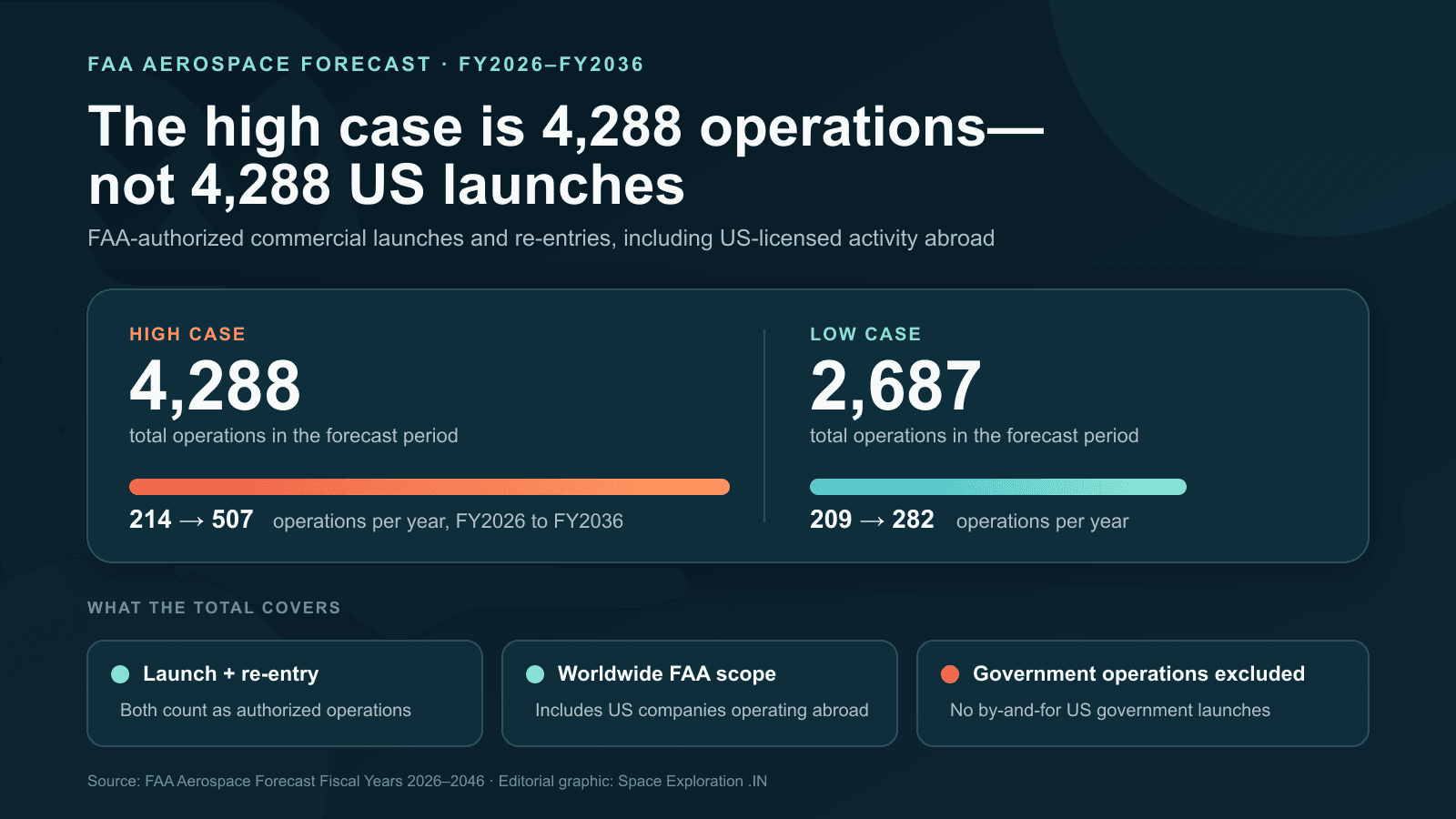
A USA Today report published on August 17 described nearly 4,300 rocket launches expected in the United States over the next decade. The FAA document behind that number makes a narrower projection: its high case totals 4,288 FAA-authorized commercial launch and re-entry operations from fiscal 2026 through fiscal 2036. The figure is not a count of rockets departing US launch pads.
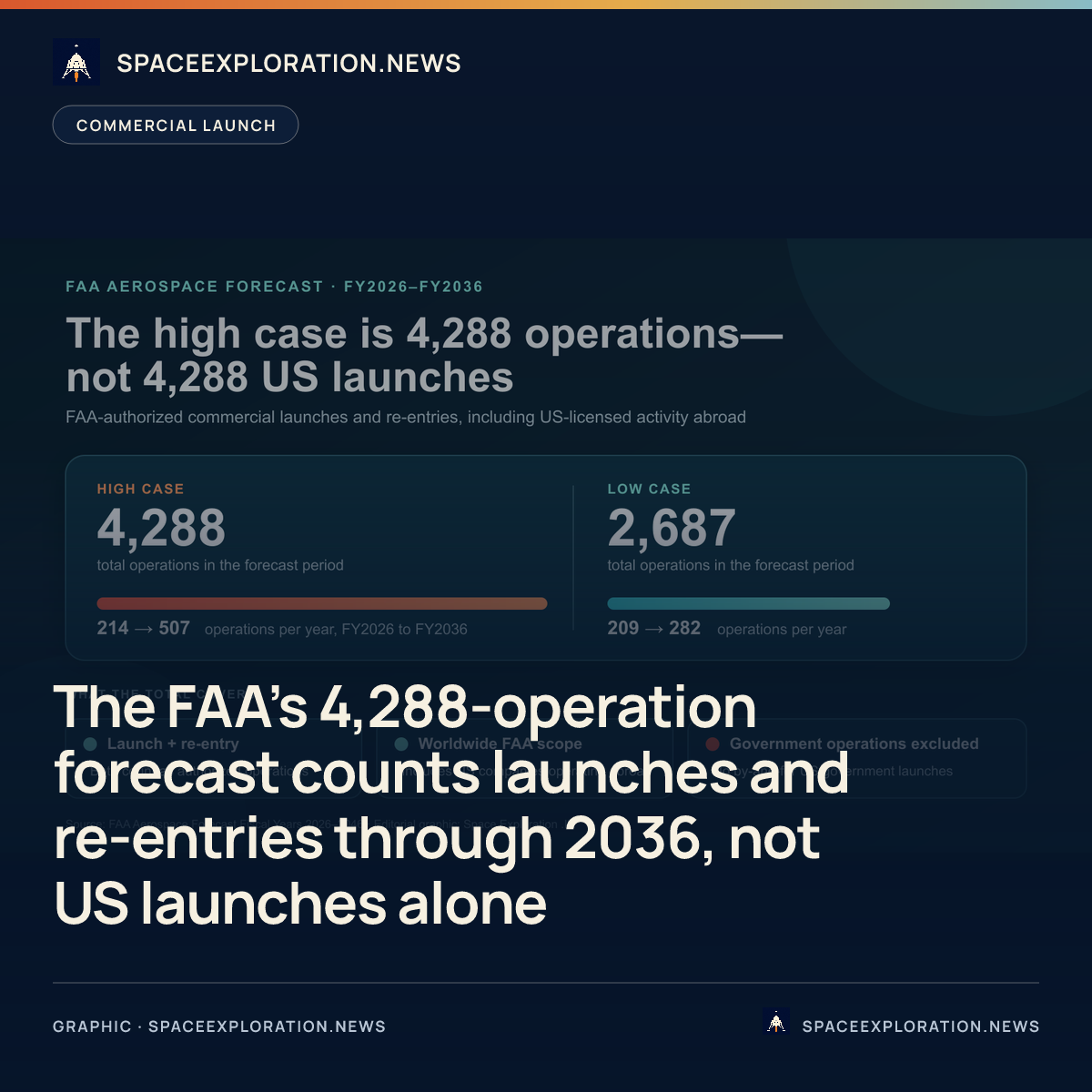
The same forecast has a low case of 2,687 operations. In the high case, annual activity rises from 214 operations in fiscal 2026 to 507 in fiscal 2036; the low case moves from 209 to 282. The gap grows from five operations in the opening year to 225 in the final year, showing how much of the decade depends on projects that may accelerate, slip or disappear.
Scope explains part of the difference between the forecast and the circulated headline. The FAA licenses commercial launches and re-entries conducted inside the United States and those carried out by US persons, including companies, outside the country. It does not license launches or re-entries conducted by and for the US government, and the forecast says it includes every FAA-authorized commercial operation regardless of location. In fiscal 2025, that scope covered 195 launches and nine re-entries, including 15 US-licensed launches from Mahia, New Zealand, and two re-entries at Australia’s Koonibba Test Range.
What produces the high case
The FAA built the outlook from information supplied by licensed operators and prospective applicants known to the agency. It uses low and high cases to represent uncertainty in when and how often those companies will fly; the report assigns no probability to either path. The high case therefore describes a possible workload for planning, not a booked manifest or a promise that 4,288 operations will occur.
Satellite deployment is the clearest near-term driver in the record. The FAA says more than 68% of fiscal 2025 missions deployed satellite constellations, and its current forecast includes SpaceX’s Starlink and the Kuiper constellation’s deployment and replacement activity. The wider high case also includes crew and cargo transport, in-orbit servicing, assembly and manufacturing, cislunar missions, lunar outposts, space tourism and Mars-related activity. The agency says additional providers may enter while existing firms may leave, with smaller launch companies facing high development costs and competition from established operators.
The forecast itself shows how quickly that mix can change. For the common fiscal 2026–2034 window, the new high case is 545 operations below the previous edition, which the FAA attributes mainly to slower Mars activity, one provider’s move towards missile defence and Blue Origin’s pause of New Shepard flights until at least 2028. The new low case is 234 operations higher. The agency separately lists reusable-vehicle flight rates, new technologies, test programmes, regulatory changes and mishaps among the variables that can move annual totals.
Licensing workload grows before pads do
Each operation creates regulatory work beyond the final authorization. Prospective applicants consult the FAA before filing; agency teams then handle vehicle or site licences, modifications for new configurations and trajectories, policy and payload reviews, safety analysis, inspections and compliance. The forecast says the FAA currently performs as many as 750 pre-flight, flight and post-flight safety inspections a year across 14 licensed commercial sites, four federal ranges and three exclusive-use sites. At the highest-rate locations, at least 70% of inspections are typically performed by locally based field inspectors.
Mishap readiness is another capacity requirement. The FAA says it needs the ability to oversee at least two launch or re-entry mishap investigations simultaneously anywhere in the world and as many as nine in one year. Eight licensed operations resulted in mishaps in fiscal 2025. Those figures do not mean the high case predicts a particular accident rate; they show that staffing and oversight plans have to cover irregular work as well as scheduled licences and inspections.
On July 28, the US Department of Transportation linked the 4,288-operation figure to a proposed licensing rule. The proposal would allow requirements from 13 environmental and natural-resource laws to be waived for certain commercial space licences and permits when the transportation secretary, after consultation, decides they are unnecessary for public health and safety, property, national security or foreign-policy interests. DOT says the change would reduce duplicated reviews and delays, but it remains a proposal with a 30-day comment period; the announcement does not quantify how much licensing capacity it would create.
Workforce planning has improved since an earlier federal audit identified gaps. In 2019, the Government Accountability Office found that the FAA’s Office of Commercial Space Transportation planned workload only two years ahead and had difficulty hiring some technically qualified staff. GAO’s current recommendation record marks all four actions implemented: the office extended workload projections to five years, adopted skills-assessment plans and, by June 2025, expanded work-hour categories used to measure management and support tasks. The old finding is therefore not evidence of an unchanged 2026 staffing shortage, but the remedies show why workload data must track launch cadence.
Ranges and shared airspace
Launch demand is concentrated even though the regulatory network is national. Of 195 FAA-licensed launches in fiscal 2025, 163 departed from Cape Canaveral, Vandenberg Space Force Base or Kennedy Space Center; another 15 flew from Mahia. The busiest three US locations handled nearly 84% of the licensed launches. This suggests that high-case infrastructure pressure will depend less on the raw number of licensed spaceports than on which ranges, trajectories and operators carry the additional missions.
A 2023 DOT inspector-general audit documented the operational mechanism. United States Space Force officials were preparing federal ranges to support simultaneous users but questioned whether they would always have enough lead time for multiple launches in a day. FAA managers and employees in Florida said back-to-back launches, concurrent military and commercial missions, and scrubs complicated staffing and scheduling; a scrub can consume the same advance planning before the work is repeated for a new date. That audit predates the 2026 forecast, so it describes a workload pattern rather than proving that every system limitation it found remains unchanged.
The FAA has already shortened some airspace disruptions. It says average closures fell from more than four hours per launch before 2018 to just over two hours, and airspace can sometimes reopen within three minutes after a vehicle clears its hazard area. The Space Data Integrator receives near-real-time vehicle data, while time-based procedures aim to reroute only directly affected aircraft. A higher cadence makes those per-mission efficiencies more consequential, but neither the forecast nor the current FAA integration page estimates the total airline delay or cost under the 4,288-operation high case.
The FAA’s Office of Spaceports is developing a national strategy centred on infrastructure investment, consistent operating standards and cooperation between federal and commercial sites. If fiscal 2036’s 507 high-case operations were spread evenly through the year, they would average about 1.39 a day. They will not be evenly distributed, some will be re-entries and some may occur abroad, so that arithmetic does not mean a rocket will launch from the United States every day. Range-level demand and site-specific environmental, safety and airspace work still have to be planned locally.
The useful checkpoints are now measurable: actual annual operations against both forecast paths, licensing and inspection workload, and range and airspace performance when missions bunch together or scrub. Until those data accumulate, 4,288 is best read as the FAA’s upper planning scenario for a broad authorization system. It is a reason to test capacity, not evidence that 4,288 US rocket launches are already scheduled.
Reporting trail
Primary sources
USA Today via YahooRockets launch almost every day in the US. Here's why even more are aheadcurrently.att.yahoo.com
Federal Aviation AdministrationFAA Aerospace Forecast Fiscal Years 2026–2046faa.gov
US Department of TransportationLIFTOFF: Trump’s Transportation Secretary Sean P. Duffy Announces Major Move to Streamline Commercial Space Licensingtransportation.gov
US Government Accountability OfficeCommercial Space Transportation: Improvements to FAA's Workforce Planning Needed to Prepare for the Industry's Anticipated Growthgao.gov
US Department of Transportation Office of Inspector GeneralFAA Has Deployed a Prototype System for Monitoring Commercial Space Operations but Faces Integration Challengesoig.dot.gov
Federal Aviation AdministrationAirspace Integrationfaa.gov
Federal Aviation AdministrationOffice of Spaceportsfaa.gov
For an image post, download the card and copy this suggested caption.
The agency’s upper scenario covers commercial launches and re-entries through fiscal 2036, including US-licensed activity abroad. It still points to heavier work for licensing teams, busy ranges and shared airspace. Read the full report: https://www.spaceexploration.in/news/faa-4288-commercial-space-operations-forecast #SpaceExplorationNews #SpaceNews #RocketLaunch