Commercial signals intelligence
NRO moves HawkEye 360 RF data from trials into operational use
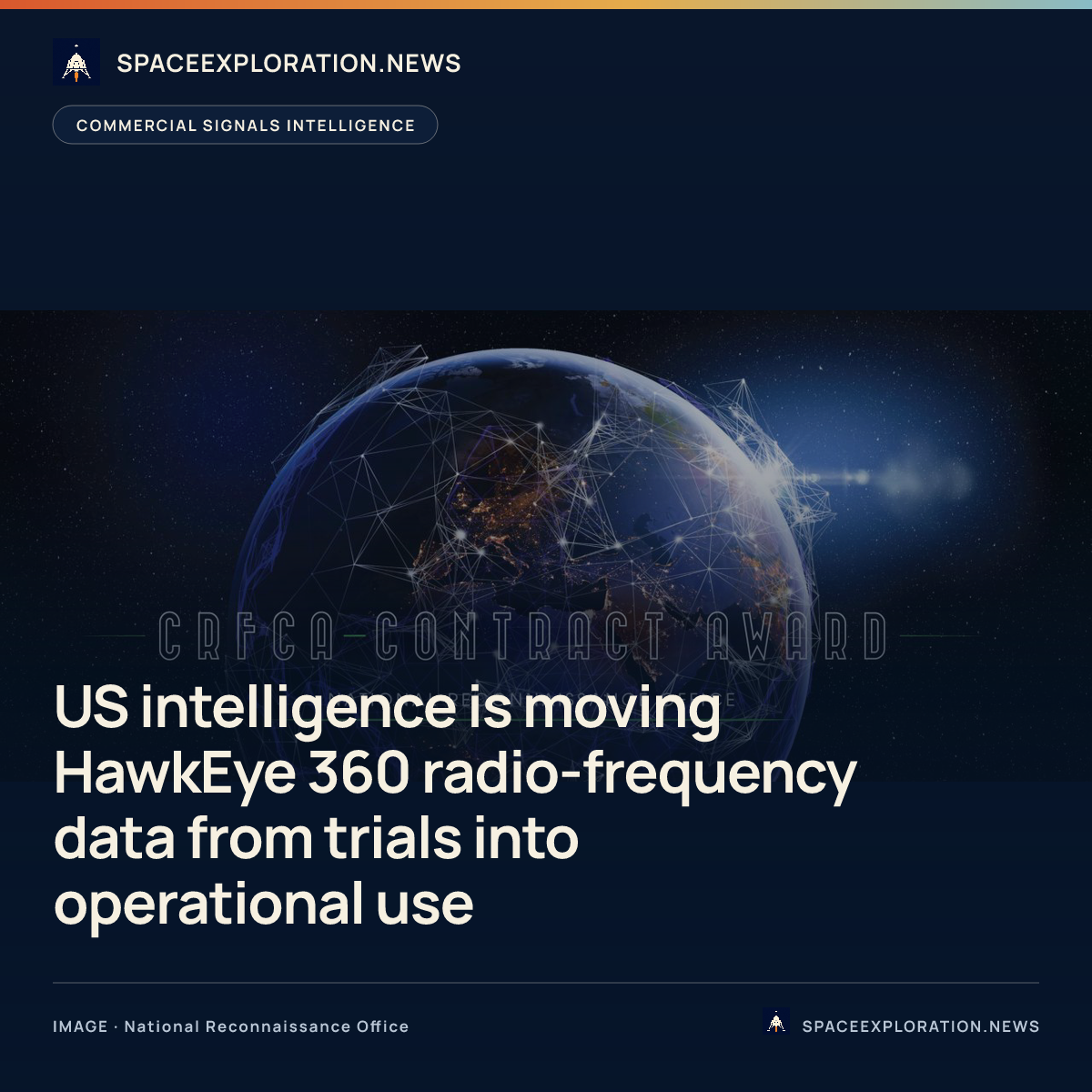
The uncapped CRFCA vehicle follows three phases of testing and years of mission use, but neither NRO nor HawkEye 360 disclosed its initial value, duration or ordered data volume.
Add us as a preferred source on Google Add us as a preferred source on Google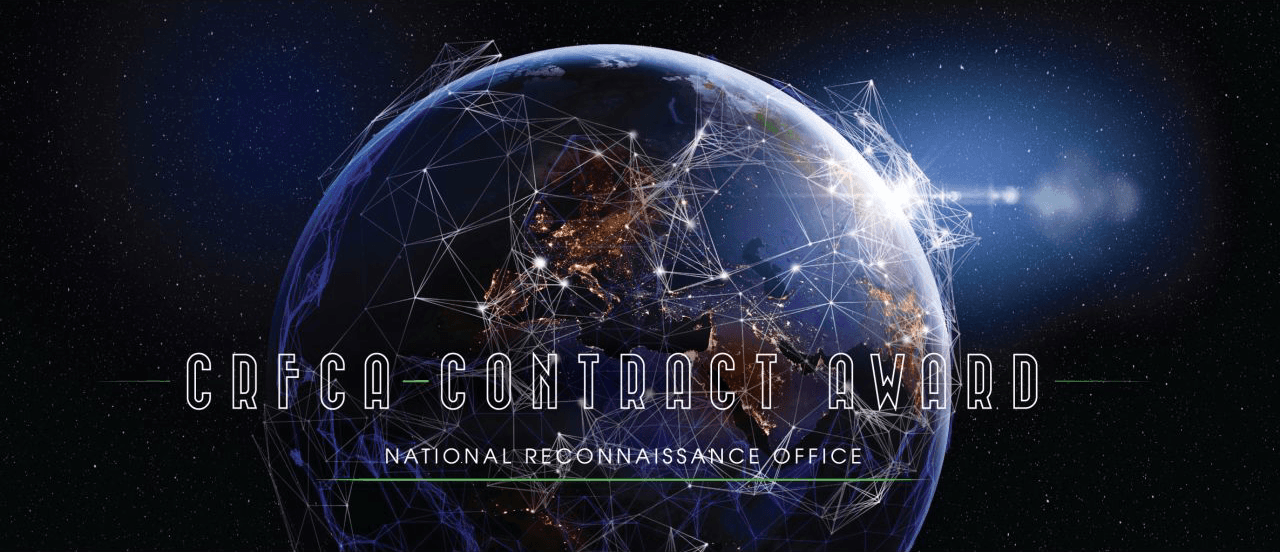
The National Reconnaissance Office has awarded HawkEye 360 a Commercial Radio Frequency Capabilities Augmentation contract, moving the company from a three-phase evaluation into a vehicle for operational data collection. The agency said on August 17 that the contract will supply commercial radio-frequency collections for national-security, civil and humanitarian missions and can scale as demand changes. HawkEye 360 announced the award publicly on August 18.
The change is in how NRO can buy the service, not in a disclosed purchase total. NRO describes CRFCA as a flexible operational vehicle without the value ceiling that applied to the Broad Agency Announcement study. Neither the agency's release nor HawkEye 360's announcement states an initial contract value, funded minimum, duration, task-order volume or geographic coverage. An uncapped vehicle permits future spending; by itself, it does not reveal how much work has been ordered.
What changed after three phases of testing
CRFCA follows the Commercial Radio Frequency Capabilities effort NRO began in September 2022. The agency says that programme used modelling, simulation and on-orbit demonstrations to assess multiple vendors over three phases. It now says HawkEye 360's trial performance established mission readiness and paved the way for the operational award. This is stronger evidence than a vendor claim because it comes from the buyer, although NRO has not published the test results or acceptance criteria behind that assessment.
The 2022 competition began with six study-contract recipients: Aurora Insight, HawkEye 360, Kleos Space, PredaSAR, Spire Global and Umbra Lab. NRO said the work was meant to measure capability and respond to rising user demand, not yet to buy a standing operational service. In April 2023, Via Satellite reported that NRO exercised second-stage options for HawkEye 360 and three other providers. The agency withheld values and said those study contracts could be scaled as mission value, user requirements and on-orbit performance were confirmed.
That sequence makes the 2026 award a down-selection as well as a change of contract type. The new NRO release names HawkEye 360 alone, while the company calls itself the first commercial provider to progress from evaluation into CRFCA. NRO does not say whether it plans additional RF augmentation awards, whether HawkEye 360 has an exclusive position or whether other study participants remain eligible. The public record therefore supports a first operational award, not a conclusion that the programme will remain single-vendor.
Operational status follows earlier real-world use
The contract label is new, but NRO had already described operationally relevant use of HawkEye 360 data. At the GEOINT 2022 conference, then-Commercial Systems Program Office director Pete Muend said NRO was using the company's RF detections over the Ukraine crisis area and drawing on that work while considering a future overhead signals-intelligence architecture, according to Breaking Defense. The 2026 step is therefore best understood as institutionalising a purchase path after years of studies and mission use, rather than the agency encountering commercial RF for the first time.
Commercial RF satellites observe transmissions rather than reflected light. NRO's 2019 integration-study announcement said the data can identify and geolocate signals including shipborne Automatic Identification System broadcasts. Breaking Defense later cited GPS jammers as another example. The useful point is that RF adds a different observable to imagery: an emitter can be located from its transmission. The public CRFCA releases do not identify the signal types, target sets or collection areas covered by the new contract.
HawkEye 360's April 2026 registration statement says its network comprised more than 30 satellites operating in three-spacecraft formations, with coverage from 30 megahertz to 18 gigahertz and a claimed global revisit time under 45 minutes. It says the system detects radars, jammers, beacons and mobile radios, then processes those observations into intelligence products. Those are company disclosures in a securities filing, not CRFCA performance specifications; NRO has not said which parts of that capacity it contracted for.
NRO says integrating commercial RF with national systems will add intelligence, surveillance and reconnaissance capacity and flexibility, with timely, persistent global coverage. It also says the Commercial Systems Program Office will manage collections across national-security, civil and humanitarian uses. What remains public is the acquisition architecture rather than the operational tasking: no release identifies end users, delivery latency, refresh requirements, data-sharing rules or how commercial collections will be combined with classified sensors.
What the award means for HawkEye 360
For HawkEye 360, the award deepens a customer relationship central to its business. In its April S-1, the company called NRO its largest customer and said its NRO contracts would span almost eight years by the end of their terms. The filing reported $71.6 million in revenue from U.S. customers in 2025, but did not assign that total to NRO. Because the new CRFCA value is absent, the award cannot yet be translated into incremental revenue or backlog.
It also shows that NRO's broader commercial-augmentation model is extending beyond electro-optical imagery. The agency explicitly linked CRFCA to lessons from its Electro-Optical Commercial Layer and other remote-sensing programmes, and the RF award followed three Radar Commercial Augmentation contracts announced on August 5. In each case, NRO describes commercially built capacity as an addition to government systems rather than a stand-alone substitute for national capabilities.
The core award and mission-readiness assessment come from NRO, with HawkEye 360 supplying its claim that it is the first provider to enter CRFCA. Historical use is independently reported by Breaking Defense, and the 2023 stage transition by Via Satellite. No full contract, task order or test report was publicly available for review on August 20.
The evidence threshold now shifts from test results to tasking and delivery. Contract value, period of performance and ordered volume would show the financial scale; disclosed mission use or renewal would show how firmly RF collection has entered routine workflows. Until those details emerge, the defensible conclusion is narrower: NRO has judged HawkEye 360's system ready for an operational acquisition vehicle that can expand with demand, while the size and persistence of that demand remain undisclosed.
Reporting trail
Primary sources
National Reconnaissance OfficeNRO Awards Operational Commercial Radio Frequency Capabilities Augmentationnro.gov
HawkEye 360HawkEye 360 Awarded NRO Commercial RF Capability Augmentation Contractprnewswire.com
National Reconnaissance OfficeNRO Announces Commercial Radio Frequency Study Contract Awardsnro.gov
National Reconnaissance OfficeNRO awards two commercial integration study contractsnro.gov
Breaking DefenseAfter success in Ukraine, NRO to pitch satellite firms on radio frequency geolocationbreakingdefense.com
Via SatelliteNRO Awards Options To 4 Commercial RF Satellite Companiessatellitetoday.com
U.S. Securities and Exchange CommissionHawkEye 360 Form S-1sec.gov
For an image post, download the card and copy this suggested caption.
The uncapped CRFCA vehicle follows three phases of testing and years of mission use, but neither NRO nor HawkEye 360 disclosed its initial value, duration or ordered data volume. Read the full report: https://www.spaceexploration.in/news/hawkeye-360-nro-operational-rf-contract #SpaceExplorationNews #SpaceNews #SpaceIndustry