Military satellite communications
Space Force awards five vendors to test shared data-network interfaces
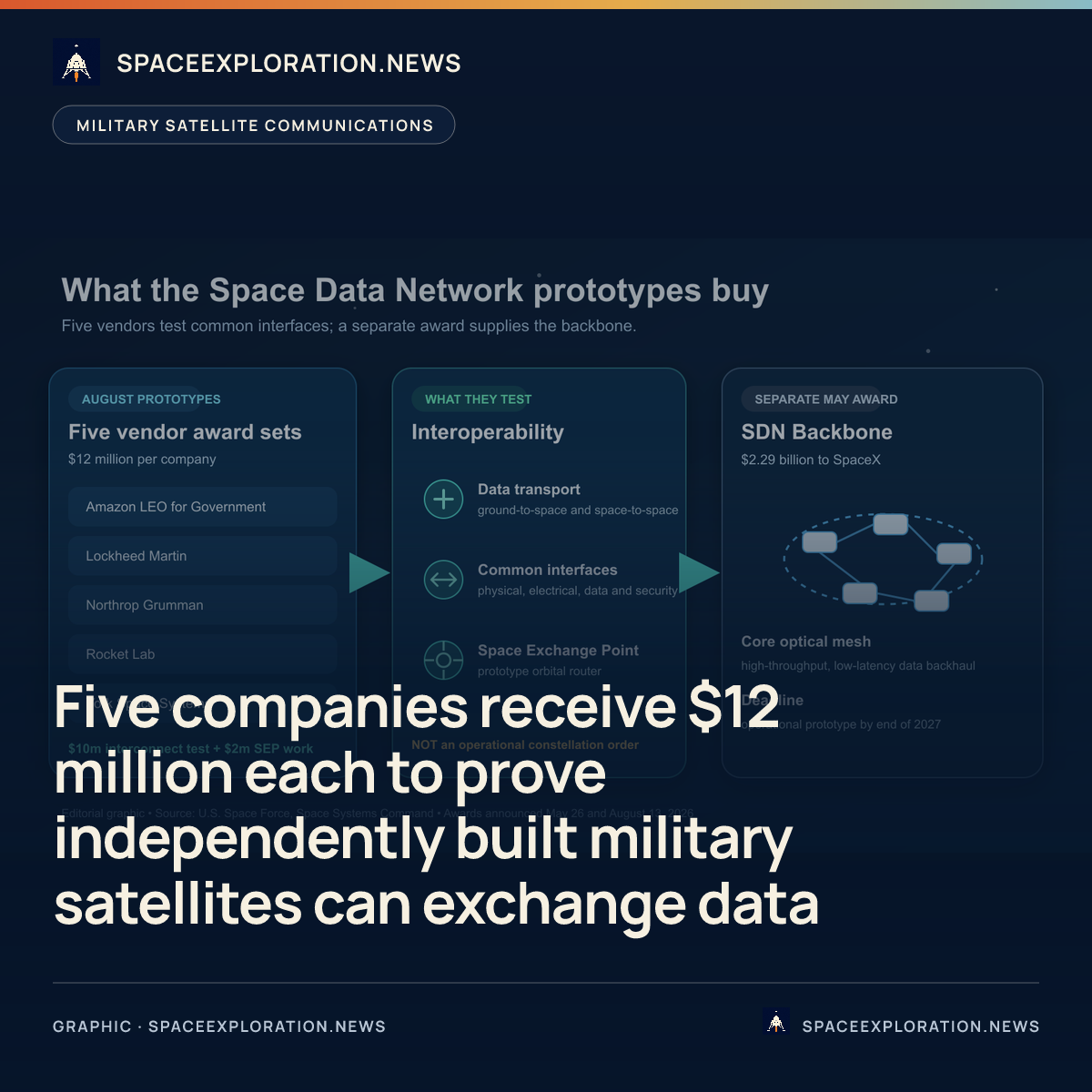
Five companies will each receive a $12 million prototype package to show that independently built satellites and terminals can exchange data through the Space Data Network. The demonstrations are integration tests, not orders for an operational fleet, and they sit beside a separate $2.29 billion backbone award made to SpaceX in May.
Add us as a preferred source on Google Add us as a preferred source on Google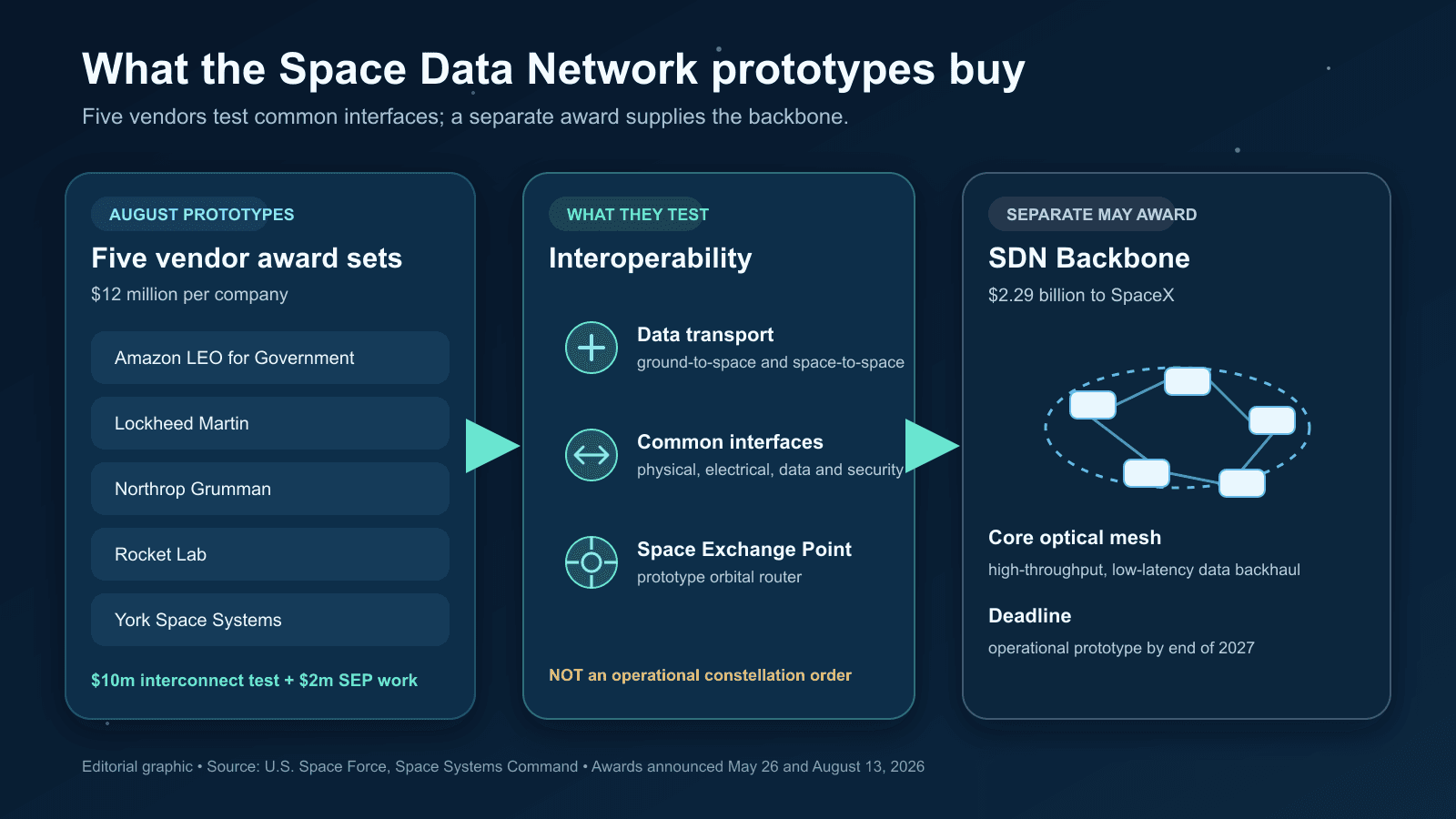
The U.S. Space Force selected Amazon LEO for Government, Lockheed Martin, Northrop Grumman, Rocket Lab and York Space Systems for complementary awards announced by Space Systems Command on August 13. Each company’s $12 million package combines two pieces of work intended to test connections to the core Space Data Network, or SDN. Across all five vendors, the announced prototype work is valued at $60 million.
The larger part is a $10 million fixed-price contract, with a six-to-nine-month performance period, to prototype and demonstrate multi-vendor connections across the SDN Backbone. A separate $2 million Other Transaction Authority agreement, with a six-month performance period, is meant to seed development and fielding of a Space Exchange Point satellite. Space Systems Command describes the two awards as complementary parts of one integration strategy.
What the demonstrations have to prove
The first test is whether data can move from ground to space and from one vendor’s space system to another while using the backbone. Space Systems Command says the demonstrations will combine on-orbit, high-speed optical-routing tests with physical, electrical and data-interface standards. The intended result is a repeatable baseline, so a new satellite offering can connect without requiring the wider network to be redesigned around it.
The Space Exchange Point, or SEP, supplies the orbital side of that connection. The command describes it as a router in space that would let otherwise separate commercial networks and government satellite systems connect directly to the SDN Backbone. The $2 million agreements fund prototype development and fielding work; the announcement does not say that five operational SEP spacecraft have been purchased.
The SEP work also carries forward technology from the multi-year Enterprise Space Terminal programme. Those optical terminals use a government-owned communications standard and were designed for links spanning low Earth orbit to geostationary Earth orbit. Space Systems Command says pairing terminal developers with commercial satellite-bus providers is meant to establish a technical baseline that can later be procured at scale.
Interoperability in this programme therefore covers more than whether two terminals can establish an optical link. The vendors must work through common physical and electrical connections, data interfaces, digital models and security protocols. In practical terms, the demonstrations are meant to reveal integration and onboarding problems while the Space Force is still dealing with laboratories and small prototypes, before it commits to larger procurements.
Prototype packages are not operational orders
The August awards do not constitute production task orders for an operational constellation. They fund time-limited demonstrations and SEP prototype work. Space Systems Command’s announcement gives no operational satellite quantity, later task-order schedule or value for follow-on production. It says the present work is intended to reduce technical and onboarding risk and inform how SDN systems may be bought in the future.
They are also separate from the SDN Backbone procurement. On May 26, Space Systems Command announced a $2.29 billion, firm-fixed-price Other Transaction Authority delivery order to SpaceX for that backbone. The backbone is the core, proliferated low-Earth-orbit mesh expected to carry high-throughput, low-latency traffic through optical links. SpaceX is required to deliver a fully operational prototype capability by the end of 2027.
Air & Space Forces Magazine reported that the SpaceX-built backbone satellites will be government-owned and will include changes for government security and resilience requirements rather than simply copying commercial Starlink satellites. The command did not tell the publication how many spacecraft SpaceX would provide. That undisclosed fleet belongs to the backbone award, not to the five $12 million integration packages announced in August.
The value of the new work can also be read two different ways if the award structure is collapsed. There are five $10 million interconnectivity contracts and five $2 million SEP agreements: $50 million plus $10 million, or $60 million in all. The announcement’s $12 million per set refers to one combined set for each selected company, not a $12 million operational order attached to every future SDN spacecraft.
Why the Space Force is testing several vendors now
Space Systems Command presents standard interfaces as a way to avoid dependence on a single supplier. Col. Ryan Frazier, the acting portfolio acquisition executive for space-based sensing and targeting, said the aim is to let capable companies compete without forcing the government to treat each new satellite as a bespoke integration project. The demonstrations will test whether that acquisition premise is technically workable.
The broader network is supposed to connect more than the new backbone. In May, Space Systems Command said SDN would work alongside the Space Development Agency’s Transport Layer to form an open hybrid mesh for military data transport. Air & Space Forces Magazine subsequently reported that officials also envisage connections with missile-tracking and traditional military satellite-communications systems, although the service has not publicly provided a complete map of the programmes inside SDN.
That missing detail limits what can be concluded from the August announcement. The command has named the five companies, the two prototype mechanisms, their values and their performance periods, but it has not published test dates, launch assignments, acceptance criteria or follow-on quantities. The next meaningful evidence will be whether the vendors can demonstrate cross-system data transport and field SEP prototypes on the stated schedule; larger operational work remains a later acquisition decision.
The core award details and programme descriptions in this account come from Space Systems Command, which is both the buyer and the source announcing the work. Air & Space Forces Magazine independently reported the five company names and award values and added comments from Space Force officials, but no demonstration results exist yet. The supported conclusion is limited to what has been purchased now: interoperability prototypes intended to qualify a multi-vendor architecture, not an operational multi-vendor constellation.
Reporting trail
Primary sources
Space Systems CommandSpace Force invests in resilient multi-vendor architecture to build next-gen Space Data Networkssc.spaceforce.mil
Space Systems CommandU.S. Space Force advances Space Data Network Backbone for global warfighter connectivityssc.spaceforce.mil
Air & Space Forces MagazineSpace Force adds 5 new vendors to Space Data Network projectairandspaceforces.com
Air & Space Forces MagazineUSSF gives SpaceX $2.29 billion for ‘Backbone’ of new data networkairandspaceforces.com
For an image post, download the card and copy this suggested caption.
Five companies will each receive a $12 million prototype package to show that independently built satellites and terminals can exchange data through the Space Data Network. The demonstrations are integration tests, not orders for an operational fleet, and they sit beside a separate $2.29 billion backbone award made to SpaceX in May. Read the full report: https://www.spaceexploration.in/news/space-force-space-data-network-interoperability #SpaceExplorationNews #SpaceNews #SpaceIndustry