Uncrewed aviation
Honeywell publishes BVLOS test results for lightweight satcom antenna
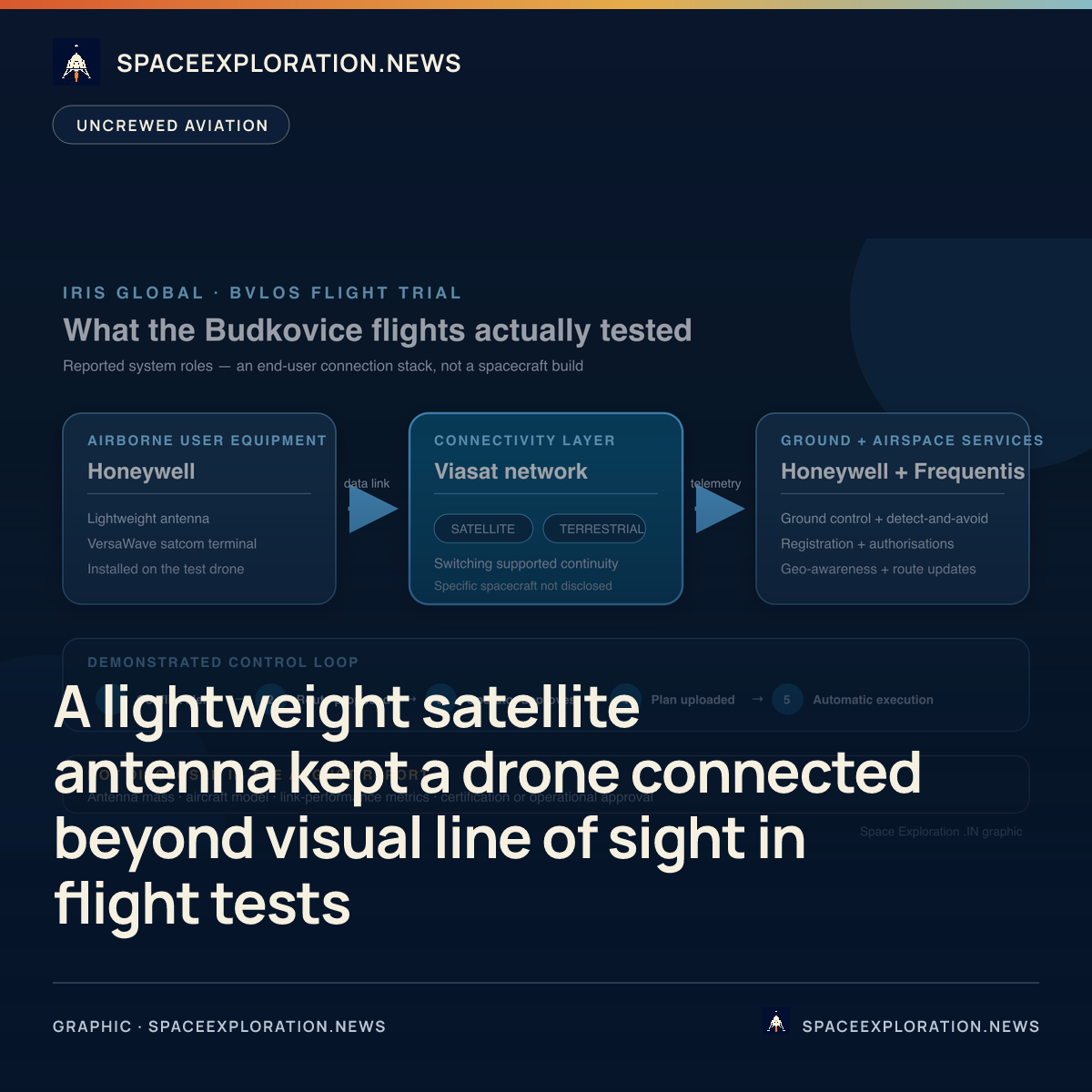
Flights at Budkovice Airport linked a drone, Viasat satellite service, Honeywell ground control and Frequentis traffic-management software. The test exercised an end-user communications stack, not a new spacecraft.
Add us as a preferred source on Google Add us as a preferred source on Google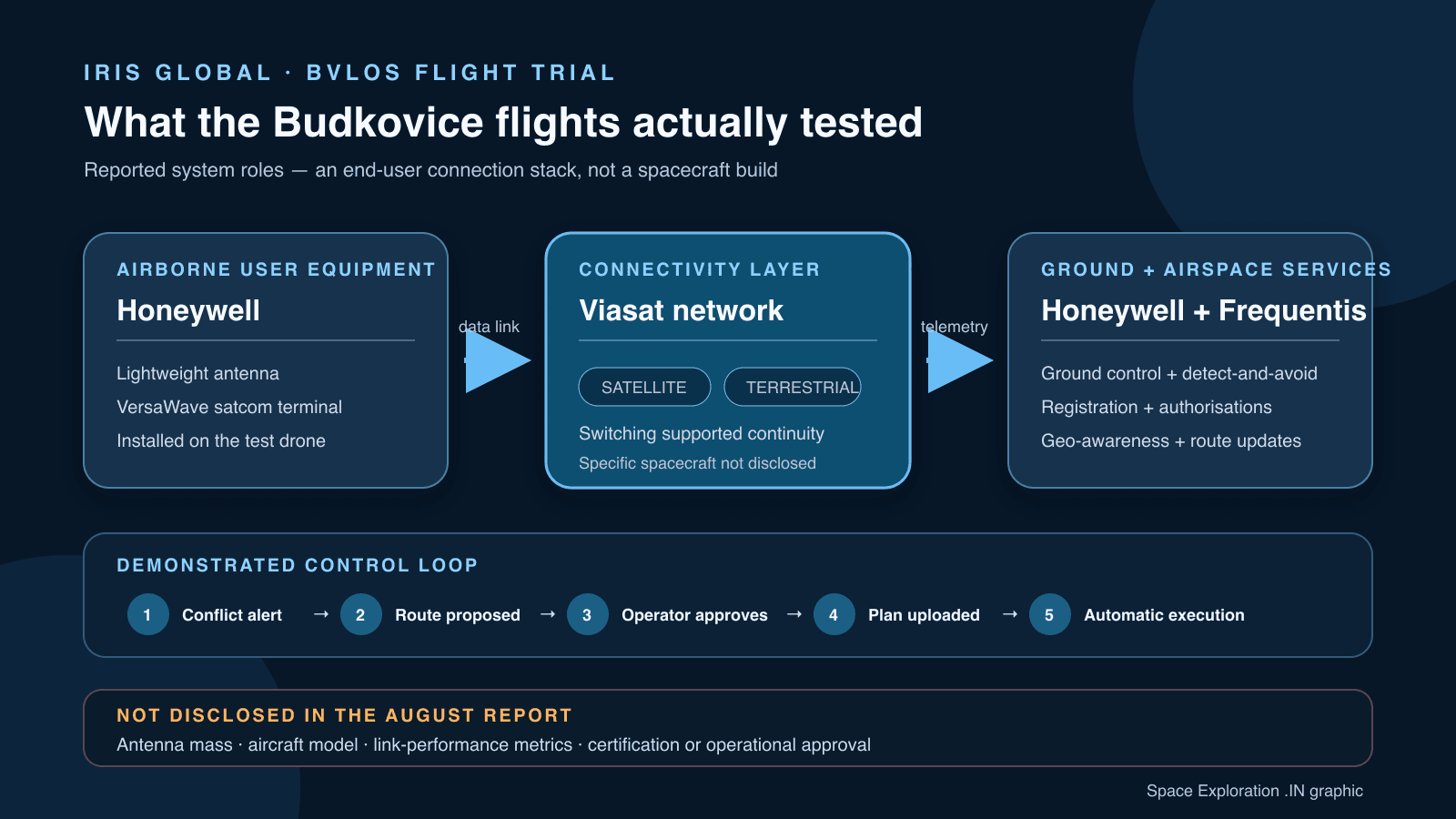
Honeywell Aerospace says a series of drone flights at Budkovice Airport in Czechia validated a lightweight satellite-communications antenna under the European Space Agency’s Iris Global programme. The antenna, developed at Honeywell’s Brno research centre, was integrated with the company’s VersaWave terminal and connected through Viasat’s satellite network. According to an August 18 report by Unmanned Airspace, the airborne system could switch between satellite and terrestrial links while keeping the command-and-control connection available during beyond-visual-line-of-sight operations.
The reported test was an end-to-end communications and traffic-management exercise, not a spacecraft-manufacturing result. Honeywell supplied the airborne antenna, VersaWave system and ground-control equipment; Viasat supplied network connectivity; and Frequentis supplied an uncrewed-traffic-management service. ESA co-funded the initiative. Nothing in the reviewed material says Honeywell built or modified a satellite for the trial, and the August report does not identify a specific Viasat spacecraft. What flew was user equipment designed to reach an existing network.
The distinction matters because the satcom antenna describes only one layer of a much larger path. On the aircraft, the antenna and terminal transmit and receive data. The network relays that traffic beyond the range of direct radio or mobile coverage. On the ground, control and airspace-management systems turn telemetry and traffic information into warnings, route proposals and commands. The Budkovice flights exercised that chain together; they do not show that the antenna alone detected or avoided other aircraft.
What happened during the flights
Unmanned Airspace reported that several missions were flown in a U-space environment at Budkovice. Frequentis’s system handled operator registration, flight authorisations and geo-awareness. Honeywell’s ground station, fitted with a ground-based detect-and-avoid system, combined telemetry from the drone with data from a crewed aircraft acting as an intruder. The station used that airspace picture to flag a potential conflict and recommend a route change to the remote operator.
Honeywell’s account also described a scenario in which another drone crossed the planned route. Operators could adjust trajectories and maintain separation when the system detected a potential conflict, the report said. After the operator approved an amended flight plan, the route was uploaded and the aircraft executed it automatically. Human approval therefore remained inside the demonstrated loop: the test showed automated execution after a remote decision, not a claim that the aircraft independently authorised its own rerouting.
The report does not give the calendar dates of the flights, the number of missions beyond several, the model or mass of the test aircraft, or the new antenna’s mass and dimensions. It also publishes no throughput, latency, availability, handover-failure or outage figures. Without those measurements, the supported conclusion is functional: the parties completed the described command, conflict-warning and rerouting sequence under real-flight conditions. Performance margins and reliability across a larger campaign remain unreported.
How this fits the Iris programme
ESA describes Iris as a satellite-based datalink for digital communications between pilots and air-traffic controllers, with terrestrial links intended to provide a dual-link service. Iris Global, launched in 2022, extends the programme beyond Europe and includes remotely piloted aircraft and BVLOS operations among its planned users. ESA’s current programme page says easyJet became the first commercial airline to use Iris in January 2024 and that more than 1,000 flights have since been completed with EASA-certified systems. That operational history belongs to the broader Iris service; it is not certification evidence for Honeywell’s new drone antenna.
Viasat’s role sits at the network and service layer. In a May 27 account of the wider Iris remotely piloted aircraft systems programme, Viasat said the work was testing how connectivity and airspace-management elements behave under representative operational conditions. That release named TTP and Frequentis and described the activity as one of several trials exploring different scenarios. It did not report the Honeywell antenna or the Budkovice results, so it provides programme context rather than independent confirmation of the August test.
That wider record also prevents the Budkovice campaign from being read as the first Iris BVLOS flight exercise. On April 21, Viasat and partners reported trials at Cranfield University using a Bulldog light aircraft and a compact TTP/Gotonomi terminal. The hardware and site were different from those in the Honeywell account. Together, the reports show a programme evaluating more than one user-terminal design and integration setup, while the reviewed sources do not provide a common scorecard for comparing their performance.
Nor does the flight test amount to a regulatory approval. ESA’s Iris Global page says the programme aims for global interoperability and compatibility with an International Civil Aviation Organization Internet Protocol Suite standard that remains under development. The August report does not name an aviation authority that witnessed or accepted the Budkovice results, quote a certification basis, or state that the antenna is approved for commercial BVLOS service. A real-flight demonstration can produce evidence for those processes, but it is not the same as completing them.
Production work comes next
Honeywell is now preparing the antenna for industrial production and assessing Czech suppliers for its manufacturing chain, according to Unmanned Airspace. Czech industrial partners had already contributed to prototype production, while Brno University of Technology supported radio-frequency validation. The initiative was co-funded by ESA, with additional support from the Czech ministries of transport and industry and trade.
The next useful disclosures would be the antenna’s physical specification, the flight-test plan and measured link performance, followed by the certification or operational approvals required for service. The core Budkovice results in this article trace to Unmanned Airspace’s account of an August 18 Honeywell press release. The Viasat and ESA material confirms the surrounding Iris programme and other BVLOS trials, but neither independently publishes the Honeywell flight data reviewed here.
Reporting trail
Primary sources
Unmanned AirspaceHoneywell Aerospace tests satcoms antenna for BVLOS operationsunmannedairspace.info
European Space AgencyIris Globalconnectivity.esa.int
ViasatViasat and partners take Beyond Visual Line of Sight to new heights with integrated connectivity demonstrationviasat.com
ViasatThales, Viasat and partners complete Beyond Visual Line of Sight (BVLOS) connectivity demoviasat.com
European Space AgencySatellite communications for safer and greener aviationesa.int
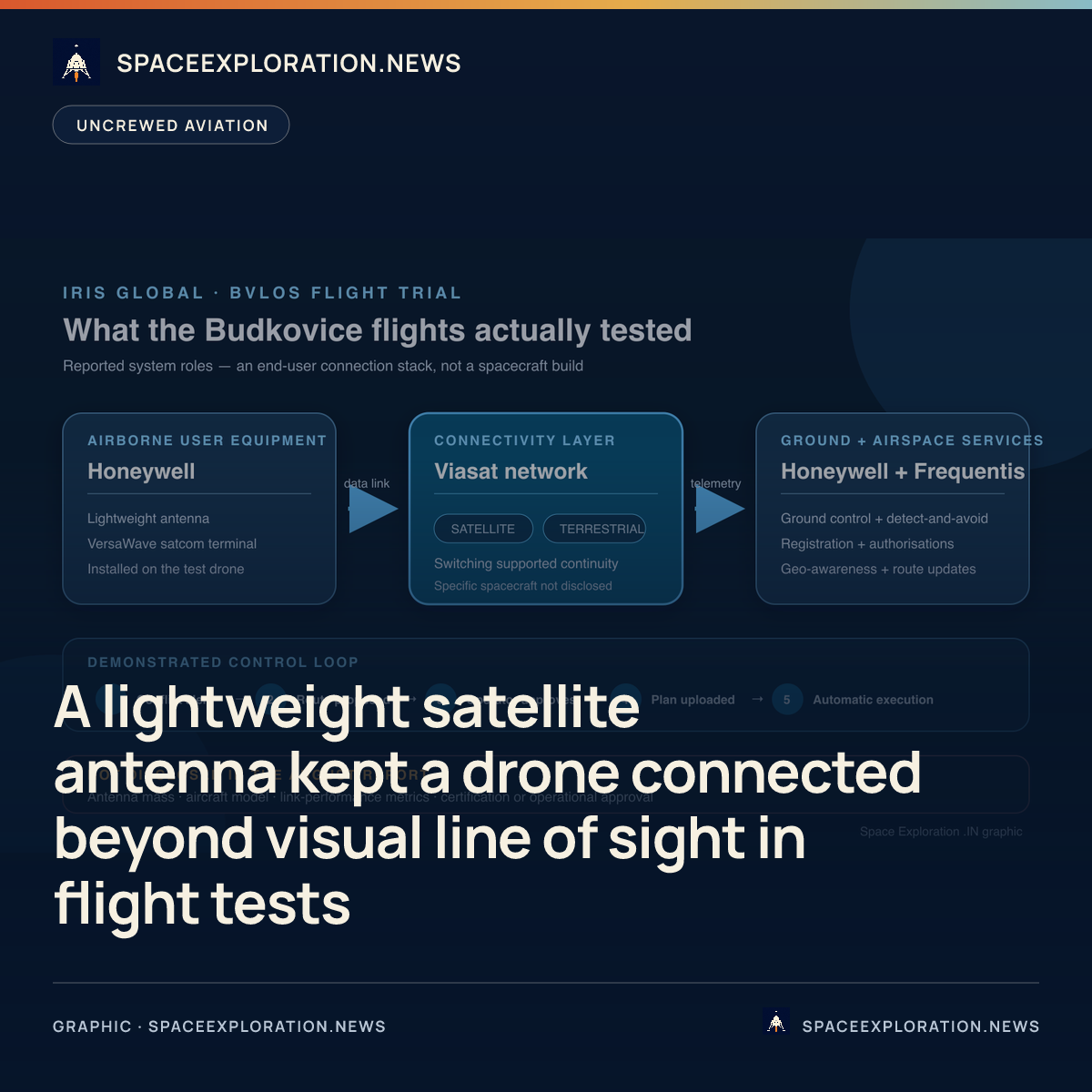
For an image post, download the card and copy this suggested caption.
Flights at Budkovice Airport linked a drone, Viasat satellite service, Honeywell ground control and Frequentis traffic-management software. The test exercised an end-user communications stack, not a new spacecraft. Read the full report: https://www.spaceexploration.in/news/honeywell-viasat-bvlos-satcom-antenna-flight-test #SpaceExplorationNews #SpaceNews #SpaceIndustry