In-space manufacturing
Serendipity Space details balloon-based drug-crystallisation test
The recovered Alchemy module exercised avionics and a return sequence, but the disclosed record does not establish microgravity production or orbital qualification.
Add us as a preferred source on Google Add us as a preferred source on Google
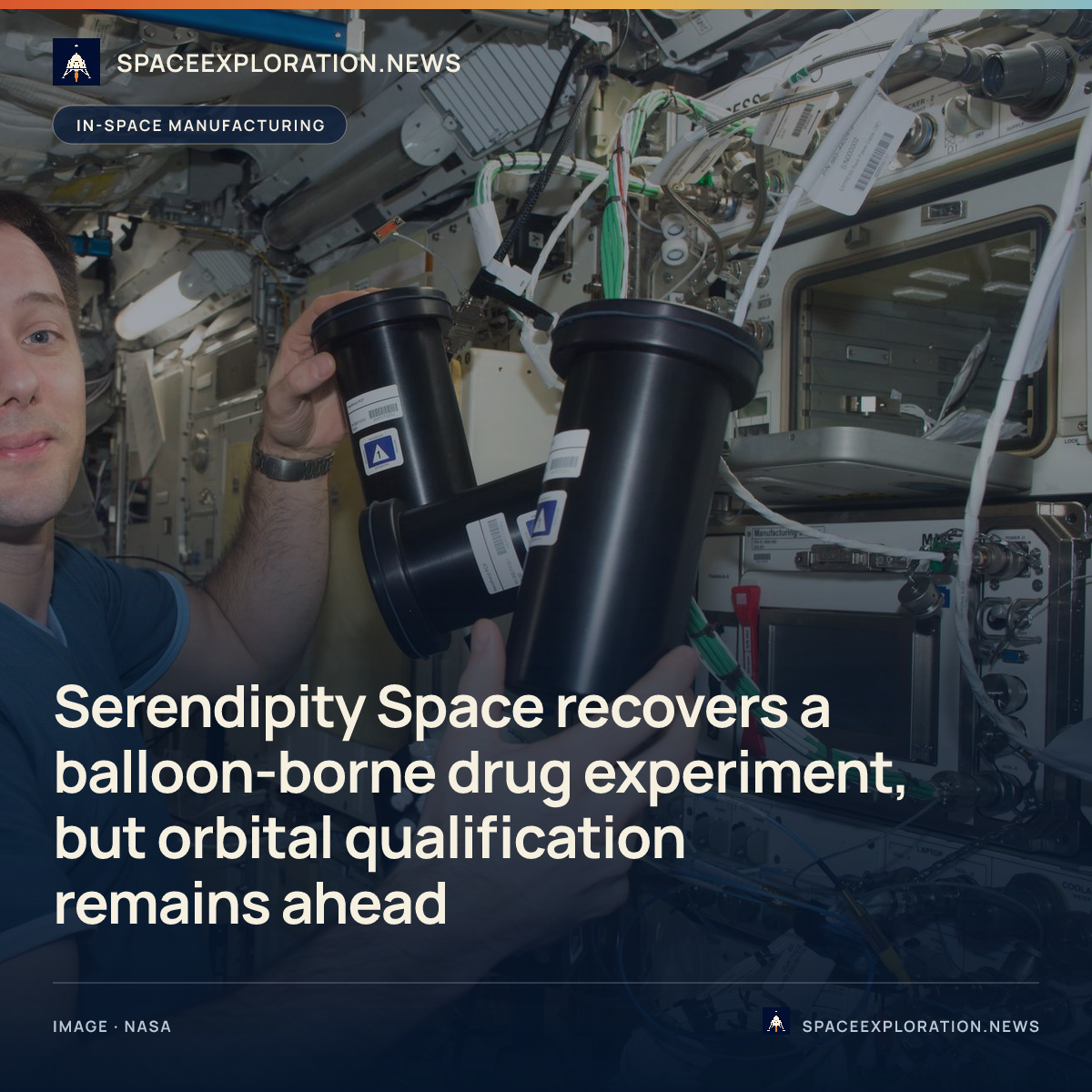
Serendipity Space says a prototype of its planned pharmaceutical-return satellite completed a stratospheric-balloon flight that exercised its avionics, heatshield and autonomous Alchemy crystallisation module before a controlled landing and recovery. The flight puts integrated hardware outside the laboratory and brings the samples back for inspection. It does not, on the evidence released so far, show that the spacecraft operated in orbit or manufactured pharmaceuticals in sustained microgravity.
Press Trust of India reported the result on August 14 from a statement by founder and chief executive Antariksh Parichha. According to that account, the payload carried commercial monoclonal antibody therapeutics, small molecules and additional proteins for drug discovery. Parichha said Alchemy operated continuously, performed crystallisation processes and preserved the resulting crystals through return, touchdown and recovery. PTI did not cite a technical report, telemetry release or independent examination of the samples.
What the balloon flight demonstrated
The test fits a development path Serendipity Space had already described publicly. At a Tata Institute of Fundamental Research balloon-users meeting in October 2025, Parichha was scheduled to discuss simulating payload re-entry with high-altitude balloon flights. TIFR says its Hyderabad facility designs balloons, integrates payloads, supplies tracking and control support, and recovers payloads after flight. It has regularly carried scientific experiments to about 43 kilometres, with lighter payloads reaching higher on some missions.
That makes a balloon useful for an integrated shakedown. A complete powered flight and recovery can test whether avionics, software, the experiment module and the return chain work together away from a bench setup. Serendipity Space’s reported outcome is therefore meaningful at the subsystem level: it says the module ran, a return sequence occurred and the hardware and samples were recovered. Those are narrower claims than qualification for an orbital mission.
The public account leaves the engineering margins unknown. It gives no flight date, maximum altitude, duration, trajectory, peak speed, release sequence or recovery location. It also provides no temperature, pressure, vibration, acceleration or heat-flux record. Without those measurements, an outside reviewer cannot tell which environment the heatshield and avionics experienced or determine whether the descent reproduced the loads of return from low Earth orbit. No separate TIFR mission report describing this flight was available when this article was prepared.
Why near-space is not the same as microgravity
Altitude alone does not create the microgravity used for orbital manufacturing. NASA explains that microgravity occurs when a vehicle and everything inside it are in free fall; an orbiting spacecraft remains in continuous free fall around Earth. A balloon, by contrast, is supported by buoyancy while it rises or floats in the atmosphere. A released capsule may experience a short interval closer to free fall before aerodynamic drag and its recovery system dominate, but Serendipity Space has not publicly stated whether that happened here or published an acceleration history.
The crystallisation result therefore has two distinct parts. The company says Alchemy autonomously ran its process and returned crystals intact, which is a claim about experiment operation and recovery. The available material does not establish that those crystals formed under a measured microgravity level, that they were better than matched samples made at normal gravity, or that the process can run for an orbital production period. The report names no drug compounds, processing times, yields, ground controls, imaging results, diffraction data or post-flight assays.
There is a scientific basis for testing crystallisation in microgravity, but the outcome cannot be assumed in advance. A review in npj Microgravity describes how suppressing buoyancy-driven convection and sedimentation can improve some protein-crystal experiments. It also records that earlier programme reviews found many gains incremental or inconclusive and identified difficulty with suitable controls. An automated balloon run can advance the flight hardware, but comparative claims about crystal quality require matched samples and measurements.
The Keytruda precedent, in proportion
Serendipity Space points to Merck’s work on pembrolizumab, sold as Keytruda, as evidence for the market it wants to serve. NASA says Merck has flown protein-crystal experiments to the International Space Station since 2014. Findings about particle structure and size informed development of a subcutaneous formulation that the US Food and Drug Administration approved in September 2025. NASA says the injection takes about one minute, compared with intravenous infusions that had taken up to two hours for some patients.
That precedent is narrower than the claim that a finished medicine was manufactured in space. The station experiments produced research insights that helped Merck refine a formulation made on Earth, after years of orbital work and terrestrial development. It shows why a pharmaceutical company may pay for controlled microgravity experiments and sample return. It does not validate Serendipity Space’s hardware, prove that every molecule benefits from microgravity or remove the need for compound-specific controls.
The qualification work still ahead
Serendipity Space’s longer-term plan is to fly reusable satellites that process compounds in low Earth orbit and return them. A March 2026 collaboration agreement with Siksha ‘O’ Anusandhan separates the research stages into laboratory crystallisation, clinostat-based simulation and spaceflight experiments. The balloon result belongs in that staged programme as a recovered hardware test; it is not a substitute for an orbital campaign.
The next evidence needed is visible in what the announcement omits: a published flight profile and Alchemy telemetry, matched normal-gravity controls, analysis of the recovered samples, and eventually an orbital flight followed by re-entry and recovery. Repeat missions would then have to show that the process and return system produce consistent results. Until those data appear, the strongest supported reading is that Serendipity Space has completed an integrated balloon shakedown and recovered its pharmaceutical payload—not that it has qualified an orbital factory or demonstrated superior drugs made in microgravity.
The flight details in this account rest on PTI’s report of the company statement. No independent mission log, telemetry set or laboratory analysis of the recovered crystals was publicly available for review. The unresolved milestone is an orbital mission whose environmental record, controls and returned samples can be examined together.
Reporting trail
Primary sources
ThePrint / Press Trust of IndiaOdisha-based start-up tests drug manufacturing in near-space missiontheprint.in
Tata Institute of Fundamental ResearchTIFR National Balloon Facility Users Meeting programmetifr.res.in
Tata Institute of Fundamental ResearchA brief history of 500 scientific balloon flights by the TIFR Balloon Grouptifr.res.in
NASAWhat is Microgravity?nasa.gov
npj MicrogravityMicrogravity protein crystallizationnature.com
NASASpace Station Research Informs New FDA-Approved Cancer Therapynasa.gov
Siksha ‘O’ AnusandhanSOA Signs MOU With Serendipity Space For Joint Collaboration In Microgravity Drug Developmentsoa.ac.in
For an image post, download the card and copy this suggested caption.
The recovered Alchemy module exercised avionics and a return sequence, but the disclosed record does not establish microgravity production or orbital qualification. Read the full report: https://www.spaceexploration.in/news/serendipity-space-balloon-pharma-test #SpaceExplorationNews #SpaceNews #SpaceIndustry