Launch
Sidus reiterates LizzieSat vibration-test completion in second-quarter results
The completion had been public since June 16; neither that announcement nor the August 14 results identifies the day the qualification work finished.
Add us as a preferred source on Google Add us as a preferred source on Google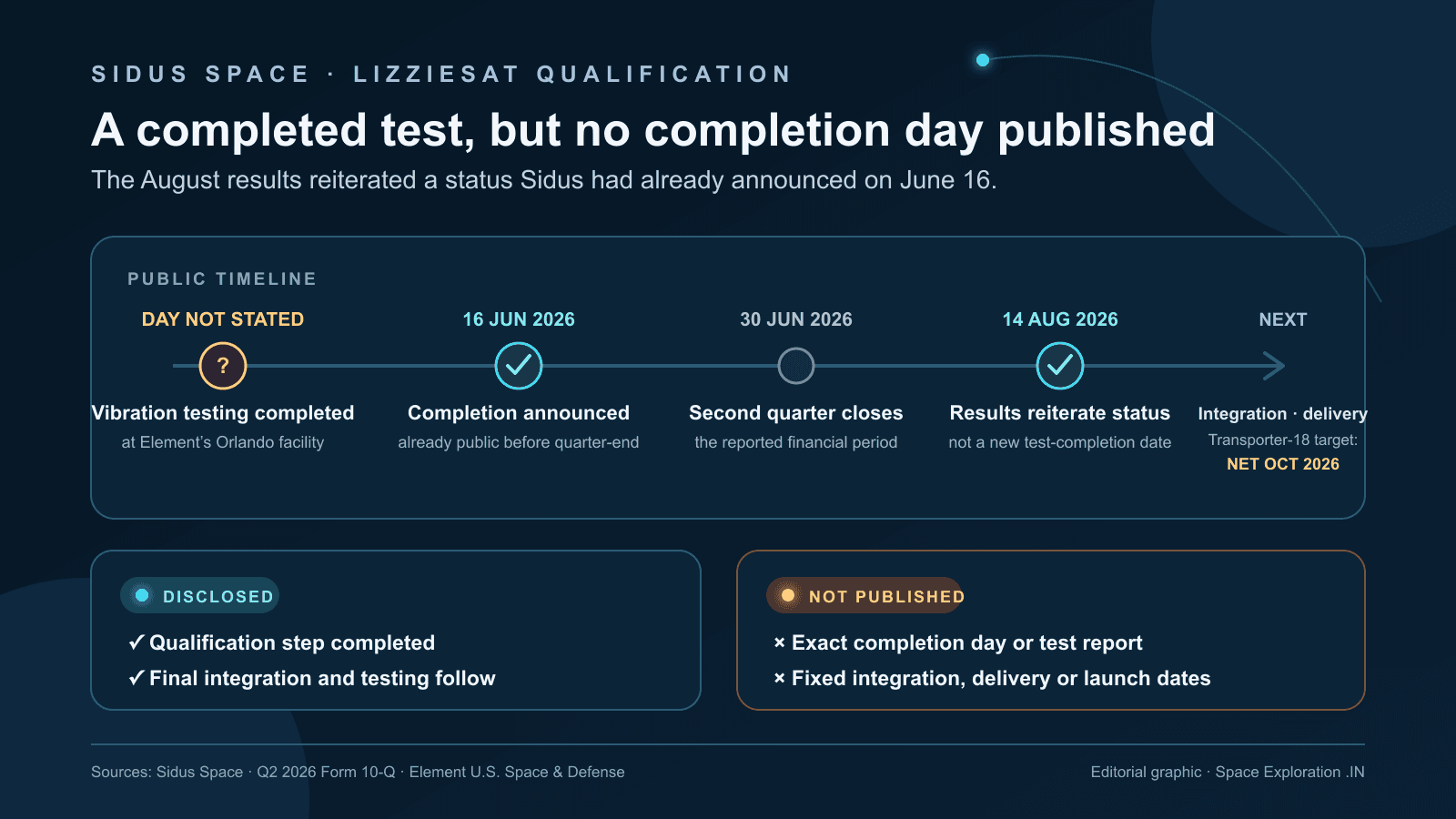
Sidus Space used its August 14 second-quarter results to reiterate that its next LizzieSat spacecraft had completed vibration testing at Element U.S. Space & Defense in Orlando, Florida. The company had already announced the completion on June 16, before the June 30 quarter end. Neither disclosure states the day the test campaign finished, so August 14 marks a financial-results reiteration, not a newly completed qualification event.
Element later acknowledged on LinkedIn that its Orlando facility supported qualification testing for the spacecraft and said vibration testing had been completed. Its post likewise did not date the completion or publish the test levels or detailed results. The status is therefore supported by statements from Sidus and the test provider, but no test report was public in the sources reviewed for this article.
What the vibration test established
Sidus described vibration testing as a simulation of the intense mechanical loads a spacecraft experiences during launch and ascent. According to the company, the work was intended to check that the satellite’s structure, components and integrated payloads could withstand liftoff stresses and remain operational in orbit. That description establishes a bounded result: one environmental qualification step was completed. It does not document completion of final spacecraft integration, every remaining test, delivery or flight.
The June announcement said the satellite would move from vibration testing to final integration and testing before delivery to the launch provider. It assigned no dates to either step. Sidus then targeted the spacecraft for SpaceX’s Transporter-18 rideshare mission from Vandenberg Space Force Base in California no earlier than October 2026. That was a forward-looking company schedule; the August results did not publish an exact launch date or time.
The June and August releases both refer only to the company’s next LizzieSat and do not assign it a spacecraft number. Sidus’s quarterly filing says the company has launched LS-1, LS-2 and LS-3 since 2024 and describes LS-4 onward as its second-generation platform, with 100-, 200- and 400-kilogram configurations. The filing does not connect the tested spacecraft to one of those masses, so neither a flight number nor a configuration can be inferred from the qualification statement.
Fortis rides with the next spacecraft
The quarterly release paired the test update with another spacecraft development: integration of Sidus’s Fortis VPX Maxima digital mission-computing platform. The company says the system combines a quad-core ARM processor and reconfigurable field-programmable gate array with an NVIDIA edge artificial-intelligence engine and an assured positioning, navigation and timing suite. Sidus says that package is intended to process data and make some decisions aboard the spacecraft rather than send all sensor data to the ground first.
The June release described the coming mission as the first flight for Fortis Maxima and said successful operation in space was expected to advance the system to Technology Readiness Level 9, a designation for technology proven through mission operations. That is still a future objective. Integration aboard LizzieSat and completion of the disclosed vibration test do not constitute an on-orbit demonstration, which can begin only after launch and spacecraft operations.
A technical update inside a capital-heavy quarter
Sidus reported $583,096 in second-quarter revenue, down 54% from $1.26 million a year earlier, and attributed the decline primarily to the timing of fixed-price milestone contracts. Its net loss narrowed to $4.78 million from $5.63 million, while its gross loss narrowed to $629,723 from $1.03 million. The filing does not attribute any of those changes to the LizzieSat qualification work, so the financial and engineering updates are related here only as parts of the same quarterly report.
The company ended June with $166.52 million in cash, up from about $43.2 million at December 31, 2025, and no outstanding debt. Its filing traces the increase mainly to about $146.2 million in net proceeds from registered direct offerings in April and May. The same filing says operating revenue has not been sufficient to fund operations and gives an accumulated deficit of about $99.8 million at June 30, placing the larger cash position in the context of equity financing rather than operating profitability.
For the first six months of 2026, Sidus used $9.11 million in operating activities and $7.33 million in investing activities; the company said the investing outflow was primarily for satellite-related components and software. Its Class A share count rose 55% from December 31 to 101.1 million at June 30. Those figures show the financing and spending environment around the spacecraft programme, but the public filing does not assign a cost to the vibration campaign or to the tested LizzieSat.
Next public checkpoints
The next verifiable steps in Sidus’s stated sequence are completion of final integration and testing, delivery to the launch provider, and a dated Transporter-18 launch notice. The June announcement supplied only a no-earlier-than-October target, and the August results added no calendar precision. The exact vibration-test completion day also remains undisclosed. The supported conclusion is therefore limited: Sidus reiterated in its quarterly results a qualification completion that had been public by June 16 and kept its next LizzieSat on a company-stated path toward Transporter-18.
Reporting trail
Primary sources
Sidus Space via PR NewswireSidus Space Reports Second Quarter 2026 Financial Resultsprnewswire.com
Sidus SpaceSidus Space’s LizzieSat Completes Vibration Testing Ahead of Expected Fall 2026 Launchsidusspace.com
U.S. Securities and Exchange CommissionForm 10-Q for the quarter ended June 30, 2026sec.gov
For an image post, download the card and copy this suggested caption.
The completion had been public since June 16; neither that announcement nor the August 14 results identifies the day the qualification work finished. Read the full report: https://www.spaceexploration.in/news/sidus-lizziesat-vibration-test-q2-results #SpaceExplorationNews #SpaceNews #RocketLaunch