Launch cadence
SpaceX reaches 100 missions in 2026 with Starlink 17-50
Falcon 9 lifted off from Vandenberg and B1097 landed after its 12th flight. The sources reviewed did not separately confirm deployment of the 24 satellites.
Add us as a preferred source on Google Add us as a preferred source on Google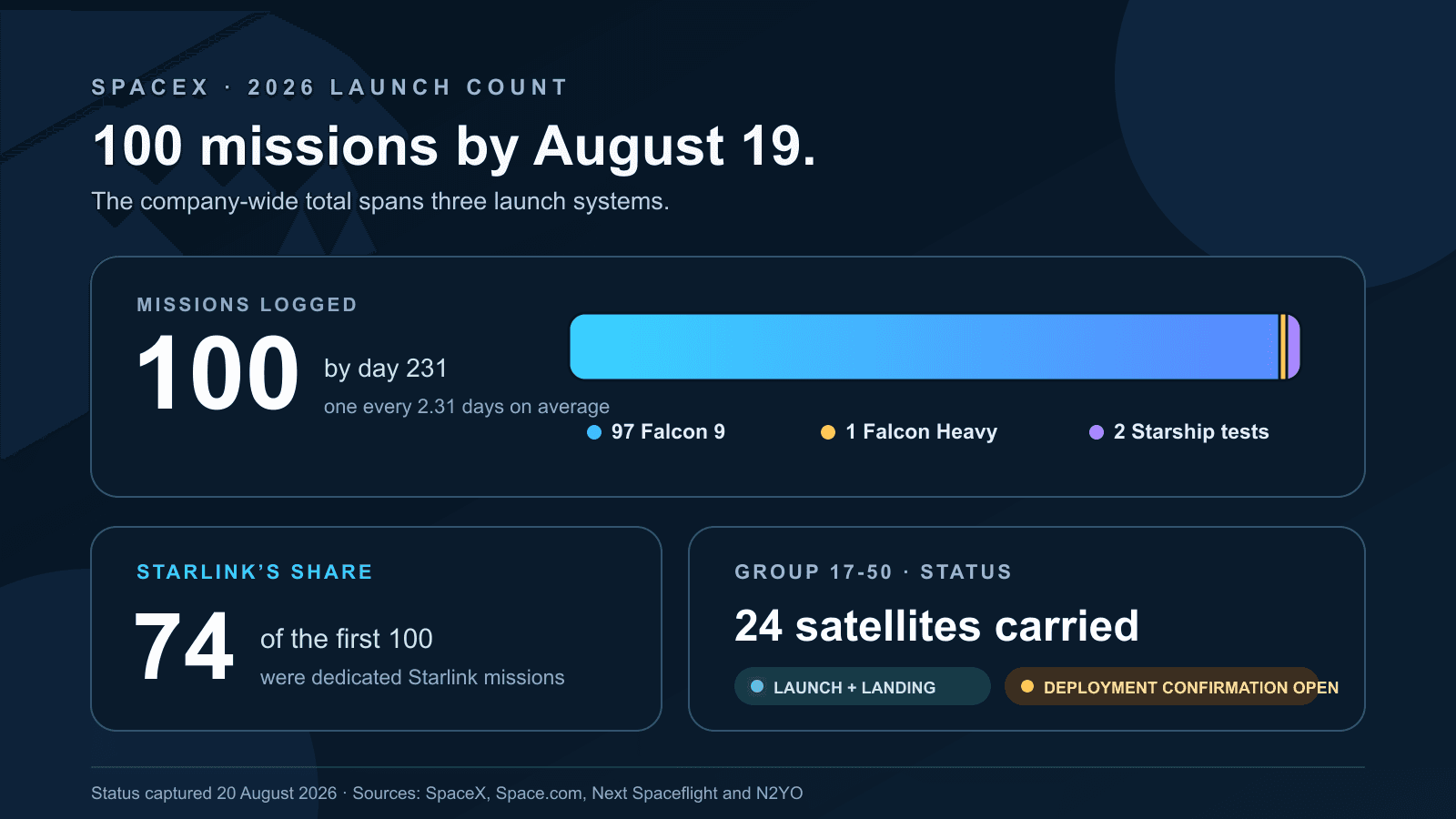
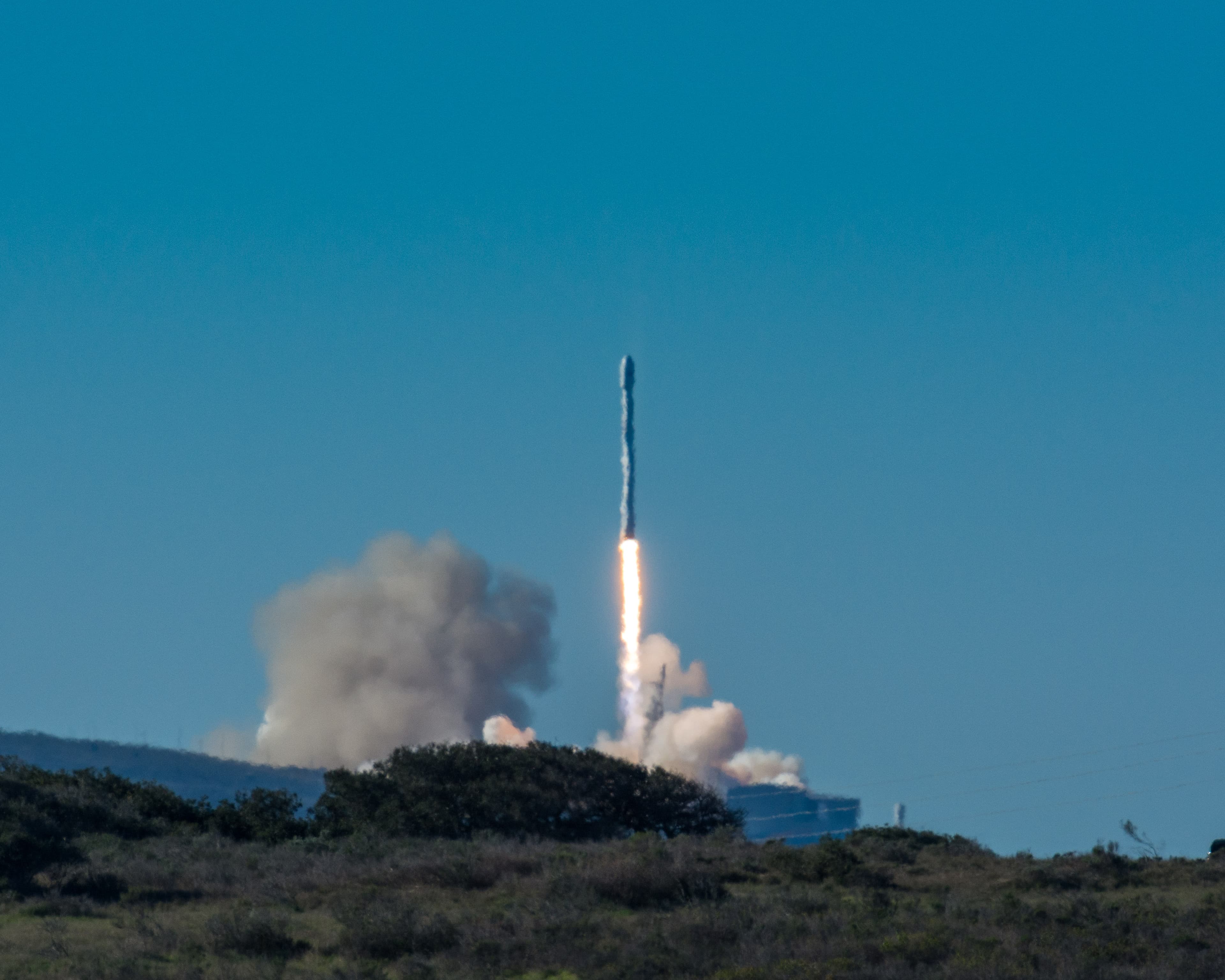
SpaceX logged its 100th mission of 2026 when a Falcon 9 carrying 24 Starlink satellites lifted off from California and the rocket’s first stage landed at sea. The August 19 flight took the company to that count for a third consecutive year. The launch and booster recovery are confirmed; the public material reviewed for this report did not separately confirm that the satellites had deployed from the upper stage.
Falcon 9 left Space Launch Complex 4 East at Vandenberg Space Force Base at 9:01 p.m. Pacific time on August 18, or 04:01 UTC on August 19. Space.com reported that the first stage touched down on the Of Course I Still Love You droneship in the Pacific about eight and a half minutes later. SpaceX’s mission page identifies the payload as 24 Starlink satellites and the booster as B1097, flying for the 12th time.
What the 100 count includes
This was SpaceX’s 97th Falcon 9 mission of the year, according to Space.com and Next Spaceflight. The other three flights in the company’s 100-mission total were one Falcon Heavy launch and two suborbital Starship test flights. The total is therefore a count of SpaceX vehicle missions across three systems; it should not be described as 100 orbital launches, because the two Starship flights were suborbital tests.
Starlink supplied most of that activity. Space.com counted 74 dedicated Starlink missions in the first 100, meaning nearly three quarters of SpaceX’s 2026 flights had been used to expand the broadband constellation. Group 17-50 added another 24 spacecraft to the launch manifest, but the number aboard the rocket and their separation status are different facts. The available sources establish the payload count without providing a distinct post-deployment confirmation.
The company reached 100 missions on the 231st day of 2026, an average of one mission every 2.31 days from January 1 through August 19. That arithmetic describes the accumulated pace, not evenly spaced launches. Space.com reported annual totals of 138 missions in 2024 and 170 in 2025, including each year’s Starship flights. The 2026 threshold was crossed with 134 days still left in the calendar year, but the sources reviewed do not provide a year-end target.
A reused booster inside the cadence
B1097’s 12-flight record shows how booster reuse sits inside that launch rate. SpaceX lists Sentinel-6B, Twilight, NROL-172 and Transporter-17 among its non-Starlink assignments, alongside eight Starlink missions including Group 17-50. Next Spaceflight records a 43-day turnaround before this launch. Space.com also reported that an April Starlink flight by B1097 produced SpaceX’s 600th landing of a booster used on an orbital launch.
The 100th mission followed another cadence marker three days earlier. On August 16 UTC, SpaceX launched the Globalstar 2-R Mission 1 from Cape Canaveral and the classified USSF-366 mission from Vandenberg 38 minutes apart. Space.com described that as the company’s shortest interval between two orbital launches and said the pair raised the 2026 Falcon 9 count to 96. Group 17-50 then became Falcon 9 flight 97 of the year, again using the California range and a droneship recovery.
Deployment remains a separate status
Space.com’s editor’s note says its Group 17-50 story was updated at 12:20 a.m. Eastern time on August 19 with the successful launch and landing. That was 19 minutes after liftoff. The same article says deployment was planned for 61.5 minutes after launch, so the captured update preceded the scheduled separation by roughly 42 minutes. Its headline uses completed language about sending the satellites to orbit, but the body still describes deployment prospectively.
SpaceX’s mission page is also a mixed postflight record. Its summary says Falcon 9 launched 24 Starlink satellites to low Earth orbit and confirms the booster landing. The page’s event table lists satellite deployment at 1 hour, 1 minute and 27 seconds after liftoff, but labels all times approximate and does not carry a separate statement that separation was completed. Next Spaceflight marks the mission as a success, without publishing an independent deployment observation on its detail page.
Those records support a narrow distinction. Liftoff, first-stage landing and payload separation appear as separate events in SpaceX’s own sequence. The first two have explicit postflight confirmation in the reviewed coverage; the third has a planned time and broader success language, but no distinct completion notice in the captured sources. This report therefore does not convert the mission-level status into a more specific claim about spacecraft separation.
The payload-tracking link on Next Spaceflight points to an N2YO search for the 2026-190 international designator. On August 20, that search returned one unlabelled entry, listed only as Object A, rather than 24 named Starlink spacecraft. The single entry is not evidence that deployment failed; it means the public catalogue view reviewed here did not identify the individual satellites or independently close the separation question.
A SpaceX postflight statement explicitly confirming deployment, or orbital cataloguing that identifies the new batch, would close that gap. Neither was present in the sources reviewed by August 20. The narrower record is clear: SpaceX conducted its 100th mission of the year, Falcon 9 completed the company’s 97th flight of the vehicle in 2026, and B1097 returned from its 12th launch. The orbital status of the 24 individual spacecraft remains the next fact to verify.
Reporting trail
Primary sources
SpaceXStarlink Missionspacex.com
Space.comSpaceX launches its 100th mission of the year, sends Starlink satellites to orbitspace.com
Next SpaceflightFalcon 9 Block 5 | Starlink Group 17-50api.nextspaceflight.com
Space.comNew record! SpaceX launches 2 Falcon 9 rockets just 38 minutes apartspace.com
N2YOSearch Satellite Database: 2026-190n2yo.com
For an image post, download the card and copy this suggested caption.
Falcon 9 lifted off from Vandenberg and B1097 landed after its 12th flight. The sources reviewed did not separately confirm deployment of the 24 satellites. Read the full report: https://www.spaceexploration.in/news/spacex-100-missions-2026-starlink-17-50 #SpaceExplorationNews #SpaceNews #RocketLaunch