Solar science
Joint Aditya-L1 and Proba-3 study traces solar-eruption energy
The analysis uses September 2025 observations and first appeared as a preprint on September 6, 2026. October reports have brought renewed attention to its comparison of heat, motion and magnetic energy.
Add us as a preferred source on Google Add us as a preferred source on Google
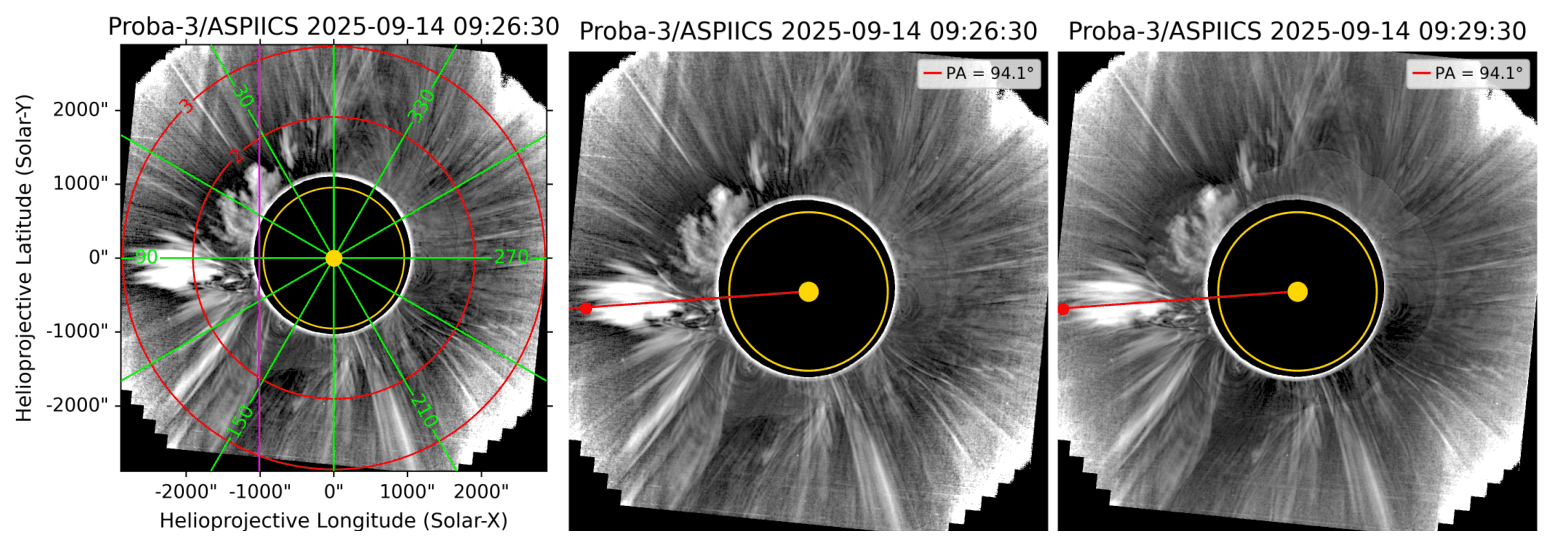
A joint analysis of India's Aditya-L1 and Europe's Proba-3 observations finds sharply different energy patterns in two solar eruptions. In one, heat remained a small part of the energy budget; in the other, thermal energy rose until it was comparable to the energy of motion, according to the study by Anjali Agarwal and colleagues.
The observations were recorded on September 14 and 16, 2025, and the authors posted their preprint on September 6, 2026. ISRO highlighted the work on October 15, followed by a Nature India research highlight on October 20. That current coverage revisits the earlier analysis. ISRO identifies researchers at the Indian Institute of Astrophysics in Bengaluru as the study's leaders and reports its publication in Astronomy & Astrophysics.
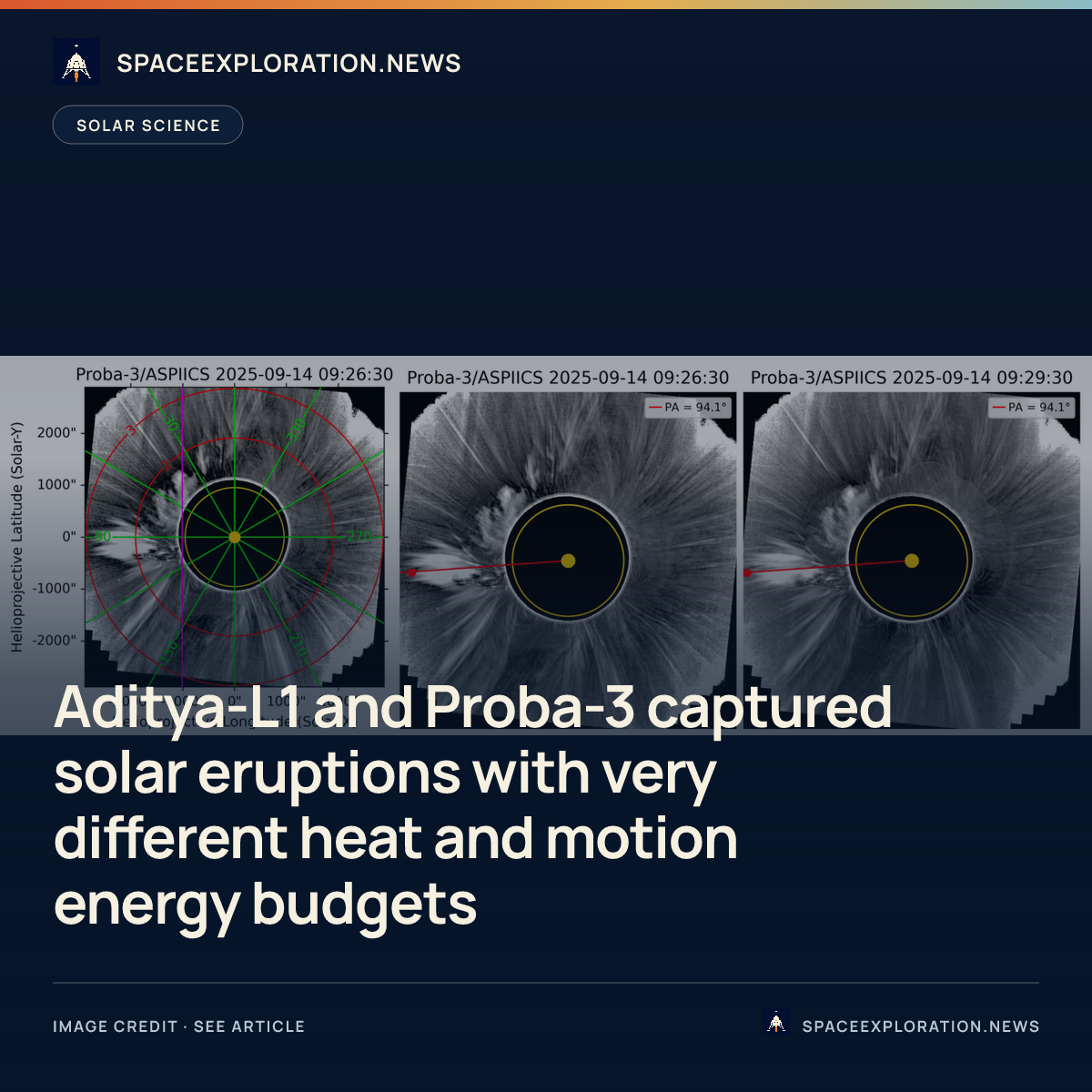
The researchers examined coronal mass ejections, or CMEs: eruptions of magnetised plasma from the Sun. Their search through July–December 2025 observations found only these two events recorded simultaneously by the missions' coronagraphs, instruments that suppress the Sun's bright face to observe its surrounding atmosphere.
Aditya-L1's Visible Emission Line Coronagraph, or VELC, supplied spectra from the hot gas. Proba-3's ASPIICS coronagraph supplied images that the team used to estimate the eruptions' shape, movement and mass. The overlapping views allowed the researchers to compare independently derived estimates despite different observing methods and assumptions, ISRO explained.
The authors' preprint finds that thermal energy in the September 14 eruption was nearly two orders of magnitude below its kinetic and magnetic energies. The September 16 event showed stronger heating, with thermal energy eventually approaching kinetic energy. For both eruptions, the estimated magnetic energy was comparable to or greater than kinetic energy over the observed heights.
The authors estimate magnetic energies from the observed eruption properties using physically motivated assumptions. Their evidence consists of two events, with coordinated imaging and spectroscopy providing constraints on early eruption evolution close to the Sun.
Reporting trail
Primary sources
Anjali Agarwal et al. / arXivCoordinated Coronagraphic Observations from Proba-3 and Aditya-L1: Investigating CME Energetics in the Inner Coronaarxiv.org
ISROFirst Joint View by Coronagraphs on India's Aditya-L1 and Europe's Proba-3 Decodes Solar Eruptions Near Their Birthplaceisro.gov.in
Nature IndiaSpace probes decode solar eruptions near their originsnature.com
For an image post, download the card and copy this suggested caption.
The analysis uses September 2025 observations and first appeared as a preprint on September 6, 2026. October reports have brought renewed attention to its comparison of heat, motion and magnetic energy. Read the full report: https://www.spaceexploration.in/news/aditya-proba-joint-cme-energetics #SpaceExplorationNews #SpaceNews #SpaceScience