Science
AT2024wpp points to a black hole shredding a massive star—not a confirmed survivor
Whippet’s fast rise, extreme energy and X-ray-driven wind favour black-hole accretion; its late hydrogen and helium lines leave several possible structures, not proof that the disrupted star survived.
Add us as a preferred source on Google Add us as a preferred source on Google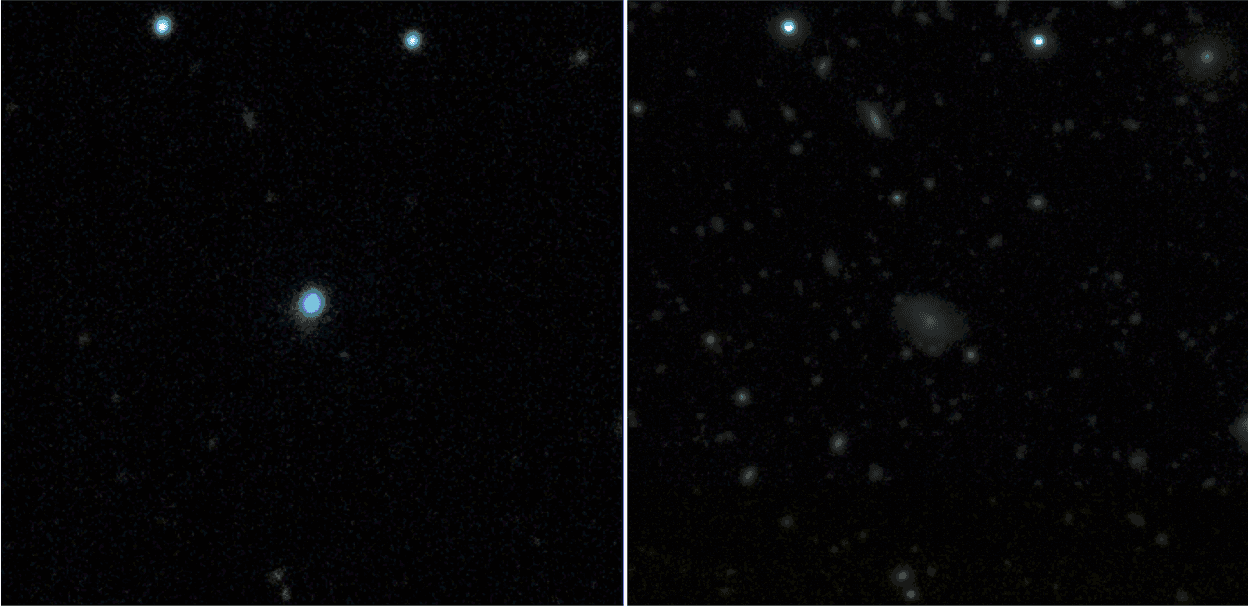
AT2024wpp, the luminous fast blue optical transient nicknamed Whippet, provides strong evidence that a black hole powered one of the brightest events of its class, but it does not show that a star or stellar core survived. The team behind the main observational study favours a merger in which a black hole accreted a massive companion. A late hydrogen-and-helium signal could instead trace separated streams of tidal debris or gas stripped from a different companion. Those are competing readings of the same spectra, not direct detections of a survivor.
An August 15 ScienceDaily report, sourced to Liverpool John Moores University, brought the survival language into the current news cycle. The peer-reviewed paper beneath that report was published in Monthly Notices of the Royal Astronomical Society on April 10 and is more circumspect. It documents a transient first detected by the Zwicky Transient Facility on September 25, 2024, at redshift 0.0868. That makes Whippet the fourth-nearest event in the empirical class defined by AT2018cow, the 2018 transient that gave Cow-like explosions their shorthand.
Why black-hole accretion fits
Whippet brightened on an extraordinary timescale. The study measured a rise to peak bolometric luminosity in less than two days, a peak near 2 × 10^45 ergs per second and total radiated energy near 10^51 ergs. It remained more luminous than any normal supernova for at least 30 days. The authors calculate that radioactive decay would require at least 300 solar masses of nickel-56 to reproduce the peak, an impossible match to the roughly 0.1 solar mass of fast ejecta inferred from the short diffusion time. A large and efficient central energy supply is therefore required.
The multiwavelength observations supply a working mechanism. Whippet was luminous in X-rays during its first week, while the optical photosphere expanded at about 20 per cent of the speed of light and reached roughly 1.5 × 10^15 centimetres before contracting. The team models a rapidly accreting central engine that drives a wind at about 0.2c and irradiates that outflow with X-rays. Strong ionisation and Doppler broadening would erase most recognisable spectral features, explaining why the early optical and far-ultraviolet spectra were hot and nearly smooth even as the system radiated so much energy.
Radio and millimetre observations add evidence for dense material around the source. They trace an energetic shock moving through gas whose density fell approximately as the inverse cube of distance, before the radio behaviour changed after about 100 days. The event occurred off-centre in a low-mass, moderately metal-rich galaxy, and late spectra contained hydrogen and helium. Perley and colleagues argue that a massive-star–black-hole binary can combine those massive-star surroundings with tidal-disruption-like accretion more naturally than a single collapsing star can.
What the late spectral lines actually show
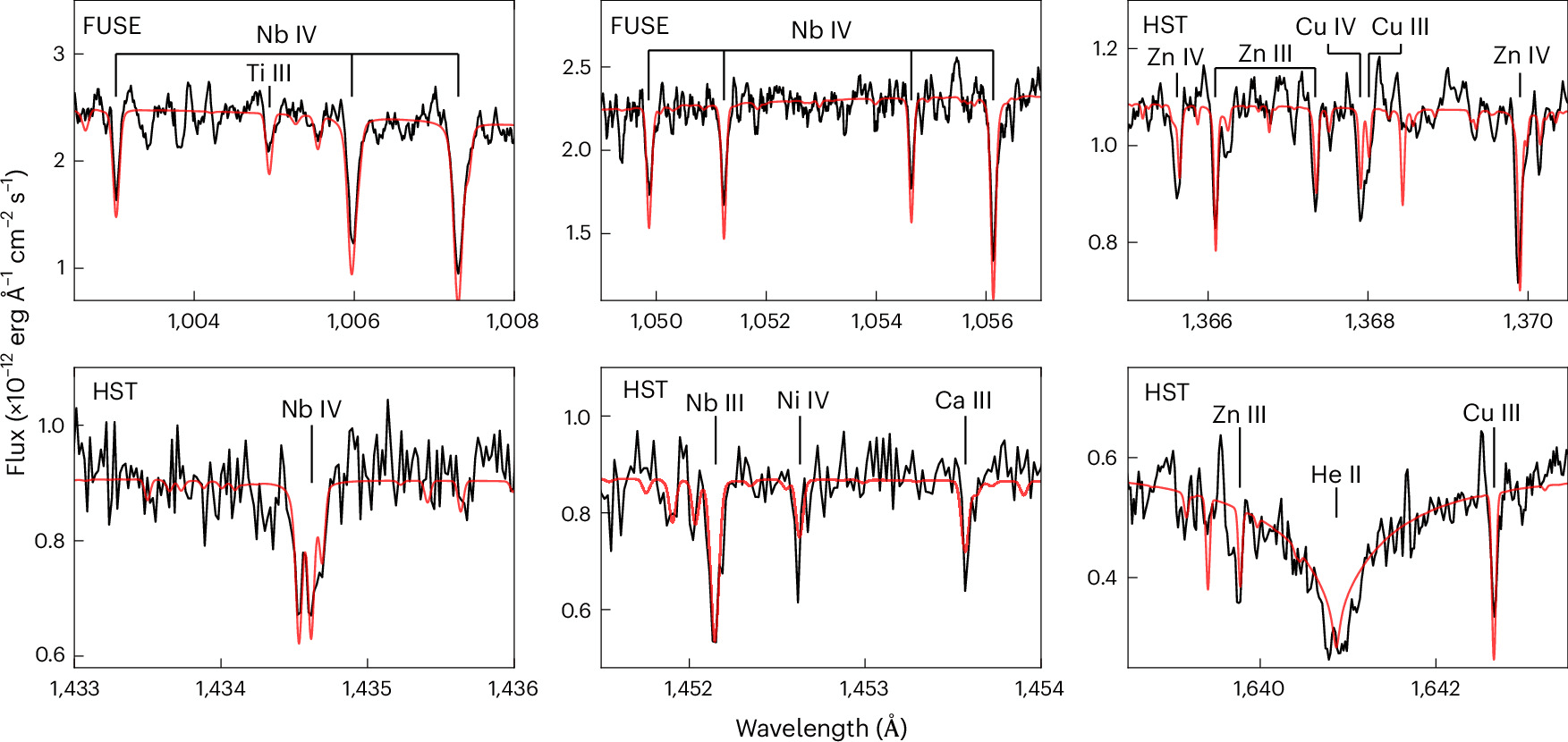
The unusual late signal appeared only after about 35 days. Hydrogen and helium emission formed two physically separated velocity components: each was roughly 2,000 to 3,000 kilometres per second wide, while the blueshifted component was displaced by about 6,600 kilometres per second. Their velocities and strengths remained comparatively stable for several weeks. The observation establishes compact or stream-like concentrations of gas moving in different directions; it does not identify what object, if any, remained intact.
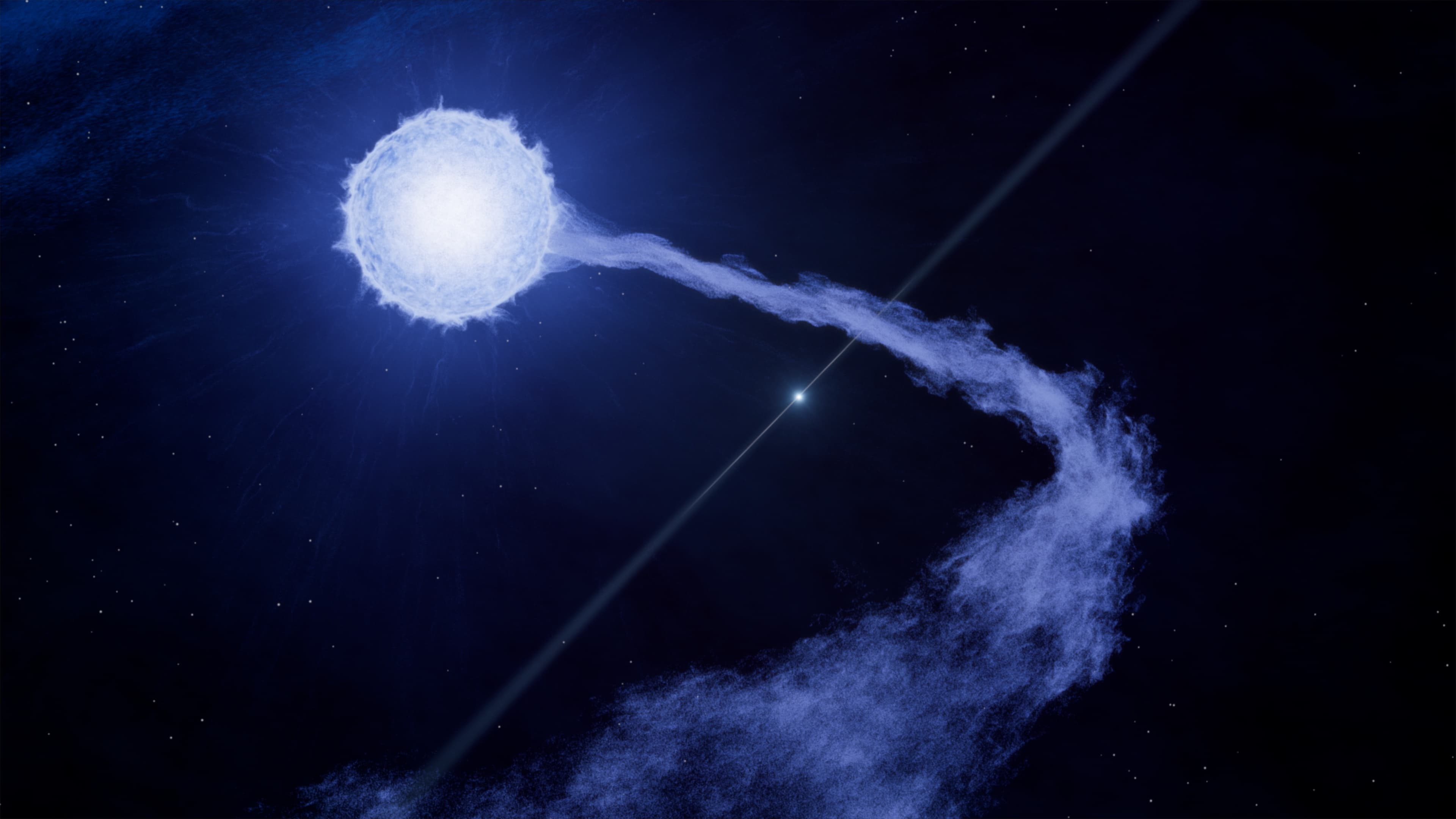
One explanation is tidal debris. In a classical disruption, some stellar material becomes unbound while the rest remains bound and can circulate towards the black hole, giving two structures with different motions. The paper notes a problem with that picture: material closer to the engine should be buried deeper in the wind, so it is unclear why both line components became visible at the same time. Two streams from repeated partial disruptions are another possibility, but Whippet’s smooth light curve gives no sign that multiple disruptions occurred.
The survivor is a separate and more speculative option. The authors consider whether X-rays and the fast wind were ablating a surviving binary or tertiary companion, producing the late emission. Such an object would have needed to orbit beyond 3 × 10^14 centimetres so that its lines were visible by day 30, making it incidental to the central progenitor system. The paper does not propose that the shredded massive star’s core was observed alive, and it calls for more late-time spectra and stronger modelling to distinguish these possibilities.
Why the exact disruption channel remains open
A second peer-reviewed MNRAS analysis, published June 10, tested supernova, magnetar, shock-cooling, black-hole–Wolf–Rayet merger and tidal-disruption models against Whippet’s optical, radio and X-ray light curves. None explained the full data set reasonably. Its authors found that some models can reproduce the optical light only by imposing a temperature floor above 20,000 kelvins, while separate afterglow or blast-wave fits cannot jointly account for the radio and X-rays. Their tidal-disruption fits also failed, although they did not rule out that family because emission from stellar-mass and intermediate-mass black holes is not well constrained.
That modelling study reaches a materially different progenitor preference. If Whippet was a tidal disruption event, it says current constraints favour a low-mass star disrupted by a stellar-mass or intermediate-mass black hole. It also leaves open a failed supernova with prompt black-hole formation and a reprocessing wind. The main observational paper judges a black hole more likely than a magnetar because the ejecta mass is so small, but it treats the massive-star merger as the best unifying scenario rather than a uniquely demonstrated history.
Future observations can separate the engine from the surviving-structure story. The modelling paper predicts that an accretion disc could remain detectable in X-rays for several years even when its late optical light is too faint, with different X-ray behaviour expected for failed-supernova and tidal-disruption discs. More Cow-like events with spectra taken after the first month can test whether Whippet’s split hydrogen and helium components recur. For now, the defensible conclusion is that accretion onto a black hole offers a coherent power source for Whippet; the identity of the disrupted star and the origin of the late-moving gas remain unsettled.
Reporting trail
Primary sources
Monthly Notices of the Royal Astronomical SocietyAT 2024wpp: an extremely luminous fast ultraviolet transient powered by accretion onto a black holedoi.org
Monthly Notices of the Royal Astronomical SocietyMultiwavelength modelling of the luminous fast blue optical transient AT2024wppdoi.org
ScienceDailyA black hole shredded a “super sun” — but something strange may have survivedsciencedaily.com
Liverpool John Moores UniversityColossal explosion as distant 'super sun' shredded by black holeljmu.ac.uk
ALMA ObservatoryRadio Telescopes Reveal “Invisible” Gas Around Record-Shattering Cosmic Explosionalmaobservatory.org
For an image post, download the card and copy this suggested caption.
Whippet’s fast rise, extreme energy and X-ray-driven wind favour black-hole accretion; its late hydrogen and helium lines leave several possible structures, not proof that the disrupted star survived. Read the full report: https://www.spaceexploration.in/news/at2024wpp-whippet-black-hole-star-disruption #SpaceExplorationNews #SpaceNews #SpaceScience