Science
JWST spectra point to three active black holes in J0148-4214
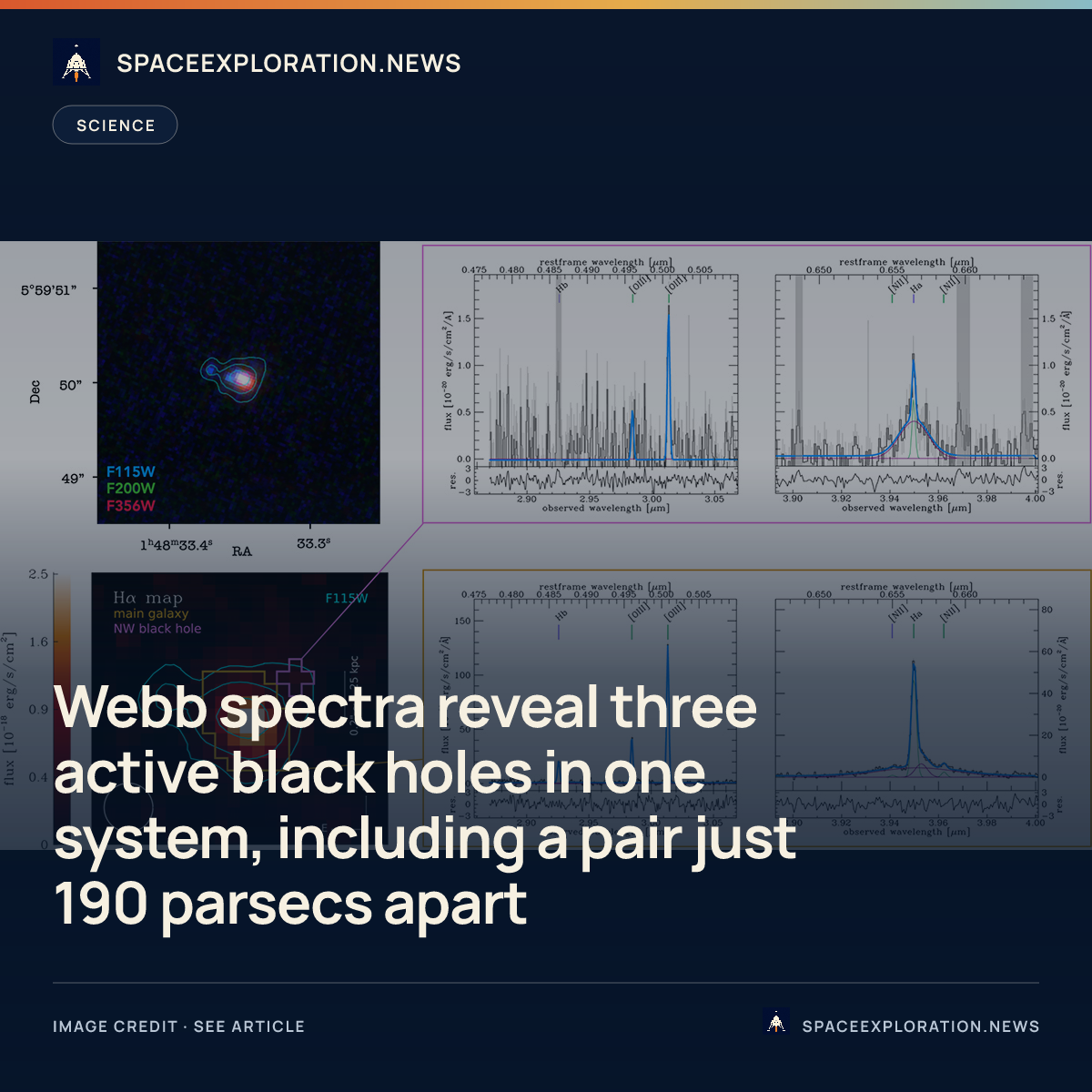
Two broad-line sources sit 190 ± 40 parsecs apart in projection, while a third is 1.7 kiloparsecs from the primary. The spectra do not show whether that outer object is falling inward or escaping.
Add us as a preferred source on Google Add us as a preferred source on Google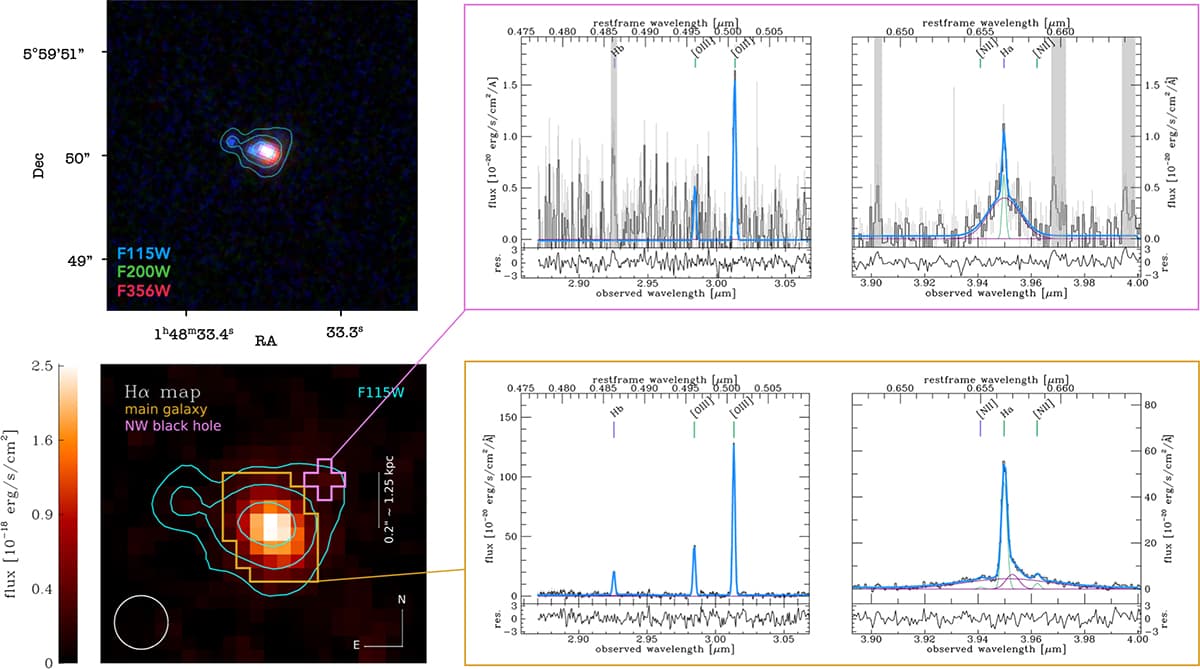
A peer-reviewed analysis of James Webb Space Telescope spectroscopy reports evidence that the early galaxy J0148-4214 hosts three massive black holes actively drawing in matter. Two broad-line sources lie near the galaxy's centre, about 190 ± 40 parsecs, or 620 light-years, apart in projection. A third appears in the north-western outskirts, about 1.7 kiloparsecs, or 5,500 light-years, from the primary. The paper was published online by Astronomy & Astrophysics on August 12.
The observations do not show three black-hole silhouettes. The team instead mapped broad emission from hydrogen-alpha, or Hα, produced by fast-moving gas in regions associated with active black holes. The three fitted broad components span full widths at half maximum of 430 to 2,920 kilometres per second, without equivalent broad components in the bright forbidden [O III] lines. The authors say that combination is most consistent with three broad-line regions around accreting black holes.
What NIRSpec separated
J0148-4214 was already known as a Type I active galactic nucleus from lower-resolution JWST/NIRCam grism data. On December 15, 2024, the BlackTHUNDER programme observed it with the integral-field unit on JWST's Near-Infrared Spectrograph, or NIRSpec. An integral-field data cube records a spectrum at each position across the target. Simultaneous fits to several emission lines placed the galaxy at redshift 5.01672 ± 0.00002, corresponding to a view about 1.2 billion years after the Big Bang.
In the central aperture, Hα has a broad, asymmetric profile that a single Gaussian does not fit well. The researchers made separate channel maps from wavelength ranges dominated by its broader and narrower components, removed contamination between them and fitted a centroid to each map. The two maps have different spatial distributions. Their centroids are offset by 190 ± 40 parsecs; a mock-recovery test returned a consistent separation of 200 parsecs, with an uncertainty range of minus 40 to plus 60 parsecs.
The third signature is less entangled with the central profile. A separate aperture about 0.27 arcseconds north-west of the main source contains broad Hα with a measured width of 1,060 ± 170 kilometres per second. It too lacks a broad [O III] counterpart. At the paper's adopted distance scale, that angular offset corresponds to a projected separation of about 1.7 kiloparsecs from the primary black hole.
The analysis tested alternatives rather than treating every broad feature as a black hole by default. A single asymmetric broad-line region, absorption, an outflow, supernovae, shocks and massive stars were considered. A two-region central model was preferred over the absorption model by a Bayesian information criterion difference of about 30, while the measured spatial shift between central components is far larger than the expected sub-parsec-to-parsec size of one broad-line region. The authors nevertheless describe the result as observational evidence and say the data are compatible with three accreting black holes, not as direct imaging of three objects.
Three unequal mass estimates
Using the widths and luminosities of the Hα components with a locally calibrated, single-epoch relation, the team estimated black-hole masses of log 7.9 ± 0.4, 5.8 ± 0.5 and 6.3 ± 0.5 in solar units. Those central values are about 80 million Suns for the primary, 630,000 for the smaller central object and 2 million for the outer object. The quoted errors are dominated by scatter in the local calibration, and the paper says applying such relations to high-redshift broad-line sources may add systematic uncertainty of roughly 0.5 to 1 dex.
The galaxy's stellar mass was estimated at log 9.1 ± 0.5 solar masses, or about 1.3 billion Suns. On the same modelling assumptions, the smaller central black hole has a central Eddington-ratio estimate above one, while the primary and outer black holes are below that level. The uncertainty on the smaller object's logarithmic ratio is ± 0.77, so the result does not provide a precise measure of how far above the Eddington limit it may be accreting.
A likely central merger, not an observed collision
The 190-parsec measurement is a distance projected on the sky, not the pair's full three-dimensional separation. The paper says the two central black holes would not yet be gravitationally bound on a circular orbit under its estimated conditions, though an eccentric orbit could change that conclusion. A simplified dynamical-friction calculation, which assumes an absolute separation of 0.3 kiloparsecs, gives the smaller central object an inspiral time of about 660 million years. Substituting the galaxy's estimated dynamical mass gives about 550 million years.
Those numbers are not a merger countdown. The calculation does not properly include the galaxy's dissipative gas, and the authors note that gas and dark matter could shorten the dynamical-friction phase. It also covers only the process that brings the black holes towards later stages of orbital hardening and gravitational-wave emission. The supported conclusion is that the central pair is likely to move towards a merger on the modelled conditions, not that JWST has observed an imminent collision.
The third black hole has a much less certain path. If it is sinking towards the centre, the same simplified calculation gives an inspiral time of about 5.9 billion years using stellar mass or 5 billion years using dynamical mass, before any acceleration caused by a three-body interaction. But the outer object could instead have been displaced from the centre by an earlier three-body encounter or by gravitational-wave recoil after a previous merger. It might escape, remain on a wider path or be re-accreted later. Its projected position and line-of-sight spectrum do not establish which direction it is travelling through three-dimensional space.
Why the spectral mapping matters
The Max Planck release described the result as the first evidence for three active black holes in one galaxy in the distant Universe. The paper uses more guarded language, calling it a possible high-redshift triplet and noting that similar complex broad-line profiles in other distant active galaxies could conceal pairs or multiples. What changed for J0148-4214 was spatial information: earlier integrated NIRCam spectroscopy was interpreted as one active black hole, while NIRSpec's channel maps separated the central profile and exposed the faint outer broad-line source.
The authors also modelled whether descendants of systems like J0148-4214 could produce mergers detectable by the planned Laser Interferometer Space Antenna, or LISA. Those calculations assume the black holes eventually merge and make simplifying choices about their later mass growth, spins and waveforms. They are forecasts for a class of possible descendants, not evidence that this particular trio is already producing a detectable merger signal.
Higher spatial and spectral resolution is the next test the paper identifies. It could refine the central geometry and the dynamics of the outer source, the missing information needed to distinguish infall from ejection. Until then, JWST has supplied spatially resolved spectral evidence for three active black holes and a likely future for the close central pair; whether the third joins them or leaves the galaxy remains open.
Reporting trail
Primary sources
Astronomy & AstrophysicsBlackTHUNDER: Evidence of three massive black holes in a z ∼ 5 galaxyaanda.org
arXivBlackTHUNDER: Evidence of three massive black holes in a z~5 galaxyarxiv.org
Max-Planck-GesellschaftThree black holes discovered in a young galaxympg.de
Space.comScientists find 3 supermassive black holes on the verge of collision inside a distant galaxyspace.com
For an image post, download the card and copy this suggested caption.
Two broad-line sources sit 190 ± 40 parsecs apart in projection, while a third is 1.7 kiloparsecs from the primary. The spectra do not show whether that outer object is falling inward or escaping. Read the full report: https://www.spaceexploration.in/news/jwst-three-active-black-holes-j0148-4214 #SpaceExplorationNews #SpaceNews #SpaceScience