Science
Radio study localizes auroral emission to Beta Pictoris b
The September 15 preprint infers a strong magnetic field from MeerKAT observations; the result has not been peer reviewed.
Add us as a preferred source on Google Add us as a preferred source on Google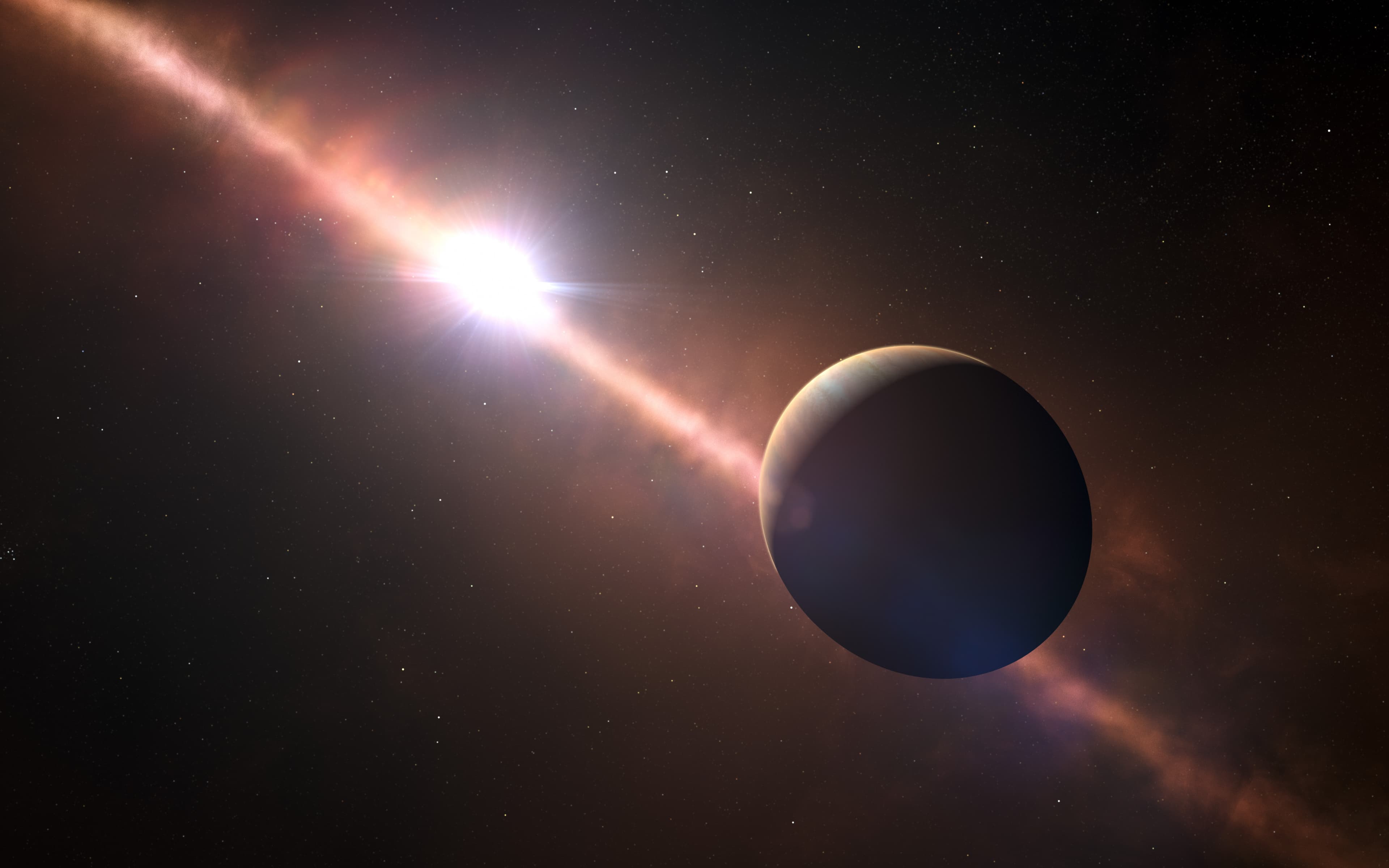
A preprint posted on 15 September 2026 locates recurring radio bursts at Beta Pictoris b, separating the giant planet’s emission from its host star. Kevin N. Ortiz Ceballos, Edo Berger and Yvette Cendes interpret the signal as auroral radiation. Their paper has not been peer reviewed.
Separate reports by ScienceAlert and BBC Sky at Night Magazine on 22 September brought renewed attention to the finding. The preprint analyses four MeerKAT observing sessions in 2025 and 2026.
Beta Pictoris b is about 10–12 times Jupiter’s mass and lies roughly 63 light-years from Earth, BBC Sky at Night Magazine explains. Its host star is magnetically quiet.
The researchers aligned the radio image with reference positions provided by quasars. Their calculation includes measured systematic errors and places the source at planet b, inconsistent with the star’s position at 4.4-sigma significance.
The authors detected rapidly changing, strongly polarized bursts reaching 3.5 gigahertz. They identify an electron cyclotron maser mechanism, in which accelerated electrons emit radio waves. That interpretation implies a magnetic field of at least 1,250 gauss at the emission site.
This is a lower bound for the radio-emitting region, rather than a map of the planet’s magnetic field. The paper proposes continued monitoring to investigate the field’s geometry.
Reporting trail
Primary sources
Ortiz Ceballos, Berger and CendesarXiv · Discovery of radio emission from the exoplanet β Pictoris barxiv.org
ScienceAlertAstronomers Detect Radio Signals Coming Directly From an Exoplanet For The First Timesciencealert.com
BBC Sky at Night MagazineRadio signals detected from a planet beyond our Solar Systemskyatnightmagazine.com
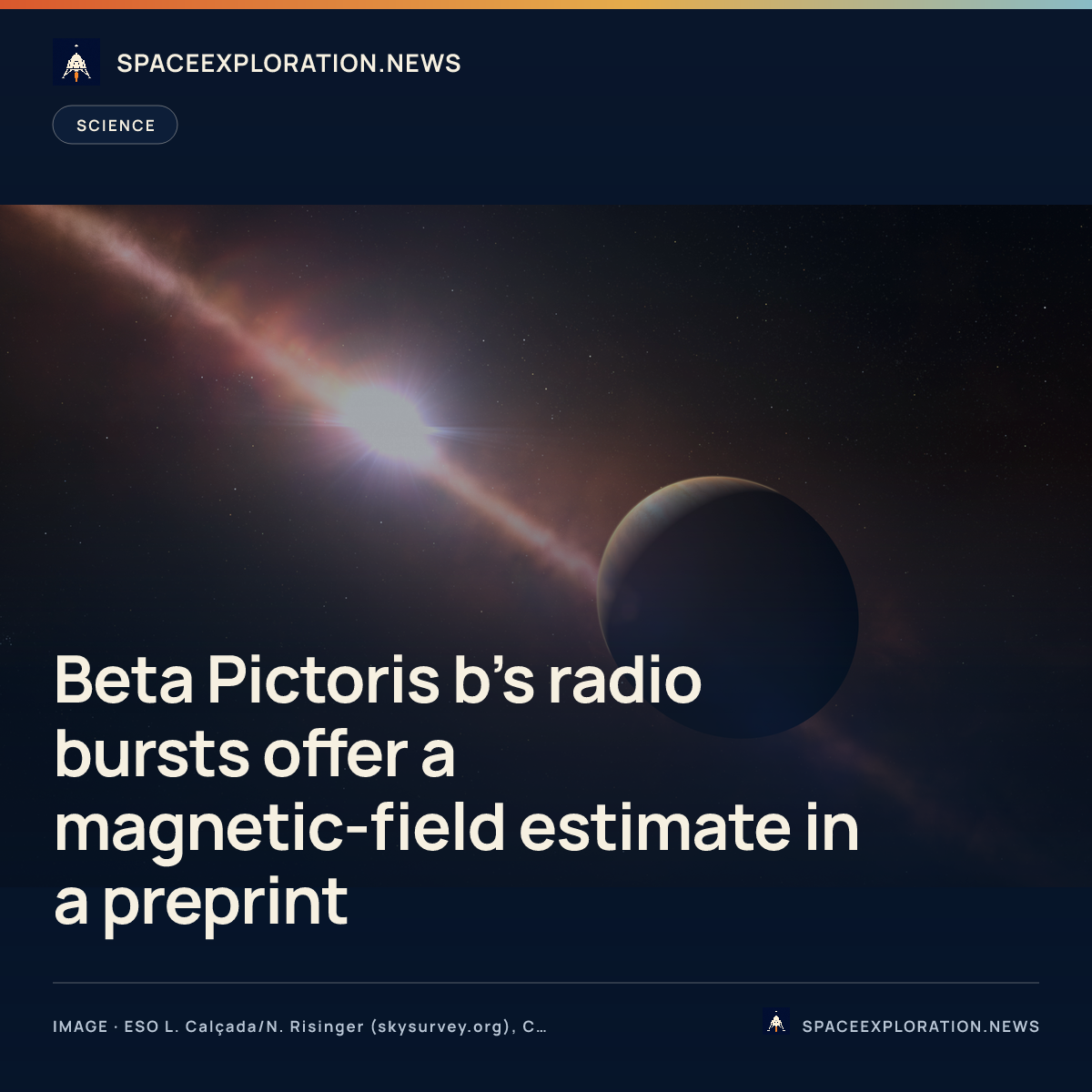
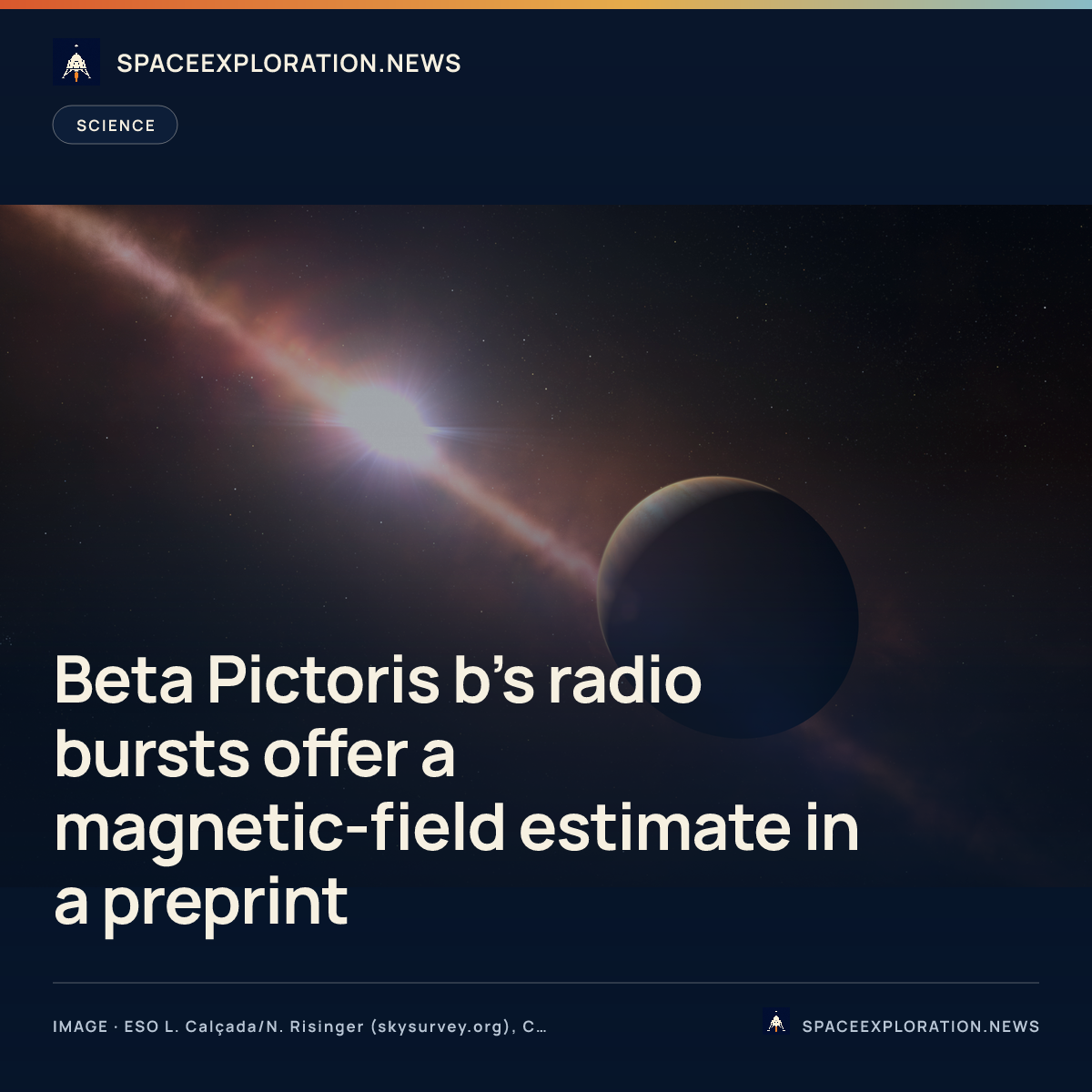
ESO L. Calçada/N. Risinger (skysurvey.org)Artist’s impression of the planet Beta Pictoris b · CC BY 4.0eso.org
For an image post, download the card and copy this suggested caption.
The September 15 preprint infers a strong magnetic field from MeerKAT observations; the result has not been peer reviewed. Read the full report: https://www.spaceexploration.in/news/beta-pictoris-radio-localization #SpaceExplorationNews #SpaceNews #SpaceScience