Science
WISPIT 2b gas map links young planet to disk swirl
The September 24 study connects a directly imaged, growing planet with nearby gas motion for the first time; the precise causes of the emission still need sharper data.
Add us as a preferred source on Google Add us as a preferred source on Google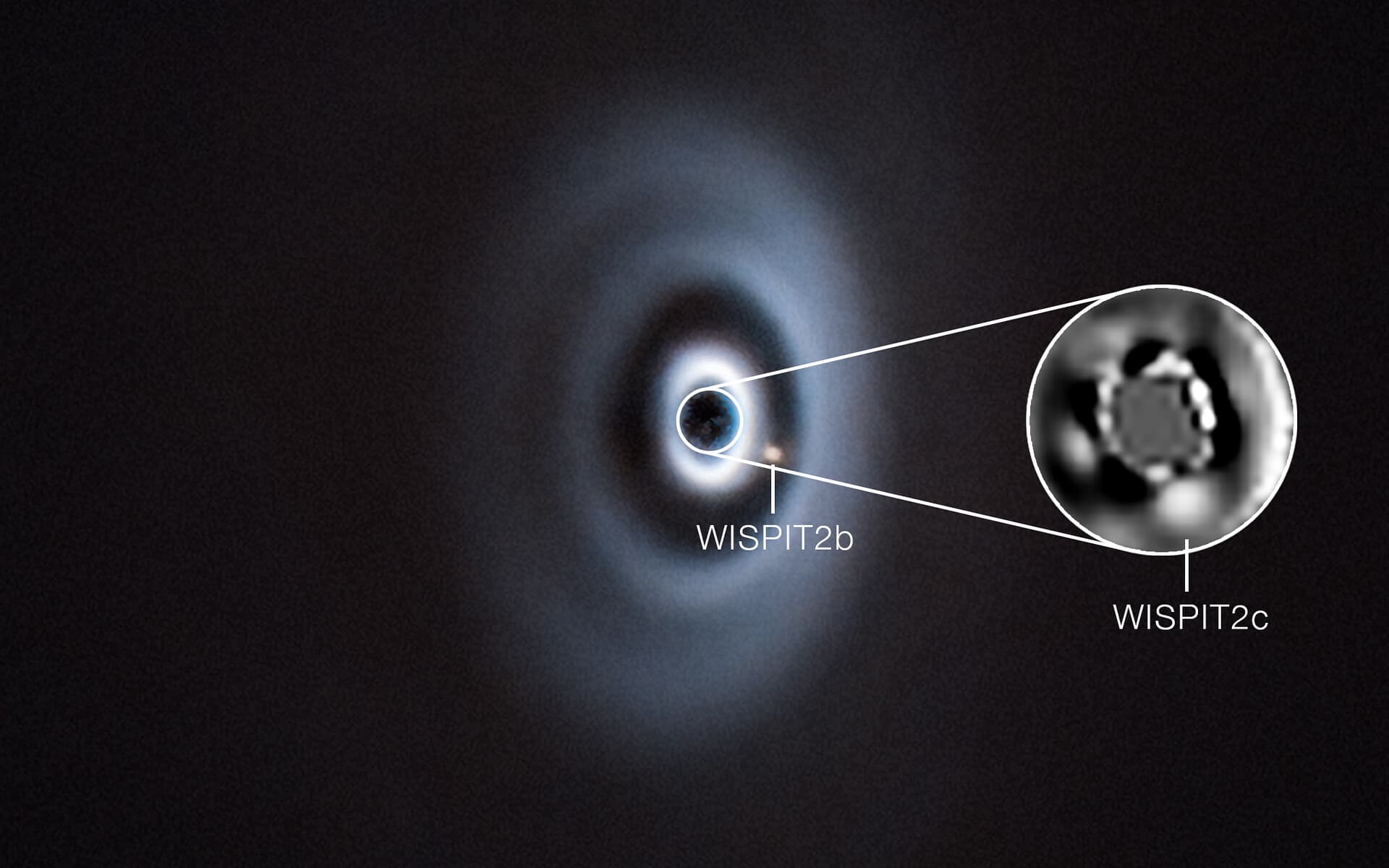
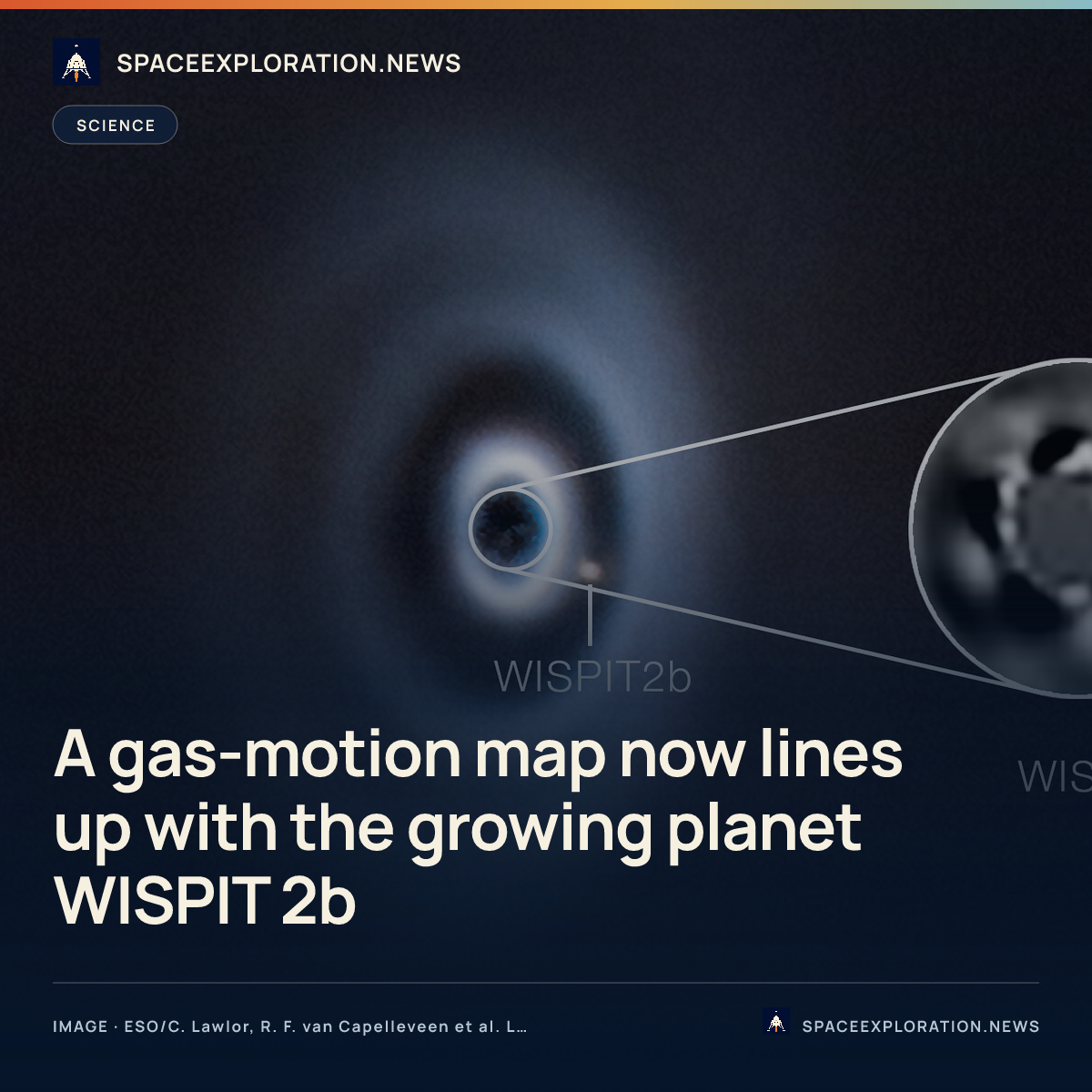
On September 24, a research team led by Myriam Benisty of the Max Planck Institute for Astronomy presented a new view of WISPIT 2b: a previously imaged young planet aligned with a disturbance in the motion of gas around it. The paper calls this the first confirmed gas-motion signature linked to a directly imaged planet.
The finding has drawn fresh coverage since its release. Space.com published a report on September 30, followed by Universe Today on October 1. Those reports revisit the September result; they do not mark a new discovery of WISPIT 2b, which was announced in 2025.
The team used the Atacama Large Millimeter/submillimeter Array in Chile to map carbon monoxide emission in the planet-forming disk. Near WISPIT 2b, gas moving toward Earth appears on one side of the planet's position and gas moving away on the other. The researchers identify a distinctive feature in the velocity maps that matches predictions for a planet disturbing its disk.
The same observations show a gas gap at WISPIT 2b's orbit and a cleared inner cavity around the second known planet, WISPIT 2c. Earlier optical and infrared observations had located WISPIT 2b, while hydrogen emission showed that it was still gathering material. The new gas map puts those separate pieces of evidence in the same system.
The paper does not isolate one cause for all the bright gas near WISPIT 2b. The authors propose a combination of planet-driven spiral wakes, local heating and a disk around the planet; they say higher spectral resolution is needed to separate those contributions. A velocity pattern at one confirmed planet also does not establish that every similar pattern elsewhere conceals a planet.
For the researchers, the paired planet image and gas map offer a test case for interpreting disturbances in other planet-forming disks. Whether the method can distinguish planets from other causes in those disks remains a question for further observations.
Reporting trail
Primary sources
arXivMapping the WISPIT2 Planet-Hosting Cavity at Sub-Hill-Radius scalesarxiv.org
Max Planck SocietyAstronomers produce the first complete picture of (gas) planet formation in actionmpg.de
Max Planck Institute for AstronomyWirbel um einen jungen Gasplaneten zeigt Planetenentstehung livempia.de
Space.comAstronomers have produced the clearest exoplanet 'ultrasound' to date and it's twins!space.com
Universe TodayFirst Direct Image of Protoplanet Swirling Surrounding Gasuniversetoday.com
ESOA Solar System in the making? Two planets spotted forming in disc around young stareso.org
For an image post, download the card and copy this suggested caption.
The September 24 study connects a directly imaged, growing planet with nearby gas motion for the first time; the precise causes of the emission still need sharper data. Read the full report: https://www.spaceexploration.in/news/wispit-2b-gas-interaction #SpaceExplorationNews #SpaceNews #SpaceScience