Science
GJ 523b packs 23.5 Earth masses into a proposed ‘mega-Earth’ class
A submitted TESS–NEID analysis places the young, dense planet between familiar size and composition categories; its gas-poor interior and likely polar orbit remain inferences awaiting further observations.
Add us as a preferred source on Google Add us as a preferred source on Google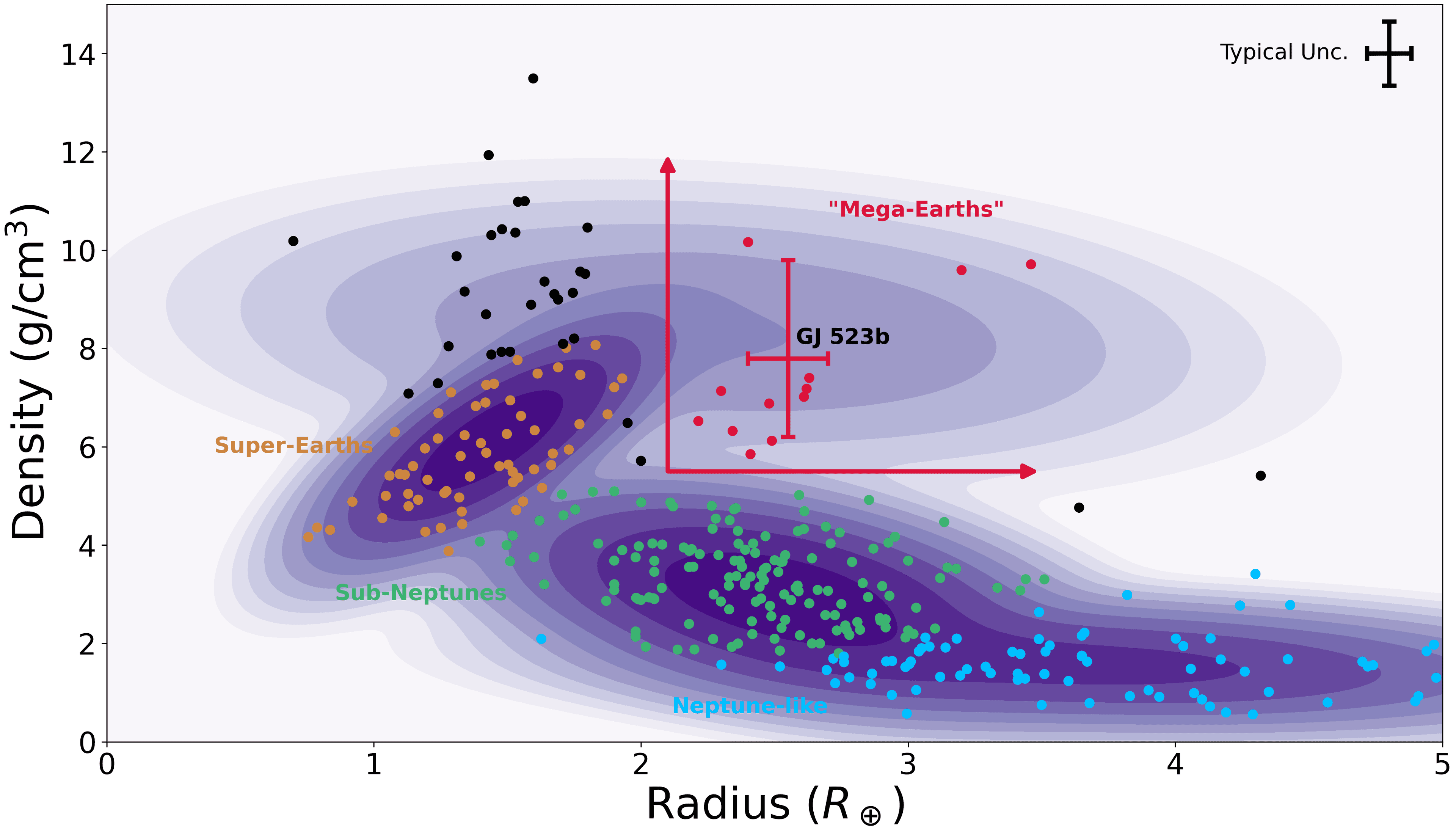
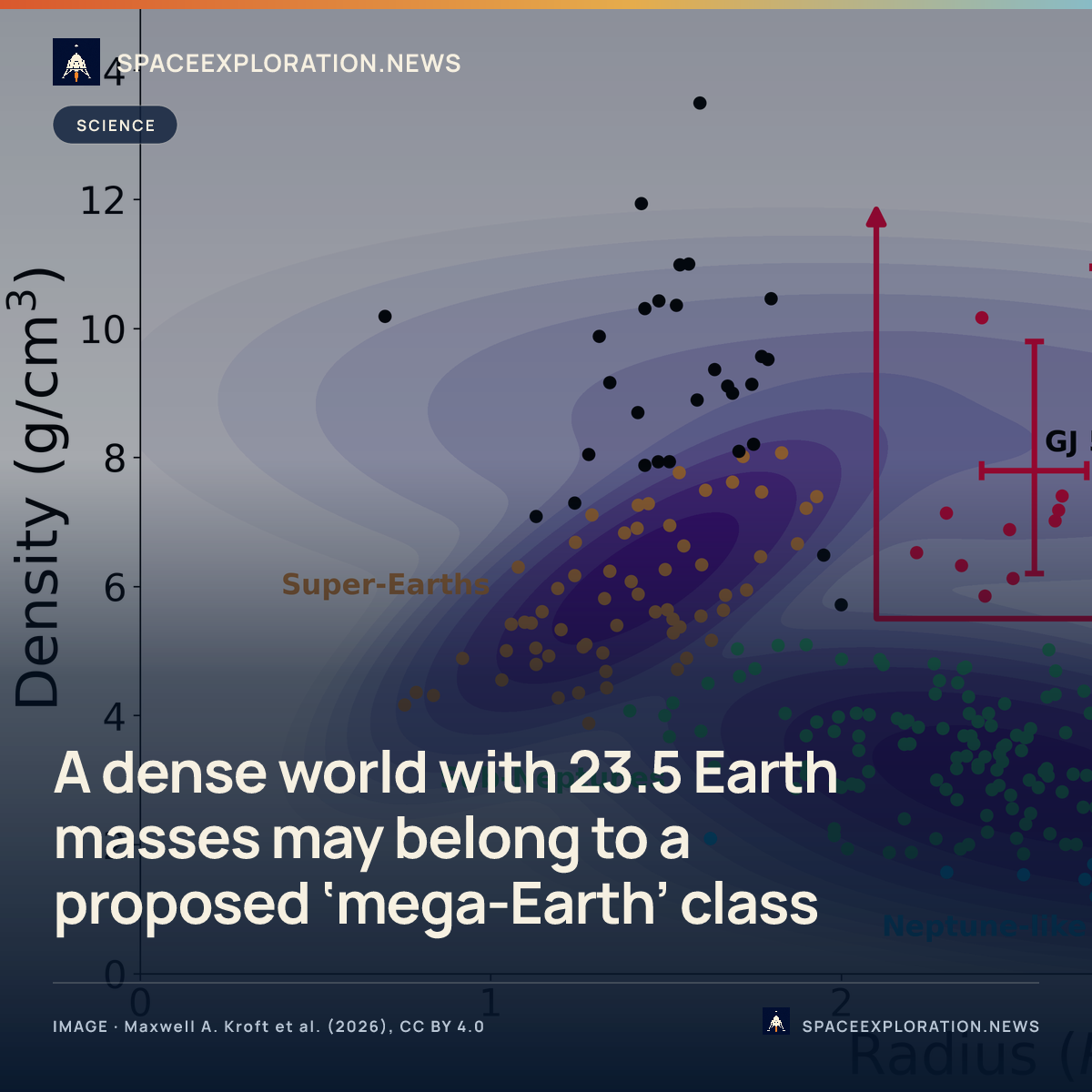
A planet with 23.5 ± 3.3 times Earth’s mass and only 2.55 ± 0.15 times its radius sits where familiar exoplanet labels begin to fail. In a manuscript submitted to The Astronomical Journal, Maxwell Kroft and colleagues report a bulk density of 7.8 grams per cubic centimetre for GJ 523b, with an uncertainty of −1.6/+2.0. That combination describes a sub-Neptune-sized body whose mass is concentrated like a solid-dominated world, leading the team to place it in a proposed observational class called mega-Earths.
An August 19 Space.com report returned GJ 523b to the news cycle, but the underlying result is not a newly published journal paper. The authors posted the first arXiv version on March 25, and a University of Wisconsin–Madison article on July 23 described the manuscript as under review. The preprint reports the confirmation and characterisation of a TESS planet candidate; its measurements can be assessed now, while the proposed class, interior model and formation history remain open to review and further data.
NASA’s Transiting Exoplanet Survey Satellite recorded three usable transits, one in each of sectors 50, 76 and 77. The team combined those brightness dips with 30 radial-velocity measurements taken by the NEID spectrograph on the WIYN 3.5-metre telescope between February 7 and July 10, 2025. Transit depth supplied the planet’s radius, while the star’s Doppler motion supplied its mass. The joint fit produced a 17.745740-day period, an orbital distance of 0.1226 astronomical units and an equilibrium temperature of 538 ± 13 kelvins, assuming zero reflectivity.
The two primary accounts conflict over the observing set. The Wisconsin article says James Webb Space Telescope data helped determine the planet’s density and atmosphere, but the manuscript lists no JWST observations in its data or fitting sections. It instead identifies a future JWST secondary-eclipse observation as a way to test for a substantial atmosphere. Because the submitted analysis supplies no JWST dataset, this article follows its methods and treats TESS and NEID as the data behind the mass-radius result.
A world too large for its density
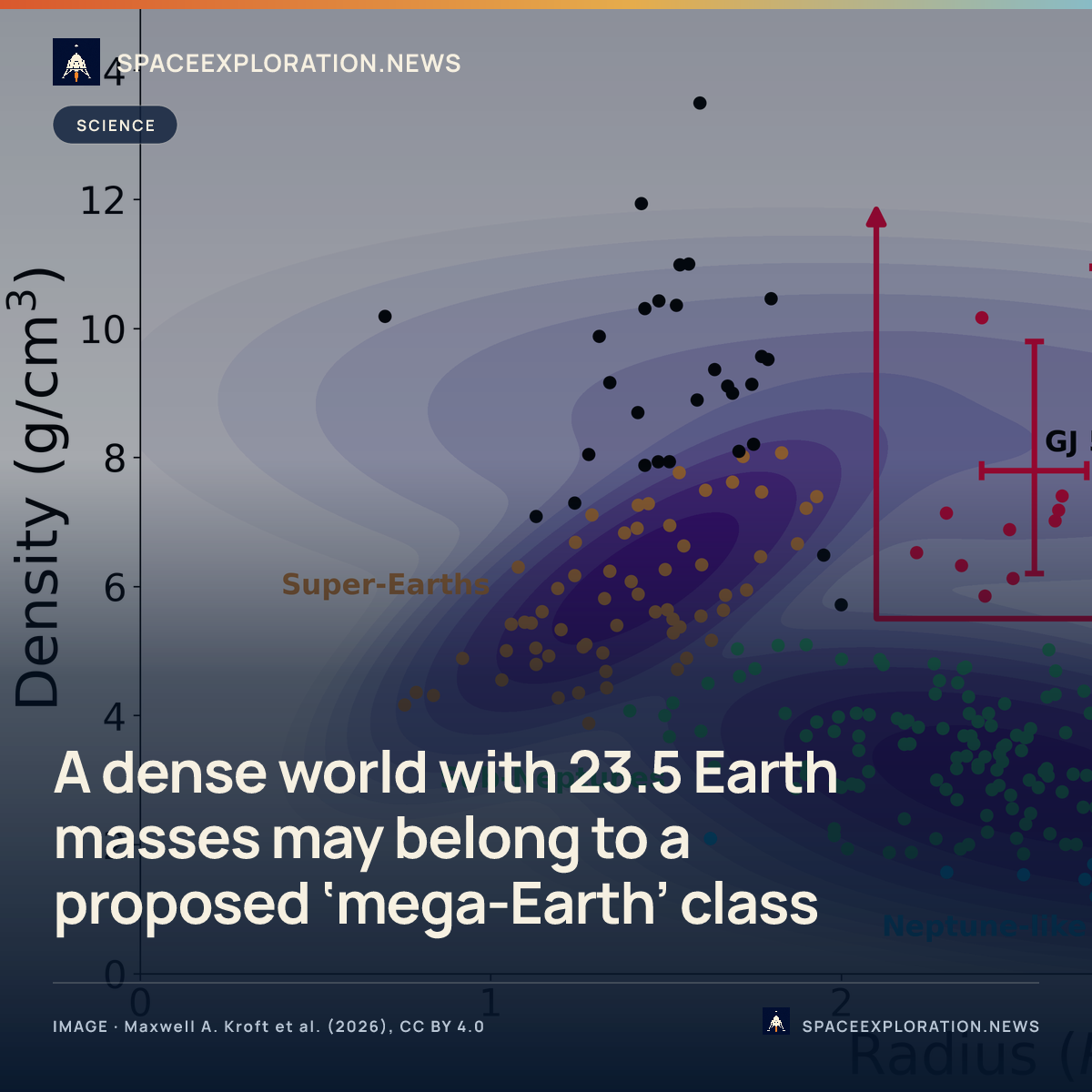
The usual shorthand divides small planets around the 1.5-to-2.0-Earth-radius gap. Super-Earths below it tend to be predominantly rocky, whereas larger sub-Neptunes generally carry lower-density volatile layers or hydrogen-helium envelopes. GJ 523b falls well above that radius gap but has a density higher than the 5.5-grams-per-cubic-centimetre boundary the authors choose for mega-Earths. Their proposed definition covers planets from 2.1 to 5 Earth radii that cross that density threshold. It is a measurement-based selection rule, not an official taxonomy or a claim that every selected planet formed the same way.
The paper’s population analysis supports the outlier label but also limits it. A mixture model applied to planets with mass and radius detections better than four sigma recovered the familiar super-Earth, sub-Neptune and Neptune-like regions plus a fourth high-density component. The authors explicitly say that fourth component should not be read as one physical population. Their table places GJ 523b beside 12 other precisely characterised mega-Earths whose ages, temperatures, periods, host stars and system architectures vary widely. What they share is a position in radius-density space, not yet a common origin story.
The rocky label also needs qualification. Interior models divided GJ 523b into an iron core, silicate mantle, water layer and hydrogen-helium atmosphere, then searched for compositions consistent with its measured mass and radius. The favoured solutions are rock- and water-rich with little gas, but the data do not reveal those layers directly. A no-water gas-dwarf solution remains mathematically possible, although the authors judge it less plausible, and their model does not include the young planet’s continuing thermal contraction. The defensible description is therefore gas-poor and solid-dominated, not a scaled-up copy of Earth.
A likely tilted orbit, not a measured pole
The orbital claim is another inference built from several measurements. The transits show the planet’s orbit nearly edge-on to Earth, at 89.03 ± 0.12 degrees. Separately, the star’s radius, 5.621-day rotation period and projected rotational velocity imply that GJ 523’s spin axis is tilted only 17.6 degrees from our line of sight, with a −4.7/+5.0-degree range. Even under the geometry that minimises the difference, the authors derive an orbital obliquity of at least 71.4 degrees. That makes a near-polar orbit likely, but the sky-projected spin-orbit angle has not been measured, so the full three-dimensional orientation is not known.
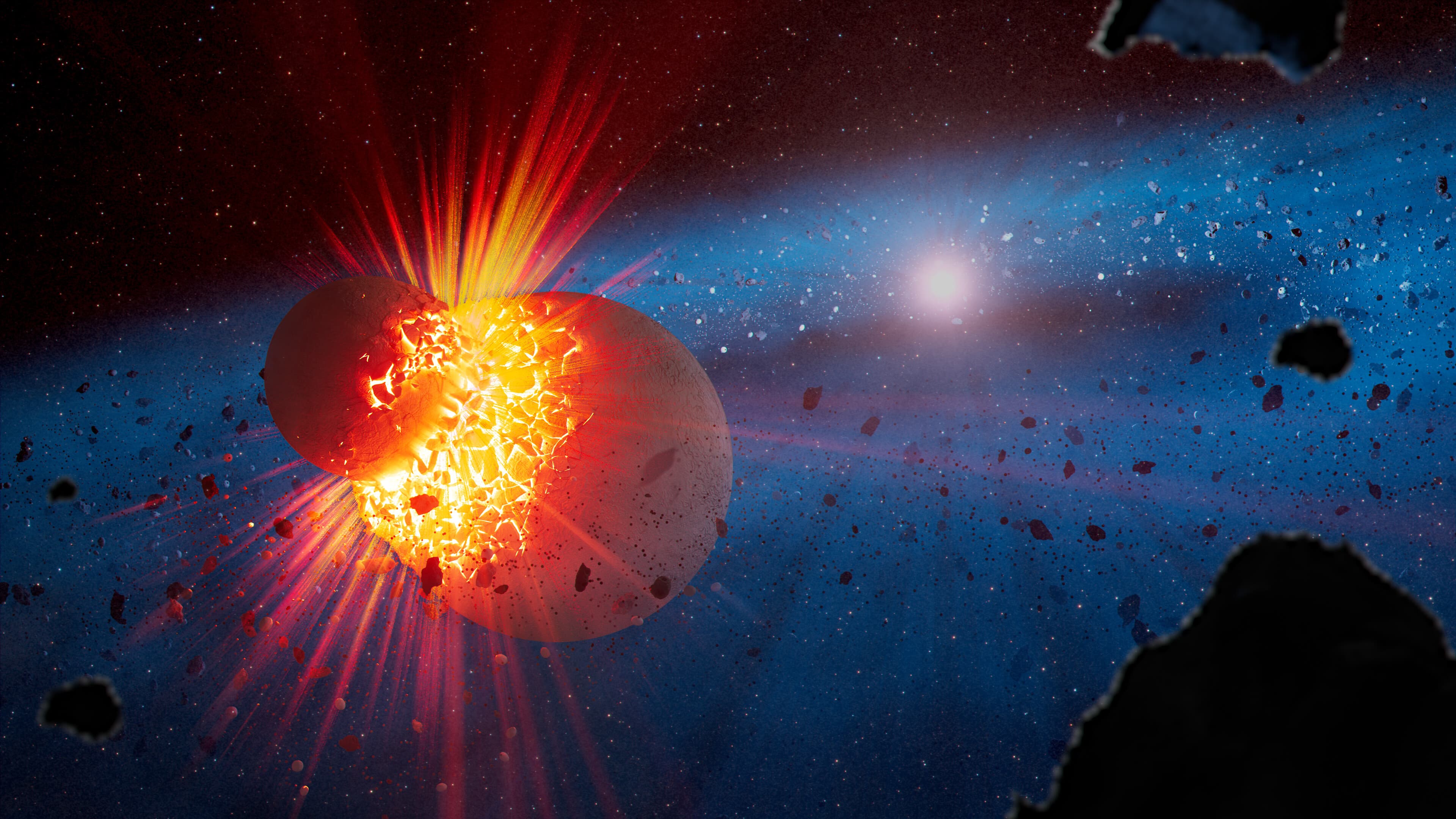
The team estimates the system’s age at 169 million years, with a −48/+100-million-year range, using the rotation of GJ 523 and four comoving stars. Youth, high density and large obliquity are difficult to produce together. High-eccentricity migration and tidal stripping could connect them, but that route would require a massive outer companion that current imaging and radial velocities have not found, and the paper’s tidal calculation struggles to reach the present low eccentricity in time. Alternatives include formation in a misaligned disc, later resonances with the disc, gas-poor pebble-and-planetesimal growth or giant impacts that enlarged the core and removed atmosphere. None is selected as definitive.
The observations that could settle the picture
The manuscript sets out three useful tests. Further high-precision radial velocities, together with future Gaia astrometry, could reveal an outer companion able to disturb the orbit. A Rossiter–McLaughlin measurement during transit could determine the sky-projected spin-orbit angle and tighten the obliquity. A secondary-eclipse observation with JWST could constrain how much atmosphere the planet retains. Those tests would address different parts of the story: orbital history, orientation and composition respectively.
For now, GJ 523b’s value lies in the mismatch that is already measured. Its radius places it among sub-Neptunes, while its density points away from a normal gas-rich sub-Neptune. The proposed mega-Earth label gives researchers a way to collect such mismatches without pretending they share one origin. Whether that class survives as a useful category—and whether this planet is truly polar and lacks a substantial hydrogen-helium envelope—depends on the follow-up observations the submitted study has identified.
Reporting trail
Primary sources
For an image post, download the card and copy this suggested caption.
A submitted TESS–NEID analysis places the young, dense planet between familiar size and composition categories; its gas-poor interior and likely polar orbit remain inferences awaiting further observations. Read the full report: https://www.spaceexploration.in/news/gj-523b-mega-earth #SpaceExplorationNews #SpaceNews #SpaceScience