Science
Euclid finds earliest quasar with a slowly feeding black hole
Dún Aonghasa appears just 630 million years after the Big Bang. Its estimated 360-million-solar-mass black hole is feeding slowly, leaving its earlier growth history unresolved.
Add us as a preferred source on Google Add us as a preferred source on Google
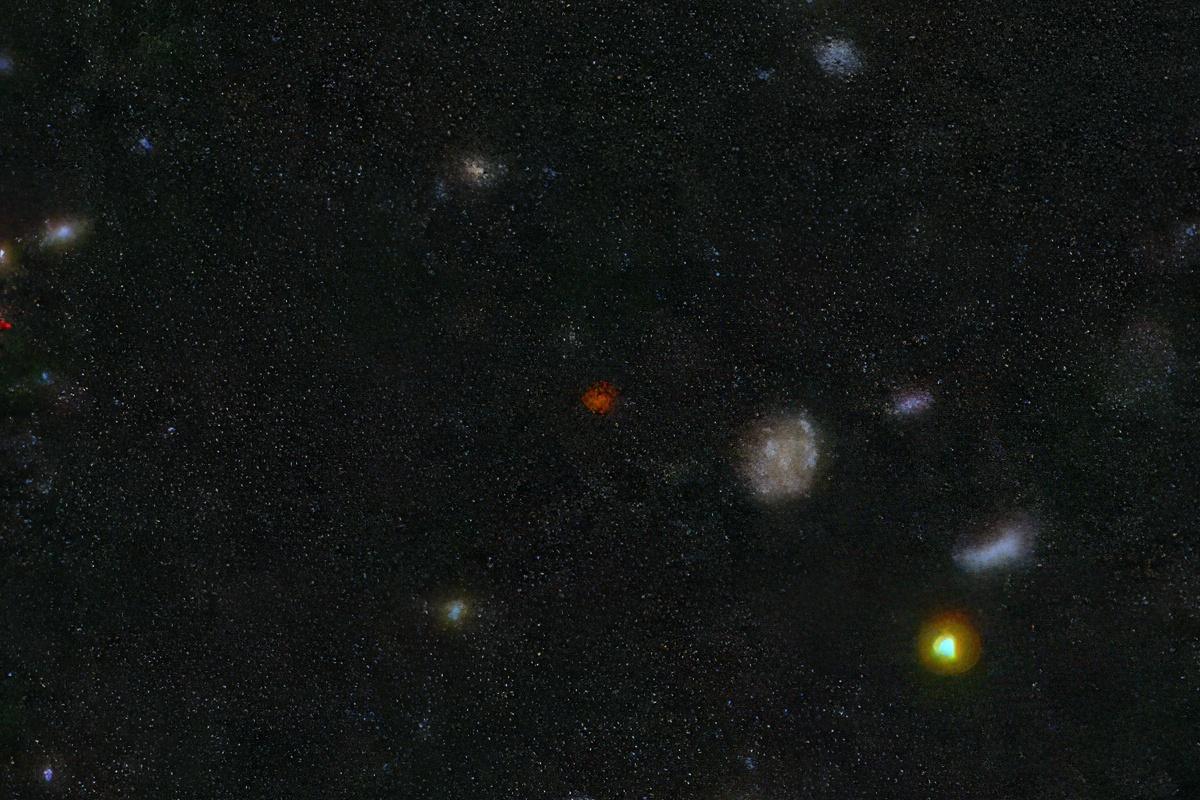
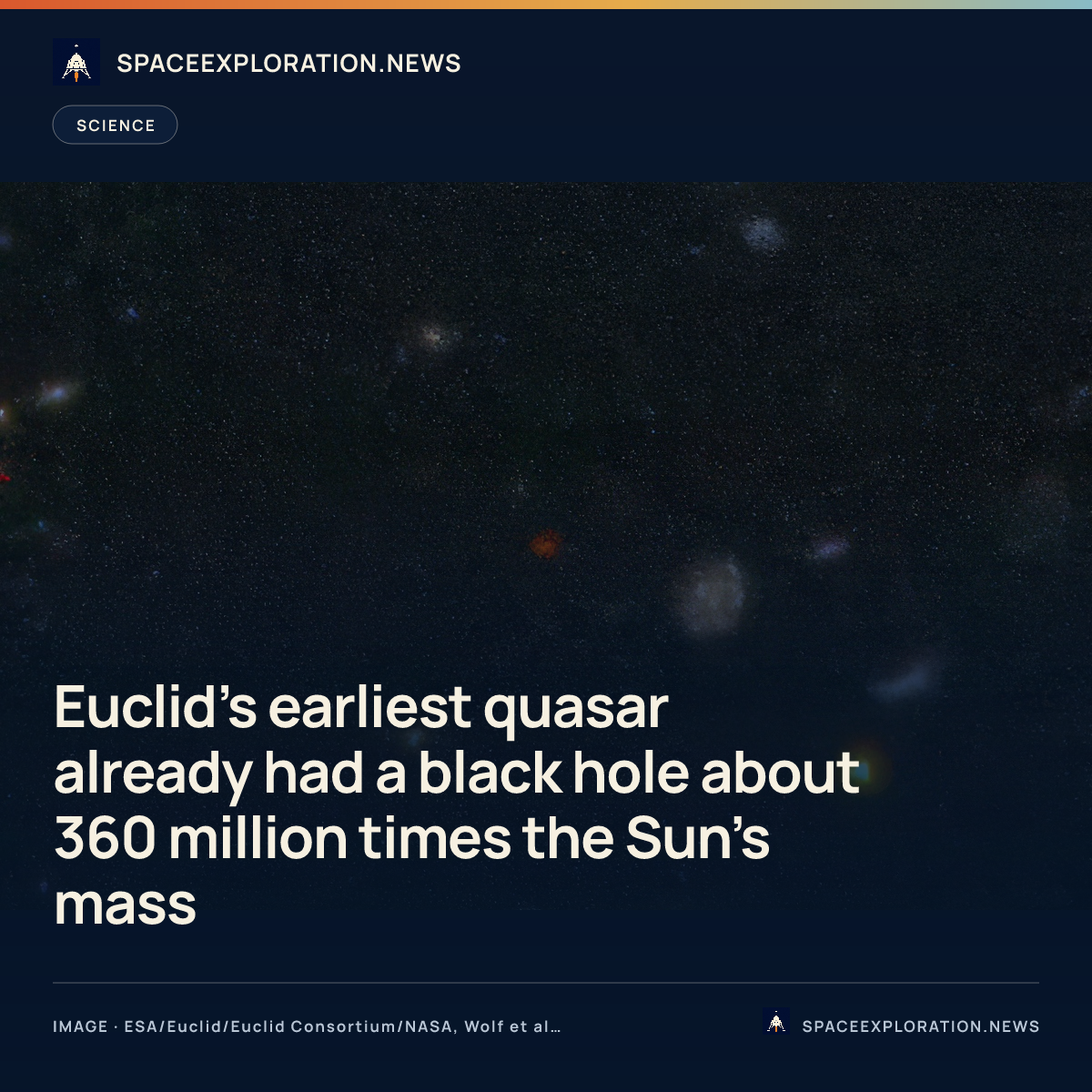
Euclid has identified the most distant known quasar, whose light comes from just 630 million years after the Big Bang, the European Space Agency announced on November 24, 2026. Follow-up observations with the James Webb Space Telescope indicate a black hole of roughly 360 million solar masses, already assembled when the Universe was about 5% of its present age.
The object, J1504+6252, is nicknamed Dún Aonghasa. The research team measured a redshift of 8.129 ± 0.005, making it the first confirmed quasar beyond redshift eight. It extends the quasar record about 40 million years further into cosmic history, according to the ESA announcement and the team’s manuscript.
Julien Wolf, who conducted the research at the Max Planck Institute for Astronomy and is now at the European Southern Observatory, led the team. The candidate emerged among millions of objects in about 18 months of Euclid observations. Observations with the Keck Observatory, Hubble, the Large Binocular Telescope and Webb established its nature and distance, the institute and ESA explained.
A quasar is a bright galactic nucleus powered by gas feeding a supermassive black hole. The hot gas releases light before falling in. Redshift measures how much cosmic expansion has stretched that light on its journey to Earth; higher redshift places this source at an earlier stage of the Universe’s history.
The mass is an estimate inferred from the widths of emission lines in Webb’s spectrum. In the author manuscript hosted by the Max Planck Institute for Astronomy, the researchers report substantial uncertainty in their reference mass and show that alternative calibrations change both the inferred mass and feeding rate. The 360-million-solar-mass figure is therefore approximate.
Across those calibrations, the team places the quasar’s luminosity at 12–44% of the Eddington limit, the reference level at which outward radiation pressure balances gravity. The researchers conclude that assembling such a large black hole so early requires a massive initial seed or much more efficient growth in its past.
The institute describes direct collapse as one scenario consistent with the growth calculations: a large gas cloud could form a black hole directly, giving it a more massive starting point. That interpretation does not establish how Dún Aonghasa actually formed. Its present slow feeding rate also does not measure the pace of its earlier growth.
The manuscript suggests that similarly massive black holes could power brighter quasars if they were feeding faster. Previously known quasars from this early era may therefore favour the rapidly feeding end of a wider population. Finding more objects with different feeding rates would test how representative those earlier discoveries are.
Reporting trail
Primary sources
European Space AgencyEuclid breaks own quasar record by 40 million yearsesa.int
Max Planck Institute for AstronomyNew Quasar Record Tightens Constraints on Black Hole Formation Scenariosmpia.de
J. Wolf et al. / Max Planck Institute for AstronomyEuclid: Discovery of Dún Aonghasa, a quasar at z = 8.13 hosting a 360-million-solar-mass black hole (author manuscript)mpia.de
For an image post, download the card and copy this suggested caption.
Dún Aonghasa appears just 630 million years after the Big Bang. Its estimated 360-million-solar-mass black hole is feeding slowly, leaving its earlier growth history unresolved. Read the full report: https://www.spaceexploration.in/news/euclid-dun-aonghasa-quasar #SpaceExplorationNews #SpaceNews #SpaceScience