Science
JWST and ALMA resolve two active nuclei 1.5 kpc apart in LID-1166
Separate Hα and [CII] velocity components support the dual-AGN identification at redshift 4.5. The manuscript is accepted by Nature Astronomy but remains an arXiv preprint, and its record claim is the authors'.
Add us as a preferred source on Google Add us as a preferred source on Google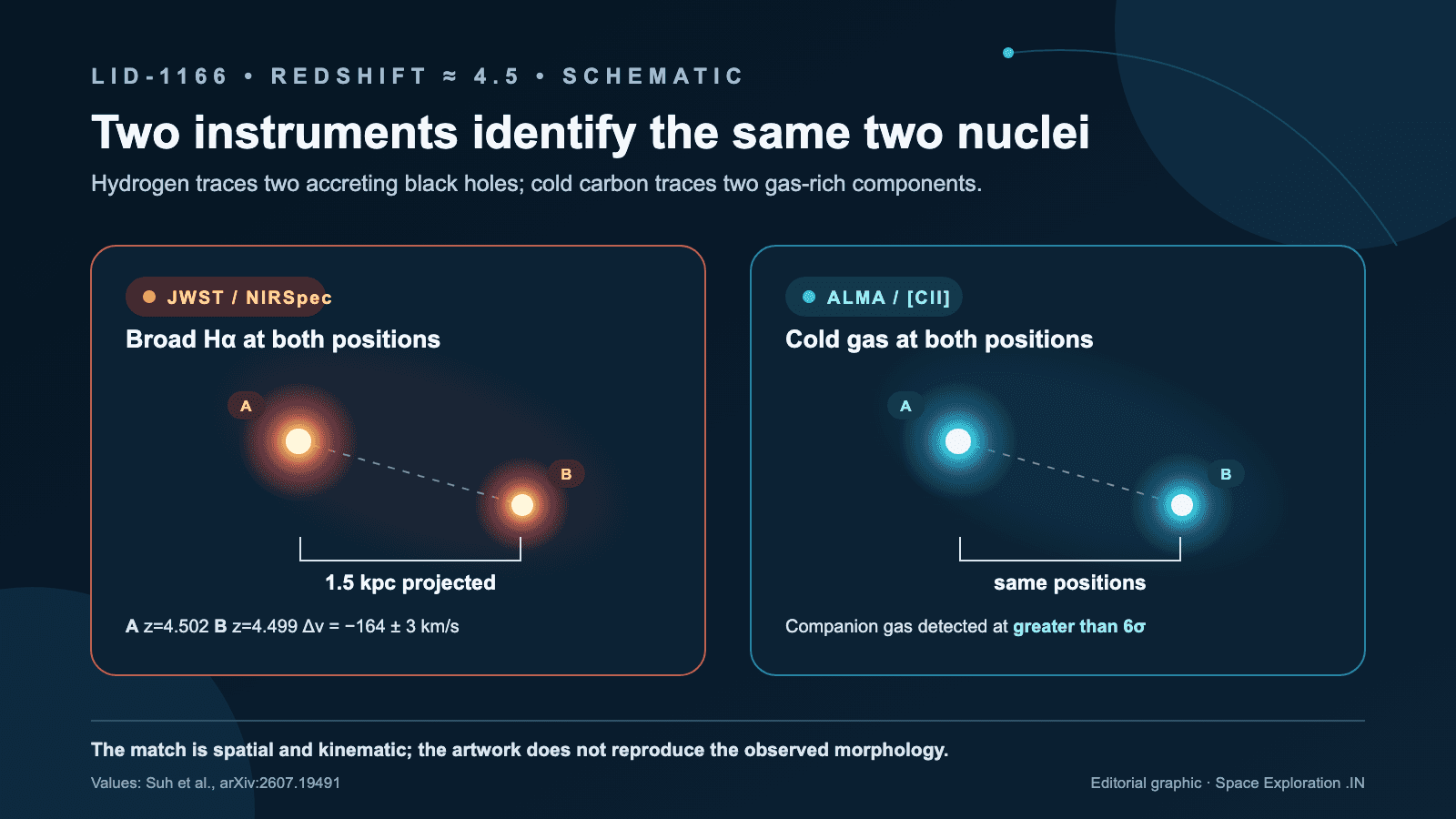
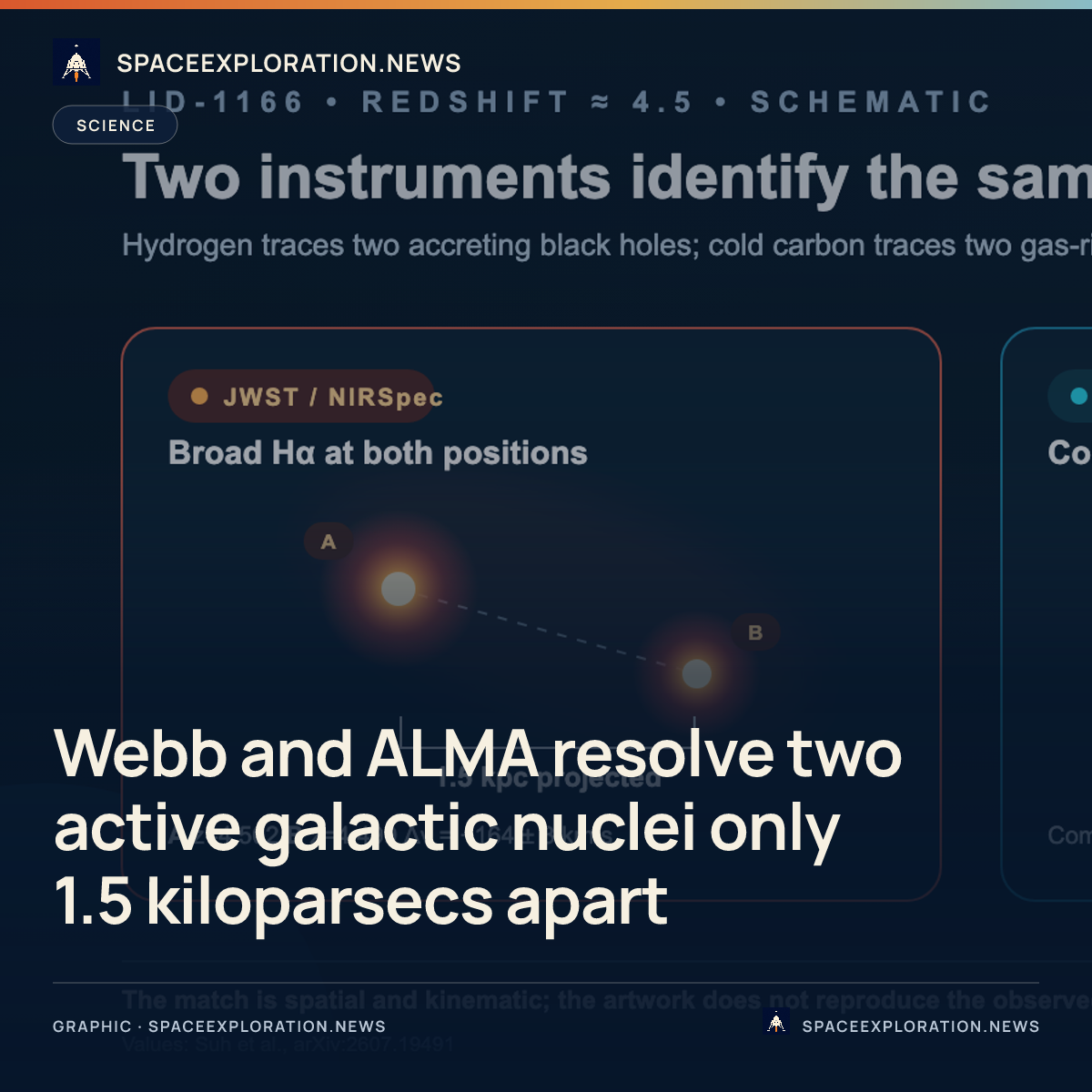
A manuscript highlighted in science coverage on August 13 reports two actively feeding supermassive black holes only about 1.5 kiloparsecs apart in LID-1166, a heavily obscured system seen at redshift about 4.5. The authors describe it as the first confirmed close-separation dual active galactic nucleus, or dual AGN, known beyond the local Universe. Their case does not rest on a double image alone: JWST separates two hydrogen-line sources, and ALMA independently finds cold-gas components at the same positions and velocities.
The wording needs two qualifications. The 1.5-kiloparsec figure is a separation projected on the sky, not a three-dimensional distance. And a dual AGN at this scale is not yet a gravitationally bound black-hole binary. It is a pair of accreting black holes carried by galactic nuclei in a late merger; the observations do not measure their orbit or establish when, or whether, the black holes themselves will coalesce.
Two Hα signatures in one NIRSpec field
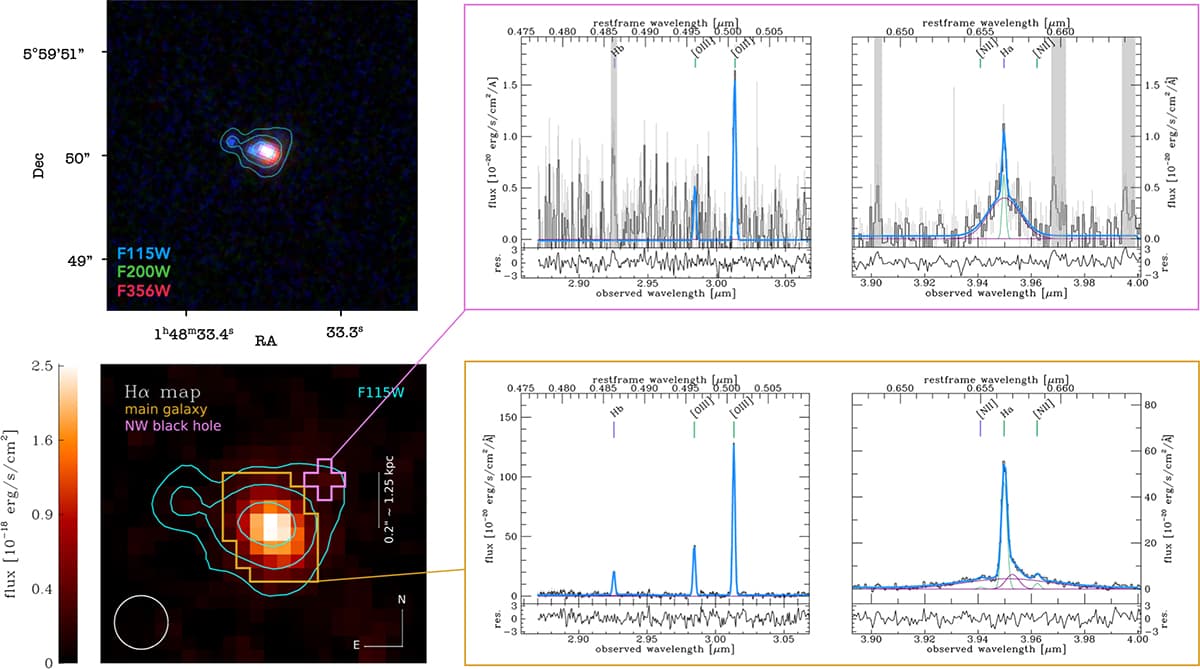
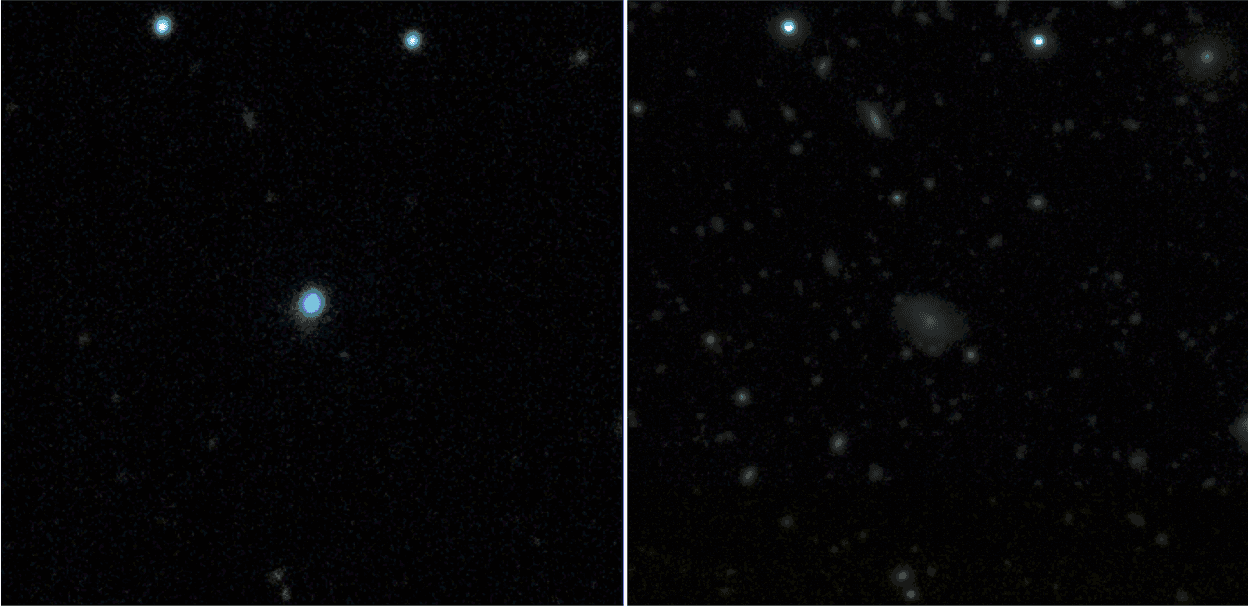
LID-1166 was first catalogued as an X-ray source in the Chandra COSMOS Legacy Survey, yet it remained absent from very deep Hubble optical and near-infrared images. JWST's NIRSpec integral-field unit changed the view by recording a spectrum at each position across a small field. In the wavelength region containing the Hα emission line, the team found a bright primary nucleus and, after modelling and subtracting its point-spread function, a second compact source 0.23 arcseconds away.
The researchers shifted the model centre, changed the aperture used to build the primary-source template and repeated the subtraction with an independently observed calibration-star point-spread function. The secondary peak remained at the same location and velocity. Narrow Hα put the primary at redshift 4.502 and the companion at 4.499, a line-of-sight difference of −164 ± 3 kilometres per second. Both locations also showed broad Hα, including a compact broad component away from the primary nucleus. Gas moving at those broad-line speeds is the paper's direct spectral evidence that both nuclei contain accreting black holes.
The spectra also argue against two magnified images of one background AGN. The two components have different systemic redshifts, broad-line profiles and narrow [NII]-to-Hα ratios. Gravitational lensing should reproduce the same underlying source spectrum in each image, apart from limited effects such as microlensing. The authors conclude that the measured differences cannot be explained by lensing or by source variability during a lensing time delay.
ALMA finds cold gas in both places
ALMA supplied a separate check using the 158-micrometre line from singly ionised carbon, written [CII]. At LID-1166's redshift, the line falls into ALMA's millimetre-wave range and traces gas in the interstellar medium through the dust that hides the system at shorter wavelengths. The integrated spectrum contains components centred at redshifts 4.5028 and 4.4989, consistent with the two Hα redshifts measured by JWST.
In ALMA channel maps around −203 kilometres per second, the offset [CII] emission peaks at the JWST companion position with greater than six-sigma significance. A spectrum extracted through a smaller aperture there isolates the lower-redshift component. This match in both position and velocity is important: it ties each active nucleus to its own gas-rich galactic component, supporting a merger rather than a subtraction artefact, a lensed duplicate or a black hole ejected without its surrounding gas.
The cold-gas result is not free of ambiguity. [CII] can also be present in an AGN-driven outflow. The authors judge that explanation less likely because the two components are relatively narrow and spatially coherent, but say some extended outflow contribution cannot be excluded. Nor do the data cleanly separate two stellar continua. The merger interpretation instead comes from the combined ionised-gas, broad-line and cold-gas evidence.
What the authors mean by ‘first confirmed’
The paper defines the close-separation class as dual AGNs less than three kiloparsecs apart. Its literature review says confirmed systems inside that boundary had previously been confined to the local Universe. Other dual-AGN candidates have been reported at higher redshift, including systems seen earlier in cosmic history, but they are either farther apart or have not met the same confirmation standard. LID-1166's two broad-line nuclei plus the matching ALMA gas components are why the team applies the stronger label here.
That remains a record claim made by the study authors, bounded by their distance threshold and survey of the literature. It is more precise than calling LID-1166 simply the oldest or closest black-hole pair. The manuscript was submitted to arXiv on July 21, and its listing says it has been accepted by Nature Astronomy, but a journal version of record was not available as of August 17. Results and wording can still change between this preprint and formal publication.
The growth rate is less secure than the pair
The paper estimates black-hole masses of about 69 million and 17 million Suns from the widths and luminosities of the broad Hα lines. Those single-epoch estimates carry an intrinsic systematic scatter of roughly 0.4 dex. Chandra cannot separate X-rays from objects only 0.23 arcseconds apart, so the authors model the combined emission. Their preferred heavy-obscuration model gives a system-wide Eddington ratio of 3.7, implying super-Eddington accretion, but simpler models that do not assume Compton-thick obscuration reduce the ratio to about 0.2–0.5.
The inferred gas reservoir also depends on a conversion from [CII] luminosity. The paper derives about 82 billion solar masses of molecular gas, then notes that [CII]-based estimates can exceed values from other tracers by factors of roughly three to five and that the conversion factor varies widely. These uncertainties affect how rapidly the system is judged to be growing. They do not erase the two independently located line-emitting components, which are the central observational result.
What follow-up still has to test
Anna Trindade Falcão, a NASA Goddard astrophysicist who was not involved in the work, told Live Science that the companion signal's survival under different subtraction methods is meaningful evidence. She also said a more detailed follow-up analysis should check that residual light from the primary has not been mistaken for a second black hole. Independent reanalysis or new spatially resolved spectra would test that concern; detecting two underlying stellar components would strengthen the merger picture further.
LID-1166 is therefore best treated as a strong, multi-instrument dual-AGN identification rather than a directly observed black-hole binary. JWST shows two distinct accretion signatures; ALMA shows two corresponding gas systems. If the identification holds through publication and follow-up, it demonstrates that sub-three-kiloparsec pairs can be found at early epochs even when dust hides their host galaxies from broad-band surveys. Establishing how common they are will require a systematic sample, not one object.
Reporting trail
Primary sources
For an image post, download the card and copy this suggested caption.
Separate Hα and [CII] velocity components support the dual-AGN identification at redshift 4.5. The manuscript is accepted by Nature Astronomy but remains an arXiv preprint, and its record claim is the authors'. Read the full report: https://www.spaceexploration.in/news/lid-1166-close-dual-agn-jwst-alma #SpaceExplorationNews #SpaceNews #SpaceScience