Science
JWST source MoM-BH*-1 fits a black hole star model—but alternatives remain
A Nature study links an extreme Balmer break to a dense, turbulent gas envelope around a black hole, but the mass estimate spans more than two orders of magnitude and another peer-reviewed model invokes one supermassive star.
Add us as a preferred source on Google Add us as a preferred source on Google
A peer-reviewed Nature study published August 12 presents the JWST source MoM-BH*-1 as evidence that at least some early-universe little red dots may contain an accreting black hole wrapped in extremely dense, turbulent, almost dust-free gas. The authors use black hole star as shorthand for that proposed configuration: the power source would be a black hole, while the gas envelope would process its light in a star-like way. JWST did not photograph a literal hybrid star, and the paper does not establish a new stellar class.
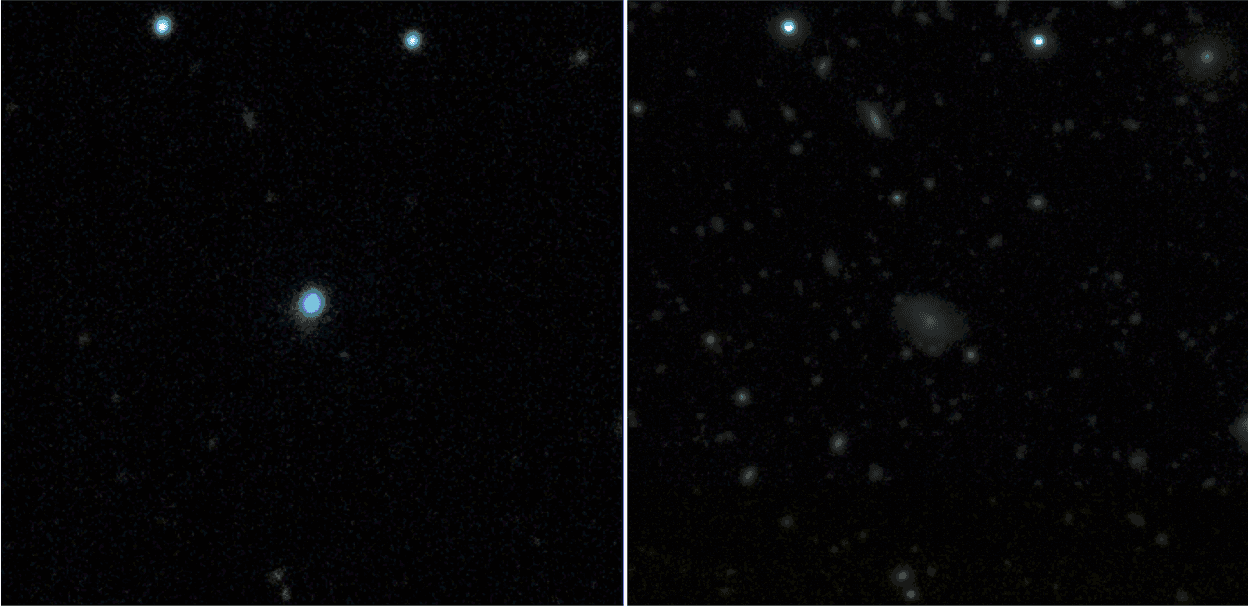
MoM-BH*-1 lies at spectroscopic redshift 7.7569, placing the observed light 660 million years after the Big Bang. It was imaged with JWST’s Near-Infrared Camera and Mid-Infrared Instrument in 2023, then observed spectroscopically with the Near-Infrared Spectrograph in December 2023 and December 2024. In a roughly 250-square-arcminute field it stood out as the reddest source: unresolved at wavelengths longer than 3 micrometres, detected in several redder bands and absent from the bluer images at the reported limits.
What JWST measured
The key measurement is an extreme Balmer break, a sharp change in brightness where hydrogen opacity alters the spectrum. Flux between the relevant JWST bands drops by more than a factor of 20; the paper measures a break strength of 7.7, with lower and upper uncertainties of 1.4 and 2.3. The authors compare that with a maximum near 3 for a normal dust-free stellar population and below 5 even for a population made only of A-type stars. The spectrum also contains broad, multi-peaked Hβ emission, deep Hβ and Hγ absorption, and a tentative narrow [O III] doublet that fixes the same redshift.
Several observations led the team toward a black-hole engine. The source is unresolved, with a 99% upper limit of 117 parsecs on its effective radius, and its Hβ emission has a full width at half maximum near 3,036 kilometres per second. The [O III] detection is only 3.5 sigma, while an apparent 30±7% brightening over about two rest-frame months was measured with different observing modes, a comparison the authors call less than ideal. Chandra detected no X-rays; the paper treats that non-detection as compatible with a thick gas envelope, not as direct proof of one.
How the envelope model works
To test the idea, the researchers passed a standard active-galactic-nucleus continuum through a grid of nearly one million Cloudy radiative-transfer models. Their fiducial fit places the accretion disc behind gas with a hydrogen density of 10^11 particles per cubic centimetre, a column density near 10^25.8 per square centimetre and a turbulent speed of 500 kilometres per second. Its schematic uses a 40-astronomical-unit column. Hydrogen opacity removes much of the ultraviolet light and creates the Balmer break and absorption, while repeated scattering can split and broaden the Balmer emission.
The fitted visual extinction is only 0.15 magnitude, far below the roughly 2–3 magnitudes used in some dusty models. That matters because the redness no longer requires a large dust correction: gas, rather than dust, suppresses the blue light. It also explains the star analogy. The envelope would act as an optically thick radiating surface with a blackbody-like continuum and Balmer absorption, but no nuclear fusion is implied and the object’s central engine remains a modelled accreting black hole.
The inferred black-hole mass changes dramatically with the assumptions. Applying local Hβ scaling relations together with about two magnitudes of dust extinction gives roughly 10^8.3 solar masses, or about 200 million. Removing that dust correction lowers the estimate to about 50 million. If scattering has inflated the observed line width and the intrinsic broad-line width is about 600 kilometres per second, the estimate falls to about one million solar masses; converting the model luminosity at near-Eddington output gives roughly two million. The authors call these order-of-magnitude brackets and say Balmer line-width masses could be overstated by as much as two orders of magnitude.
Why this could explain little red dots
Little red dots are compact, red sources with broad Balmer lines that JWST has found in the early universe. MoM-BH*-1 is useful to the Nature team because its putative black-hole light appears to overwhelm a faint host, offering a relatively clean template for the central component. A galaxy of about 10^9.5 solar masses lies at the same redshift roughly 60 proper kiloparsecs away. The authors expect the pair to merge in about 100 million years and show that adding their observed spectra produces the V-shaped spectral energy distribution used to identify typical little red dots.
In that composite model, the galaxy dominates the ultraviolet light and looks extended, while the gas-covered black hole dominates the rest-frame optical light and remains compact. A Compton-thick envelope can suppress X-rays, and low dust content avoids the strong far-infrared output expected from a heavily dust-reddened source. The exercise links several otherwise awkward properties with one division of labour. It does not demonstrate that every little red dot contains the same engine, and the Nature paper says differences in host history, gas density and component brightness could produce a range of appearances.
The model is not unique
A separate peer-reviewed Astrophysical Journal study published in February provides a direct alternative. Devesh Nandal and Abraham Loeb modelled a non-rotating, metal-free supermassive star of about one million solar masses and reported that its atmosphere can match the luminosity, V-shaped Balmer break, combination of emission and absorption lines, and MoM-BH*-1’s Hβ width to within 4%. Their interpretation would place the source before black-hole formation, in a luminous stellar stage lasting about 10,000 years. That is not the ordinary population of smaller stars ruled out by the Nature comparison.
The Nature authors themselves describe their dense-gas calculation as simple and idealized. The selected fit comes from a high-dimensional, degenerate parameter space; the intrinsic spectrum of an early active nucleus may differ from the assumed one, the gas covering factor and distance trade off against other parameters, and it is unclear whether 500-kilometre-per-second turbulence can persist across a large envelope. The model also leaves the narrow [O III] emission and some ultraviolet light to a faint host rather than reproducing them. Those limitations make the result a feasibility test for a physical picture, not an identification by elimination.
Independent astronomers interviewed by ABC Science emphasized why the black-hole picture is interesting. Nicholas Seymour of Curtin University described the low-mass case as roughly a million solar masses inside a turbulent cloud spanning the Solar System, while Christian Wolf of the Australian National University said the source points to conditions unlike those around traditionally observed black holes. Neither researcher was part of the Nature team. Their comments address the model’s implications for early black-hole growth; they do not remove the competing interpretation or the mass uncertainty.
The prism spectra are publicly archived on Zenodo, allowing other teams to reanalyse the measurement. The most immediate observational check is repeated monitoring with a consistent setup: Nature calls the apparent brightening a promising active-nucleus signal but notes the existing epochs mix instruments and calibrations. Better line-transfer calculations and additional wavelength coverage must then determine how much of Hβ’s width comes from motion rather than scattering. Until those tests separate the dense-gas black-hole model from supermassive-star alternatives, MoM-BH*-1 is evidence for a black hole star interpretation—not a literal new kind of star.
Reporting trail
Primary sources
NatureA gas-enshrouded and gas-reddened black hole at cosmic dawnnature.com
The Astrophysical JournalSupermassive Stars Match the Spectral Signatures of JWST’s Little Red Dotsiopscience.iop.org
ZenodoSpectra featured in Naidu et al. 2025: A ‘Black Hole Star’ Reveals the Remarkable Gas-Enshrouded Hearts of the Little Red Dotszenodo.org
ABC NewsAstronomers discover new type of cosmic object, ‘black hole star’abc.net.au

For an image post, download the card and copy this suggested caption.
A Nature study links an extreme Balmer break to a dense, turbulent gas envelope around a black hole, but the mass estimate spans more than two orders of magnitude and another peer-reviewed model invokes one supermassive star. Read the full report: https://www.spaceexploration.in/news/mom-bh1-black-hole-star-model #SpaceExplorationNews #SpaceNews #SpaceScience