Satellite communications
First eight Globalstar 2-R satellites reach orbit
The replenishment spacecraft have established contact and begun commissioning, opening the orbital phase of a 17-satellite refresh without yet entering operational service.
Add us as a preferred source on Google Add us as a preferred source on Google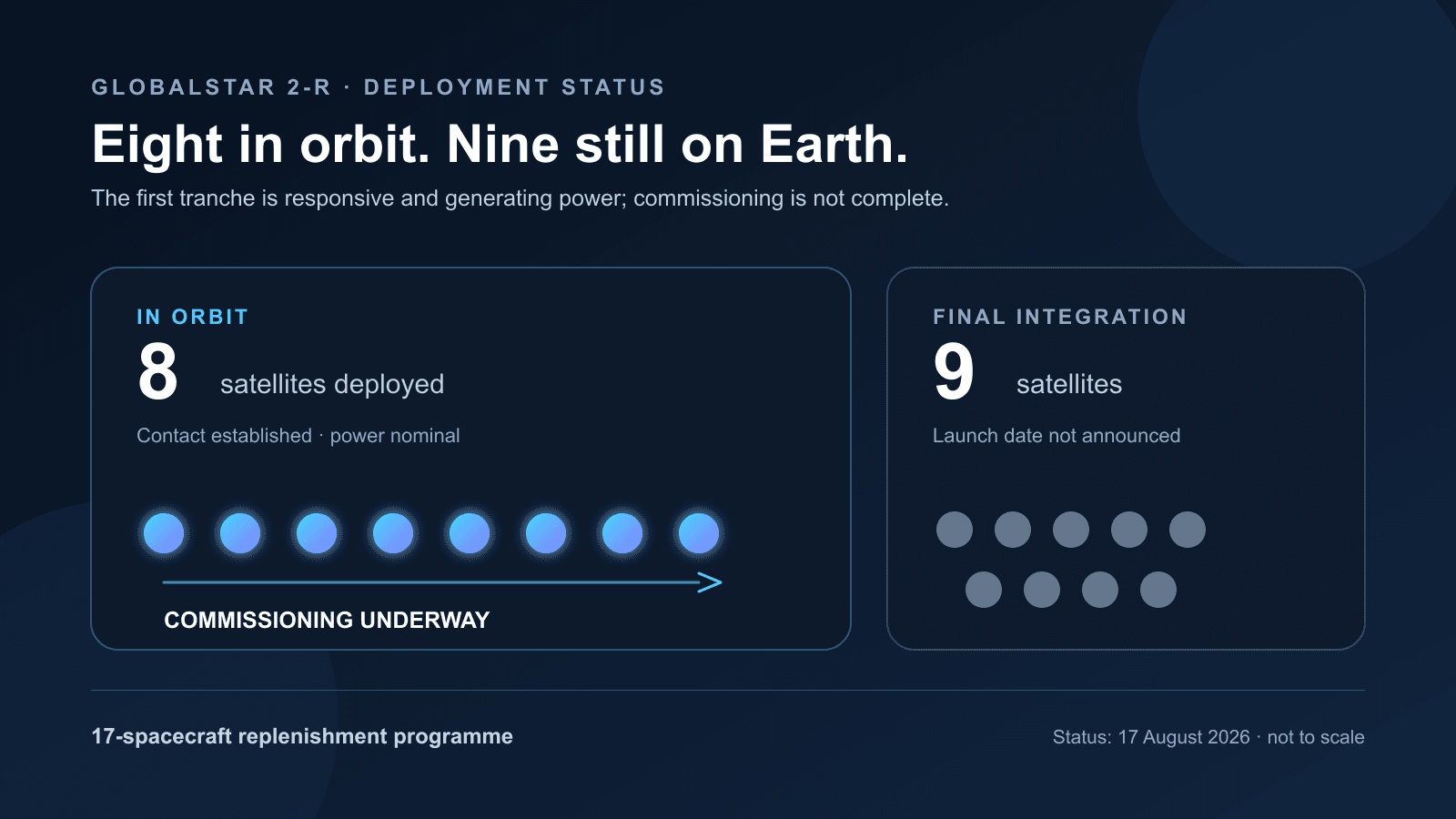
The first eight satellites in Globalstar’s 2-R replenishment programme have reached low Earth orbit and begun commissioning after deployment from a SpaceX Falcon 9. Rocket Lab said it had contacted all eight spacecraft and that they were generating power and performing nominally. Those checks confirm a successful start to the orbital phase; they do not mean the satellites have completed in-orbit testing or joined Globalstar’s operational service.
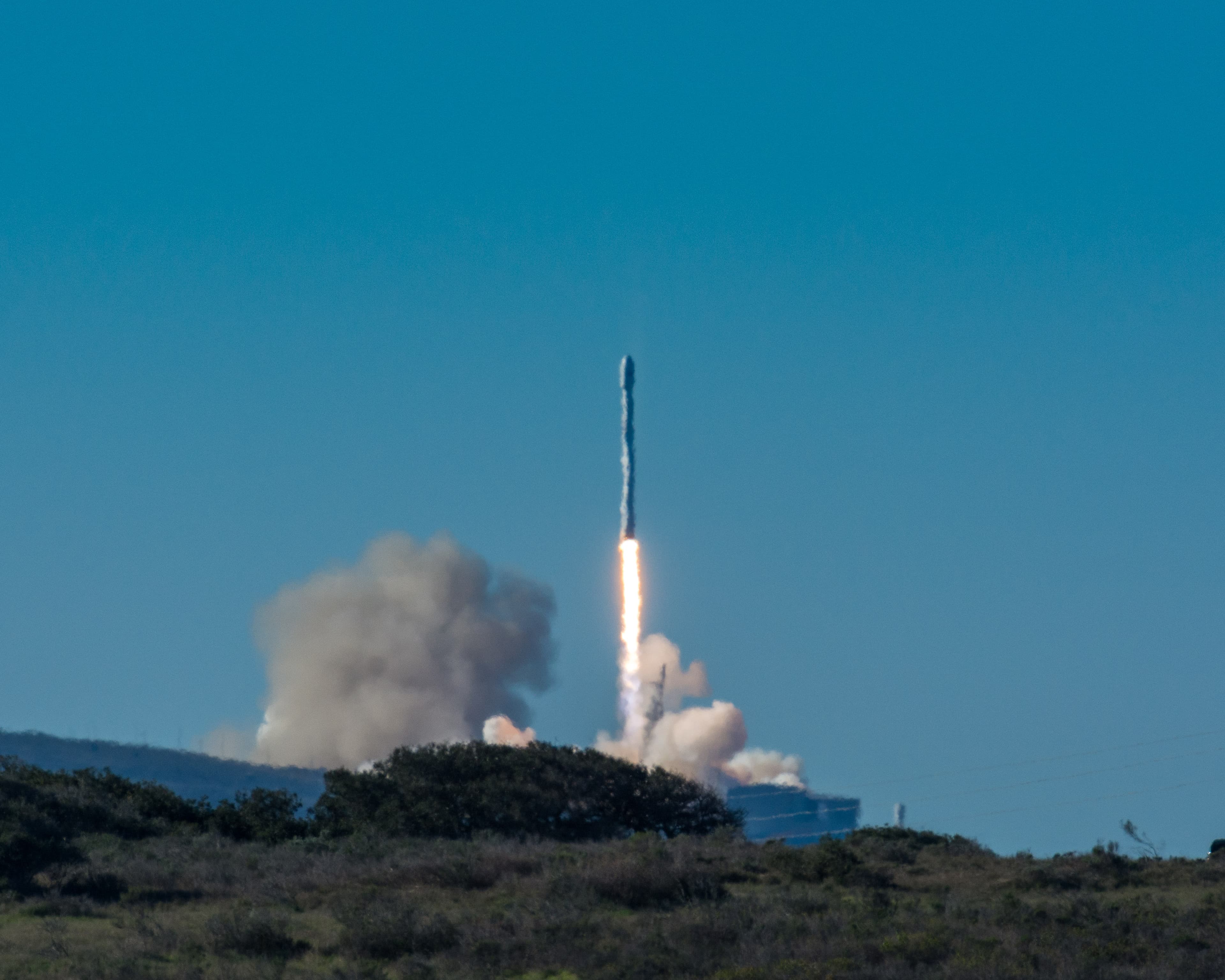
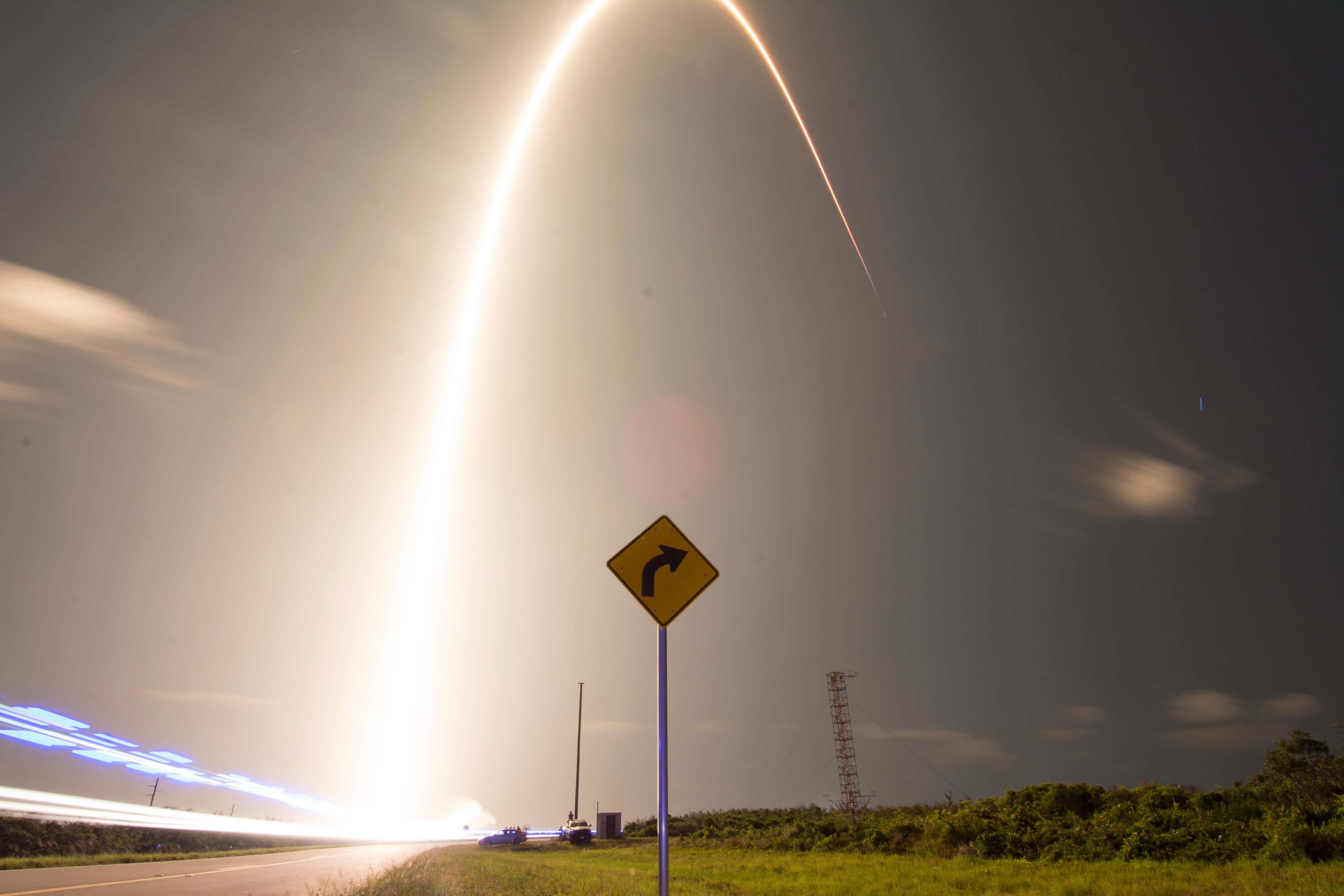
The Falcon 9 lifted off from Space Launch Complex 40 at Cape Canaveral Space Force Station at 9:12 p.m. EDT on August 15, or 01:12 UTC on August 16. Space.com reported, citing SpaceX, that the eight satellites separated over roughly six minutes, beginning 56.5 minutes after launch. The first stage returned to Cape Canaveral about eight minutes after liftoff on its 14th flight.
What the first tranche establishes
The deployment moves eight of the 17 replacement spacecraft ordered in 2022 out of production and into orbital checkout. That is the concrete threshold crossed by this mission: Globalstar now has the first part of its replenishment fleet in space, while the programme’s outcome still depends on commissioning and integration with the existing network. MDA Space said the remaining nine satellites were in the final stages of integration, but its August 16 release gave no launch date for that second group.
Globalstar originally described the 17-satellite procurement as a way to replenish and extend the life of its existing constellation and maintain continuity for mobile satellite services. Its 2022 contract announcement valued the initial order at $327 million and named MDA Space as prime contractor and Rocket Lab as the principal spacecraft-bus subcontractor. The present launch therefore begins deployment of a continuity programme, rather than placing an entirely separate service network into operation at once.
How MDA Space and Rocket Lab divided the build
Rocket Lab led design and manufacture of the spacecraft buses—the structural, power, control and communications platform that carries a mission payload—at its Long Beach, California, complex. MDA Space led payload development as prime contractor and performed final assembly, integration and testing in Montréal. The two locations in the companies’ releases describe successive parts of the build, not competing claims over where the completed satellites were produced.
Each platform has a mass of about 500 kilograms and is a tailored version of Rocket Lab’s Lightning bus. Rocket Lab said the spacecraft include its solar arrays, reaction wheels, flight and ground software, parts of the avionics suite, and telemetry, tracking and command radios. The company also developed a satellite operations control centre for the Globalstar programme, extending its role from the flight hardware to the ground system used to operate the fleet.
Deployment is not commissioning
The public status is limited but specific. Separation was reported complete, all eight spacecraft responded to contact, and power generation was nominal, according to Rocket Lab. MDA Space said the satellites would next undergo a series of in-orbit tests during commissioning. Neither company disclosed the duration of that campaign, the acceptance criteria, a handover date to Globalstar or when the spacecraft would begin carrying customer traffic.
That distinction matters for direct-to-device service. MDA Space says Globalstar’s existing constellation supports satellite-enabled services on selected mobile phones as well as Internet of Things applications. Globalstar’s March 2026 regulatory filing described services using the replacement satellites as a later phase of its Apple capacity agreement. Reaching orbit supplies the hardware needed for that phase, but the August announcements place the spacecraft at commissioning, not at commercial activation.
The 17 replacements are also separate from the larger third-generation system Globalstar ordered later. In the same filing, Globalstar said it had agreed in February 2025 to buy more than 50 third-generation satellites from MDA Space for an extended mobile satellite services network. The eight spacecraft launched on August 16 belong to the earlier replacement programme for the existing constellation; treating them as the first eight of the later 50-plus order would combine two different procurements.
A launch-cadence record in the background
The Globalstar mission became the first half of a SpaceX dual-coast launch pair. At 01:50 UTC—38 minutes after the Cape Canaveral liftoff—a second Falcon 9 launched the classified USSF-366 mission from Vandenberg Space Force Base in California. Space.com reported that the interval cut 27 minutes from SpaceX’s previous record for the shortest time between two of its orbital launches. Both first stages landed successfully.
The 38-minute mark measures SpaceX’s ability to conduct separate launches from two ranges in quick succession; it does not shorten the commissioning work facing Globalstar’s satellites. For the constellation refresh, the next evidence will be completion of the eight spacecraft’s in-orbit tests and their acceptance into service, followed by deployment of the remaining nine. The manufacturers have confirmed the first contact and power milestones, but had not published a commissioning completion date by August 17.
The launch and spacecraft-status details in this account come from MDA Space, Rocket Lab and SpaceX’s statements as reported by Space.com. No independent telemetry set or Globalstar commissioning report was publicly available for review. The supported conclusion is therefore narrower than operational readiness: the first 2-R tranche is safely deployed and responsive, with the service transition still to be demonstrated.
Reporting trail
Primary sources
MDA Space via PR NewswireMDA Space satellites for Globalstar successfully launchedprnewswire.com
Rocket Lab via GlobeNewswireRocket Lab satellite platforms built for MDA Space successfully reach orbitglobenewswire.com
Space.comNew record! SpaceX launches 2 Falcon 9 rockets just 38 minutes apartspace.com
GlobalstarGlobalstar signs contract with MDA for new satellitesinvestors.globalstar.com
Rocket LabRocket Lab selected by MDA to design and build spacecraft for Globalstarrocketlabcorp.com
U.S. Securities and Exchange CommissionGlobalstar quarterly report for the period ended March 31, 2026sec.gov

For an image post, download the card and copy this suggested caption.
The replenishment spacecraft have established contact and begun commissioning, opening the orbital phase of a 17-satellite refresh without yet entering operational service. Read the full report: https://www.spaceexploration.in/news/globalstar-2r-satellites-orbit #SpaceExplorationNews #SpaceNews #SpaceIndustry