Launch
Rocket Lab
Nasdaq-listed launch and space systems company in Long Beach whose Electron rocket flies small satellites, with the partly reusable Neutron now targeting a 2027 debut.
- Space industry
- International space
- Space companies
- Aerospace
- Launch
- Launch vehicles
Rocket Lab Corporation is an American launch and space systems company that Peter Beck founded in June 2006 and now runs from Long Beach, California. Its Electron rocket is a two-stage vehicle powered by nine Rutherford engines burning RP-1 and liquid oxygen, sized to carry up to 300 kg to low Earth orbit, and it flies mainly from Launch Complex 1 on the Māhia Peninsula in New Zealand. Electron first reached orbit on 21 January 2018, eight months after its maiden flight on 25 May 2017; Wikipedia's launch log recorded 92 flights, 88 of them successful and four of them failures, in August 2026.
Neutron, the company's second launch vehicle, is a partly reusable medium-lift rocket about 43 m tall and 7 m in diameter, with nine oxygen-rich staged-combustion Archimedes engines burning methane and liquid oxygen on a first stage designed for roughly 1.5 million pounds of thrust. Its published payload capacity is 13,000 kg to low Earth orbit with the booster recovered, or 15,000 kg expended. Announced in March 2021, the debut has slipped repeatedly: out of 2025 in November of that year, then within 2026 after a first-stage tank ruptured during a hydrostatic pressure test at Wallops Flight Facility on 21 January 2026. In an October 14, 2026 release and securities filing, Rocket Lab moved its expected inaugural launch into 2027 without specifying a month.
Launch is not the whole business. Rocket Lab also builds satellites, spacecraft components and subsystems, and it has grown by purchase: Sinclair Interplanetary in April 2020, Advanced Solutions in October 2021, Planetary Systems Corporation for $81.4 million in December 2021, SolAero Holdings in January 2022, the optical-sensor supplier Geost in August 2025, the laser-communications firm Mynaric for $155.3 million in April 2026, and the space-robotics firm Motiv Space Systems in May 2026. The company listed on Nasdaq as RKLB on 25 August 2021 through a merger with the Vector Acquisition blank-cheque company at a $4.8 billion valuation, and it reported $602 million of revenue for 2025 against a net loss of $198 million.
On 29 June 2026 Rocket Lab agreed to buy Iridium Communications, whose 66 operational satellites and 14 spares serve more than 2.55 million subscribers, for $54 a share, an enterprise value of about $8.0 billion, in a cash-and-stock deal part-financed by a $3.6 billion bridge loan from Deutsche Bank and Wells Fargo and expected to close in mid-2027. Iridium reported $871.7 million of revenue in 2025, more than Rocket Lab itself earned that year. The company also flies HASTE, a suborbital Electron variant that carries up to 700 kg on hypersonic test missions and first launched in June 2023, and it counted 2,600 employees in May 2025, more than 700 of them in New Zealand.
What they build and operate
- Electron · Launch vehicle · Operational
Two-stage small-lift rocket with nine Rutherford engines on the first stage and one vacuum Rutherford on the second, listed at 300 kg to low Earth orbit and 200 kg to a sun-synchronous orbit.[2] - Neutron · Launch vehicle · In development
Partly reusable medium-lift rocket about 43 m tall and 7 m in diameter, with nine Archimedes engines rated at roughly 1.5 million pounds of thrust and a published capacity of 13,000 kg to low Earth orbit with the booster recovered.[3][4][5] - HASTE · Launch vehicle · Operational
Hypersonic Accelerator Suborbital Test Electron, a suborbital derivative carrying up to 700 kg, first flown on the Scout's Arrow mission on 18 June 2023.[1] - Archimedes · Engine · In development
In-house oxygen-rich staged-combustion engine burning methane and liquid oxygen, with nine on Neutron's first stage and a vacuum variant on the second.[3][5] - Rutherford · Engine · Operational
RP-1 and liquid-oxygen engine that powers Electron: nine on the first stage and one vacuum-optimised engine on the second.[2]
Funding
- 29 June 2026 · Committed bridge financing for the Iridium acquisition
$3.6 billion bridge loan — Deutsche Bank, Wells Fargo[9]
Milestones
- June 2006
Peter Beck founded Rocket Lab.[1] - 25 May 2017
Electron made its maiden flight; the rocket did not reach orbit until the following January.[2] - 21 January 2018
Electron reached orbit for the first time.[2] - 04 July 2020
Electron Flight 13, Pics or It Didn't Happen, failed after a second-stage burn issue.[1][2] - May 2021
Electron Flight 20 failed and the payloads aboard were lost.[2][7] - 25 August 2021
Listed on Nasdaq as RKLB through a merger with Vector Acquisition at a $4.8 billion valuation.[1] - 19 September 2023
Electron's 41st mission failed about two and a half minutes after liftoff, and the Capella Space radar satellite aboard was lost.[7][1] - 28 August 2025
Launch Complex 3, the Neutron pad at the Mid-Atlantic Regional Spaceport in Virginia, officially opened.[1] - 11 November 2025
Rocket Lab pushed Neutron's first flight out of 2025 and into 2026, citing further engine and system qualification work.[4] - 21 January 2026
A Neutron first-stage tank ruptured during a hydrostatic pressure test at Wallops Flight Facility.[6][5] - April 2026
Completed the acquisition of the laser-communications supplier Mynaric AG for $155.3 million.[1] - 29 June 2026
Agreed to acquire Iridium Communications at $54 a share, an enterprise value of about $8.0 billion.[10][8][9] - 24 September 2026
Iridium shareholders approved the merger agreement for Rocket Lab’s proposed acquisition; regulatory approvals and other closing conditions remain outstanding.[11] - 14 October 2026
Revised the expected inaugural Neutron launch to 2027, while development and process improvements continued; no launch month was specified.[12][13]
Facilities
- Launch Complex 1 · Māhia Peninsula, New Zealand
Electron's home spaceport, with two launch positions, LC-1A and LC-1B.[1][2] - Launch Complex 2 · Mid-Atlantic Regional Spaceport, Wallops Island, Virginia, United States
Electron pad on United States soil.[1][2] - Launch Complex 3 · Mid-Atlantic Regional Spaceport, Wallops Island, Virginia, United States
Neutron's launch site, officially opened on 28 August 2025.[1]
Leadership
- Peter Beck
Founder and chief executive officer (as of 10 August 2026)[6][10] - Adam Spice
Chief financial officer (as of 07 May 2026)[5][1] - Frank Klein
Chief operating officer (as of 2026)[1]
Sources
WikipediaRocket Laben.wikipedia.org
WikipediaElectron (rocket)en.wikipedia.org
WikipediaRocket Lab Neutronen.wikipedia.org
Spaceflight NowRocket Lab delays debut of Neutron rocket to 2026spaceflightnow.com
Spaceflight NowRocket Lab announces five-launch Neutron deal as it continues aiming for late 2026 debutspaceflightnow.com
Spaceflight NowWindow for 2026 launch debut of Rocket Lab's Neutron rocket 'is narrowing' as development continuesspaceflightnow.com
TechCrunchRocket Lab's Electron suffers first failure in over two yearstechcrunch.com
TechCrunchRocket Lab continues buying spree by acquiring satellite company Iridiumtechcrunch.com
PayloadRocket Lab Enters the Satcom Market With $8B Iridium Dealpayloadspace.com
PR NewswireRocket Lab to Acquire Iridium in Historic Deal, Creating A Fully Vertically Integrated Space Powerhouse Primed for Growthprnewswire.com
Iridium Communications / SECIridium Communications Inc. Form 8-K, 24 September 2026sec.gov
Rocket Lab / SECRocket Lab Corporation Form 8-K, October 14, 2026sec.gov
Rocket LabRocket Lab Provides Update on Neutron Development and Adjusts Target Launch Timinginvestors.rocketlabcorp.com
Coverage of Rocket Lab

Neutron development
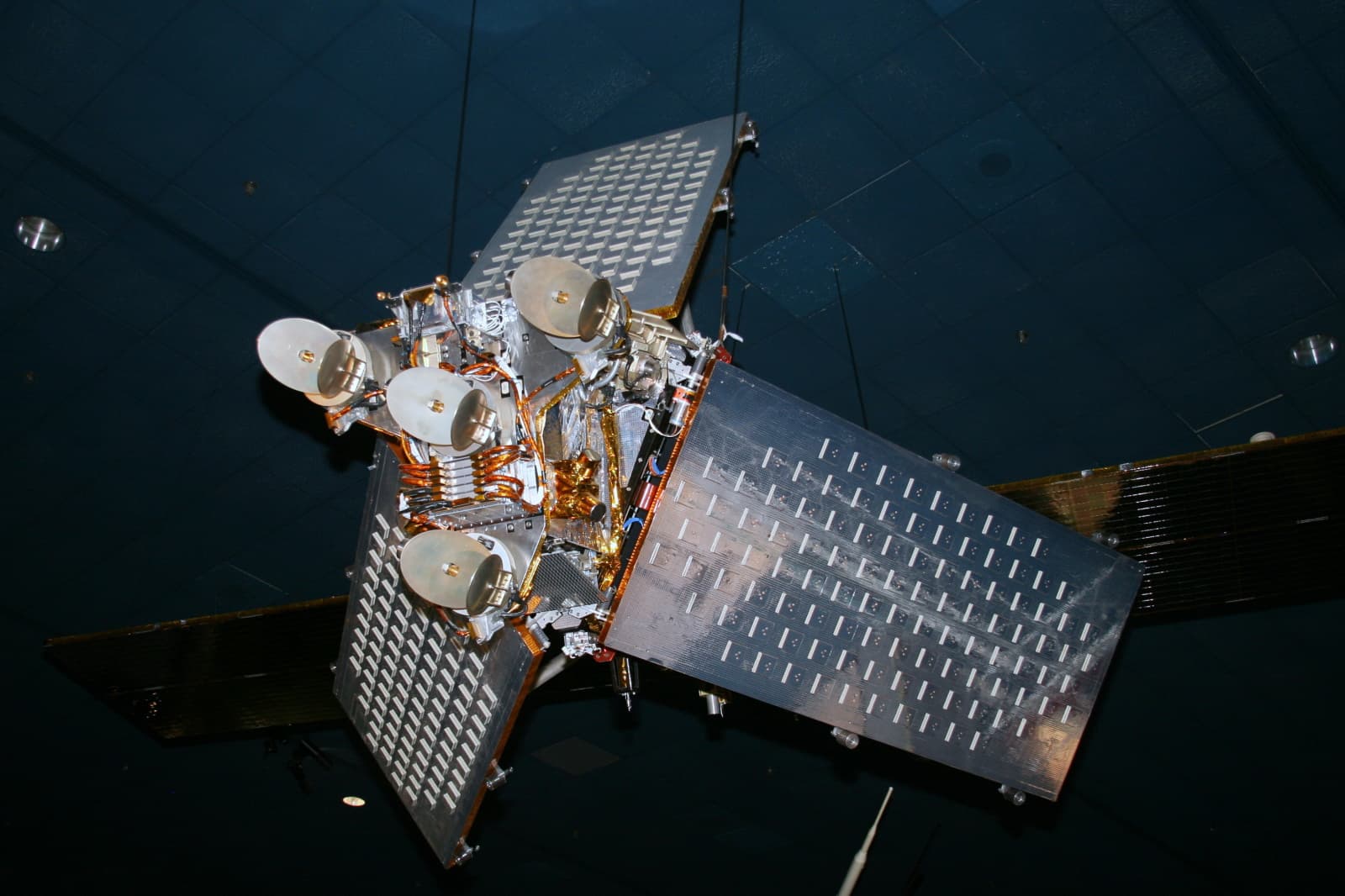
Rocket Lab files Neutron launch update targeting 2027
The October 14 disclosure puts the inaugural flight in 2027 without specifying a month. The earlier fourth-quarter target concerned delivery to the launch pad.
Satellite communications
Iridium shareholders approve Rocket Lab acquisition agreement
The vote clears a shareholder condition for the satellite-network deal. Iridium’s filing still targets mid-2027 closing, subject to regulatory approvals and other conditions.
Launch
Rocket Lab launches confidential-customer satellite from New Zealand
The company calls Happily Ever Faster its 95th Electron mission and says one Earth-observation satellite reached a 500 km circular orbit. The customer and payload identity remain undisclosed.
Military space acquisition
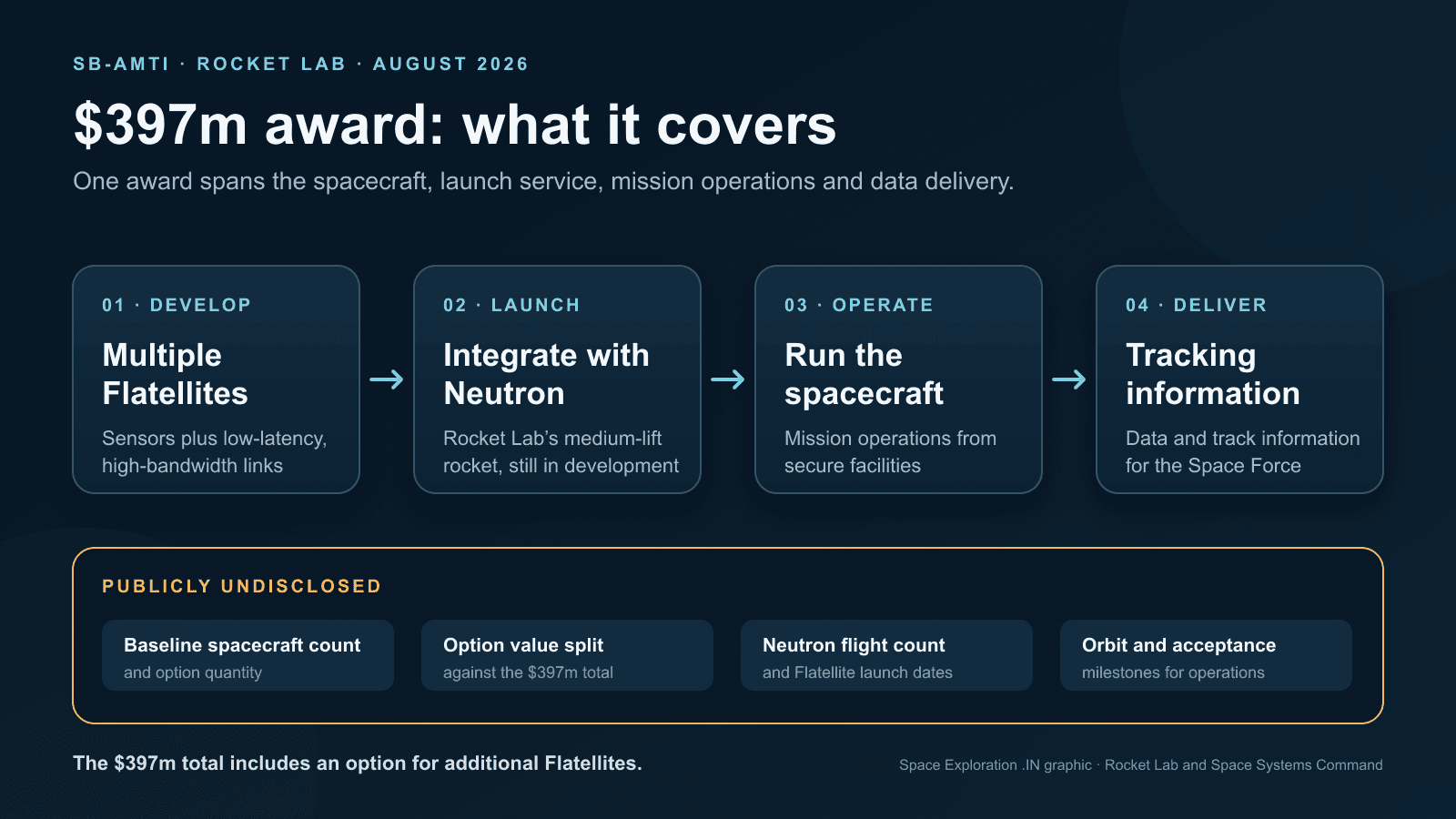
Rocket Lab’s $397m Flatellite award spans satellites, Neutron launch and operations
The Space Force deal covers multiple spacecraft and includes an option for more, but the number of Flatellites, Neutron flights and launch dates remain undisclosed. SB-AMTI’s later operational capability depends on programme-wide sensing, processing and orchestration work.
Military satellite communications
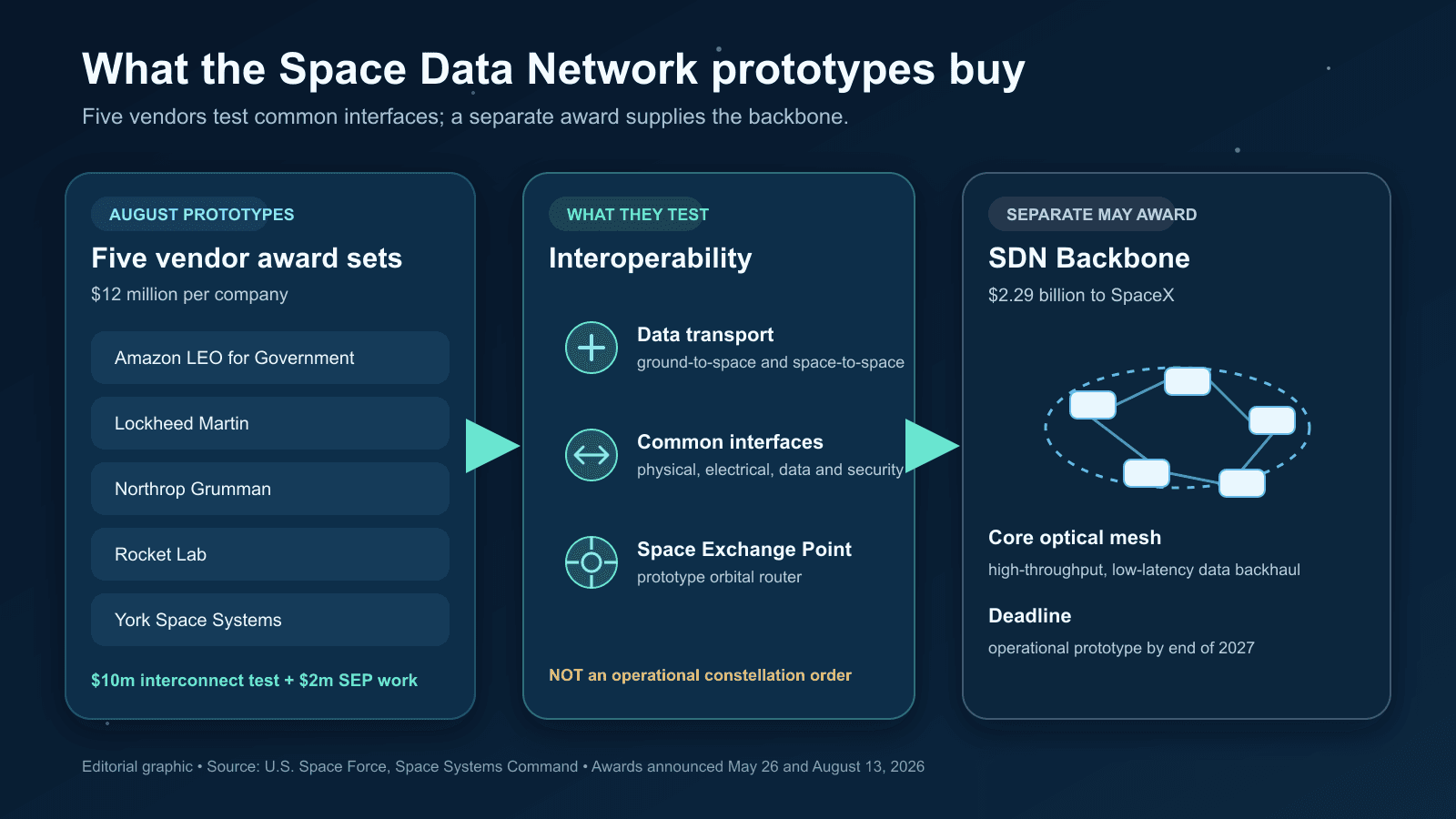
Space Force awards five vendors to test shared data-network interfaces
Five companies will each receive a $12 million prototype package to show that independently built satellites and terminals can exchange data through the Space Data Network. The demonstrations are integration tests, not orders for an operational fleet, and they sit beside a separate $2.29 billion backbone award made to SpaceX in May.
Defence satellites
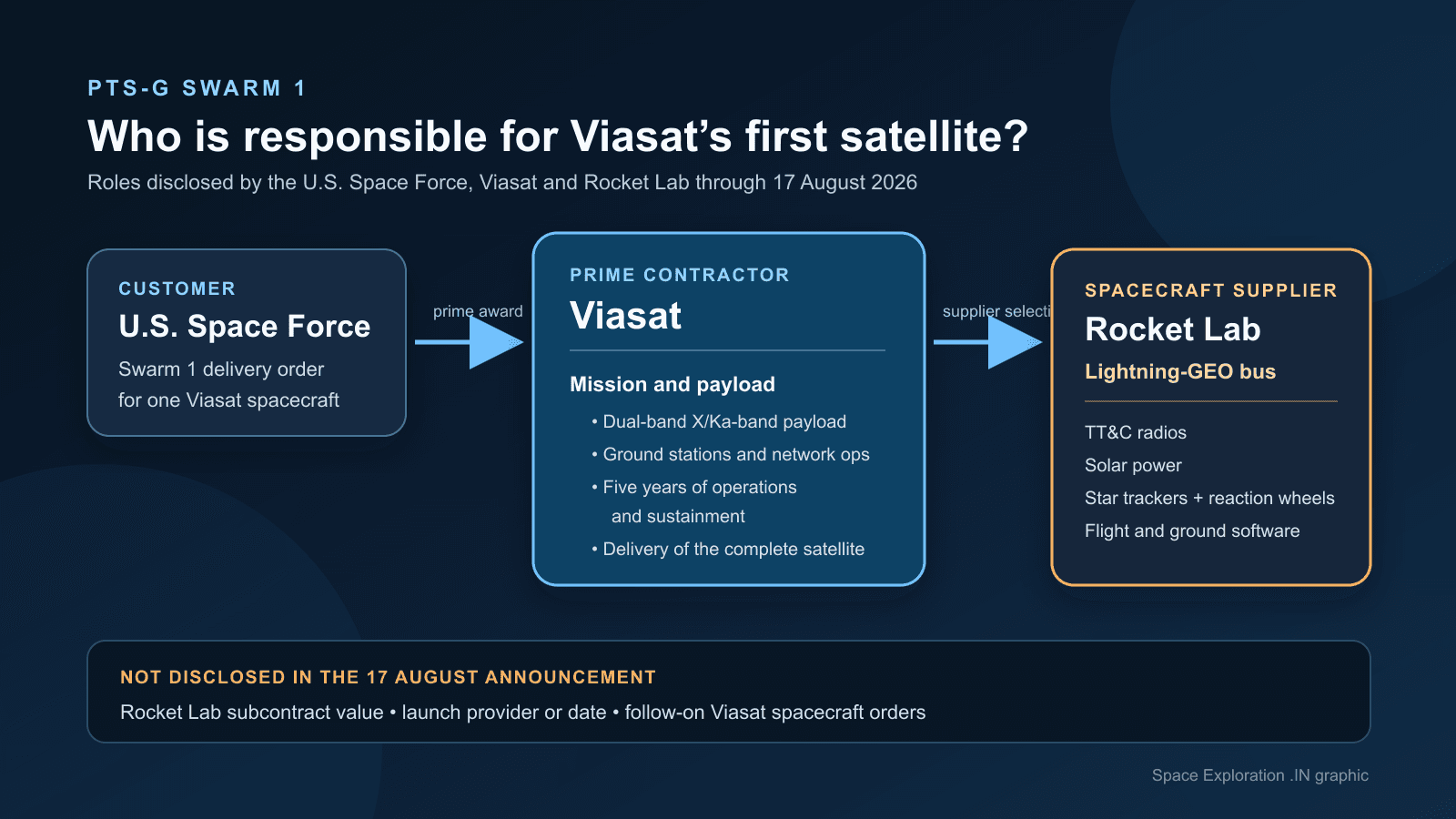
Viasat selects Rocket Lab bus for its first PTS-G satellite
Lightning-GEO supplies the spacecraft platform around Viasat’s X/Ka-band payload. Viasat remains the Space Force prime, and no follow-on satellite order was disclosed.
Satellite communications
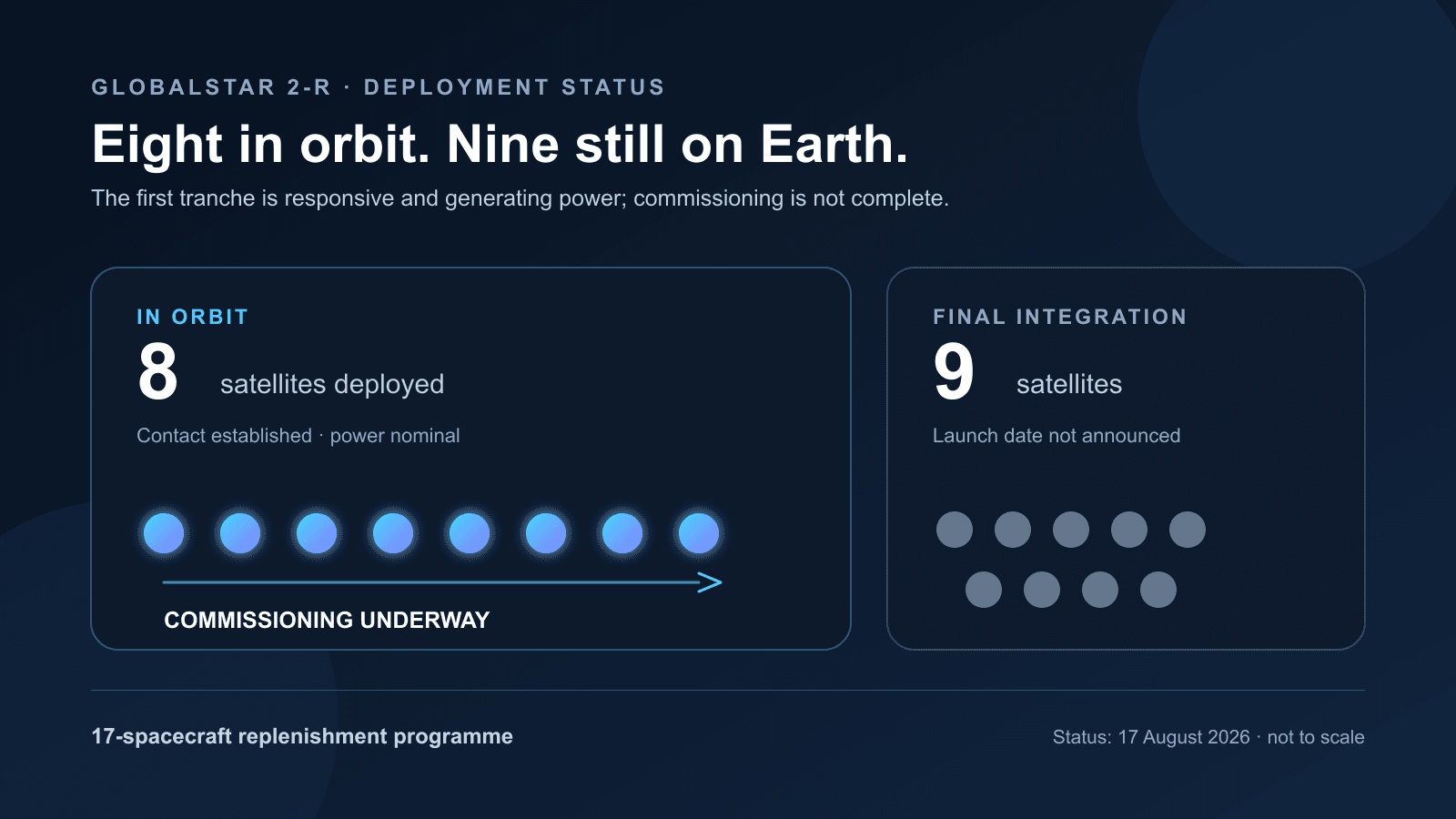
First eight Globalstar 2-R satellites reach orbit
The replenishment spacecraft have established contact and begun commissioning, opening the orbital phase of a 17-satellite refresh without yet entering operational service.
Update this profile
Work at Rocket Lab or represent it? If something here is wrong or missing, email contact@spaceexploration.news with a public source for the change. Every profile edit is verified before it is published.
Request a profile change