Science
JWST detects water in IRS 3's dust envelope near the Galactic centre
Water absorption and oxygen-rich silicate bands appear in a modelled, multi-shell outflow only 0.55 light-years in projection from Sagittarius A*. The result is about molecular survival, not habitability.
Add us as a preferred source on Google Add us as a preferred source on Google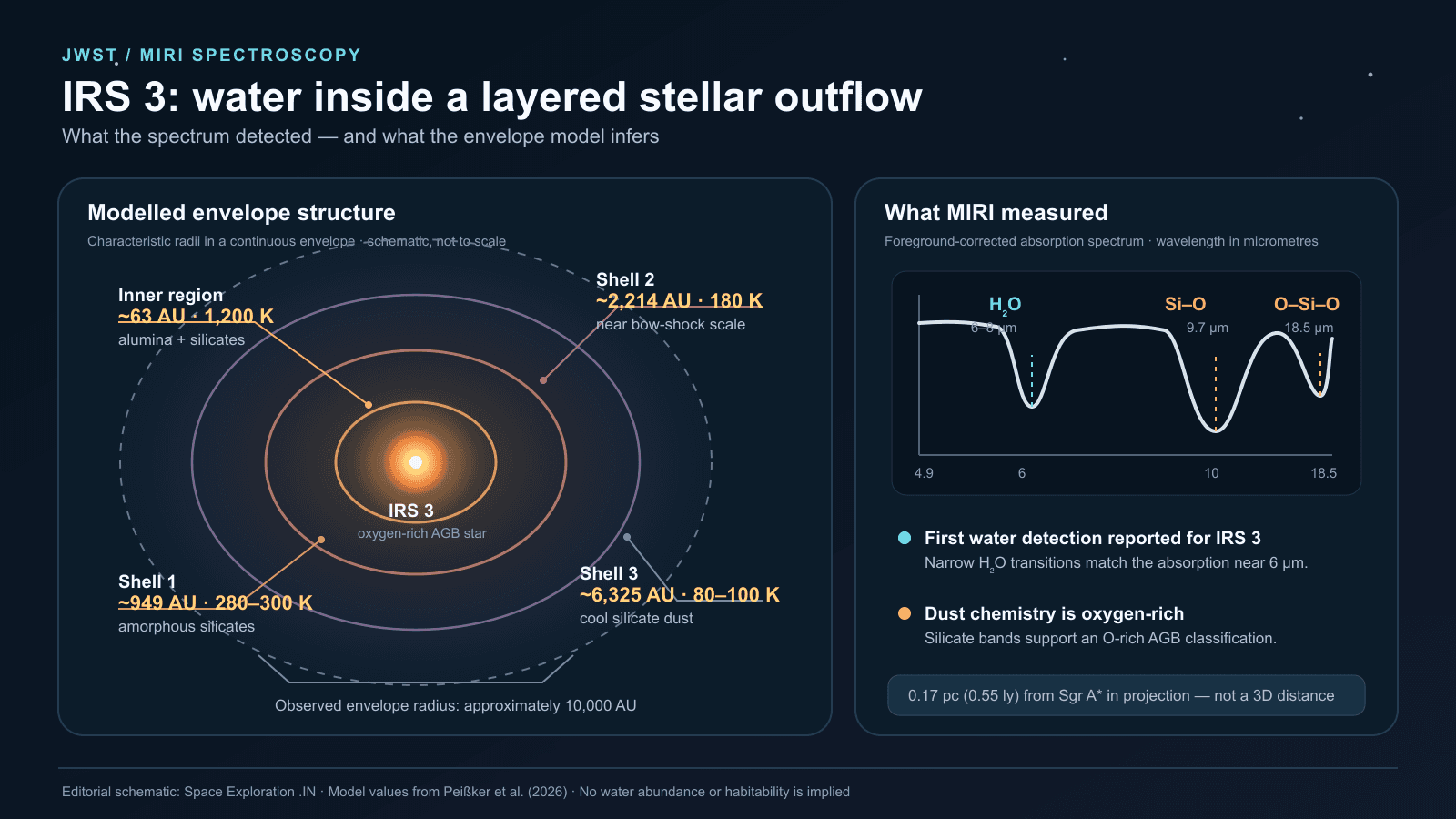
JWST has detected water absorption in the dusty envelope of IRS 3, an evolved star seen about 0.17 parsecs, or 0.55 light-years, from Sagittarius A* in projection. It is the first water detection reported for IRS 3. The finding shows that water-bearing molecular material and newly formed dust can persist in at least one stellar outflow in the radiation-dominated Galactic centre; it does not identify a habitable environment or measure a total quantity of water.
The international team observed IRS 3 on April 21, 2025, with the Medium Resolution Spectrometer on JWST's Mid-Infrared Instrument, known as MIRI. Its spectrum covers wavelengths from 4.9 to 27.9 micrometres. After correcting for foreground dust between Earth and the Galactic centre, the researchers found water signatures alongside two strong silicate absorption bands and published the study in Astronomy & Astrophysics in August 2026.
How MIRI separated water from foreground dust
IRS 3 is deeply embedded, so material along the line of sight can change the apparent spectrum. The team compared available mid-infrared extinction laws for the central parsec, then used a stellar-based curve to correct the observed light. In the resulting spectrum, the two most prominent dust features occur at 9.7 micrometres, where silicon-oxygen bonds stretch, and about 18.5 micrometres, where oxygen-silicon-oxygen bonds bend. The corrected spectrum also contains water absorption between 6 and 8 micrometres.
For the water identification, the researchers compared a narrow absorption structure around 6 micrometres with molecular transition lines from the HITRAN spectroscopic database. The model matches water lines between 6.0 and 6.25 micrometres, while separate absorption around 6.06 micrometres and across part of the 6.12-to-6.25-micrometre interval remains ambiguous. The paper says those broader components could involve ices, large molecules or residual foreground effects, and leaves a dedicated analysis to future work.
That distinction limits what can be claimed. The spectrum supports the presence of water in the envelope, but it does not yield a total water inventory for IRS 3. A synthetic spectrum tests whether water transitions can reproduce the observed absorption; it is not a measurement of all the water mass distributed through a roughly 10,000-AU envelope. The observations also do not determine whether the detected material is water vapour, ice or a mixture everywhere along the line of sight.
A layered oxygen-rich envelope
IRS 3 is an asymptotic giant branch, or AGB, star: a late evolutionary stage in which pulsations and winds remove gas and dust from the star. Earlier work had proposed a carbon-rich classification, but the JWST spectrum favours oxygen-rich chemistry. The measured optical-depth ratio of 3.5 ± 0.1 between the 9.7- and 18.5-micrometre silicate features is consistent with amorphous silicates and cannot be reproduced by the carbon-rich dust models considered in the study.
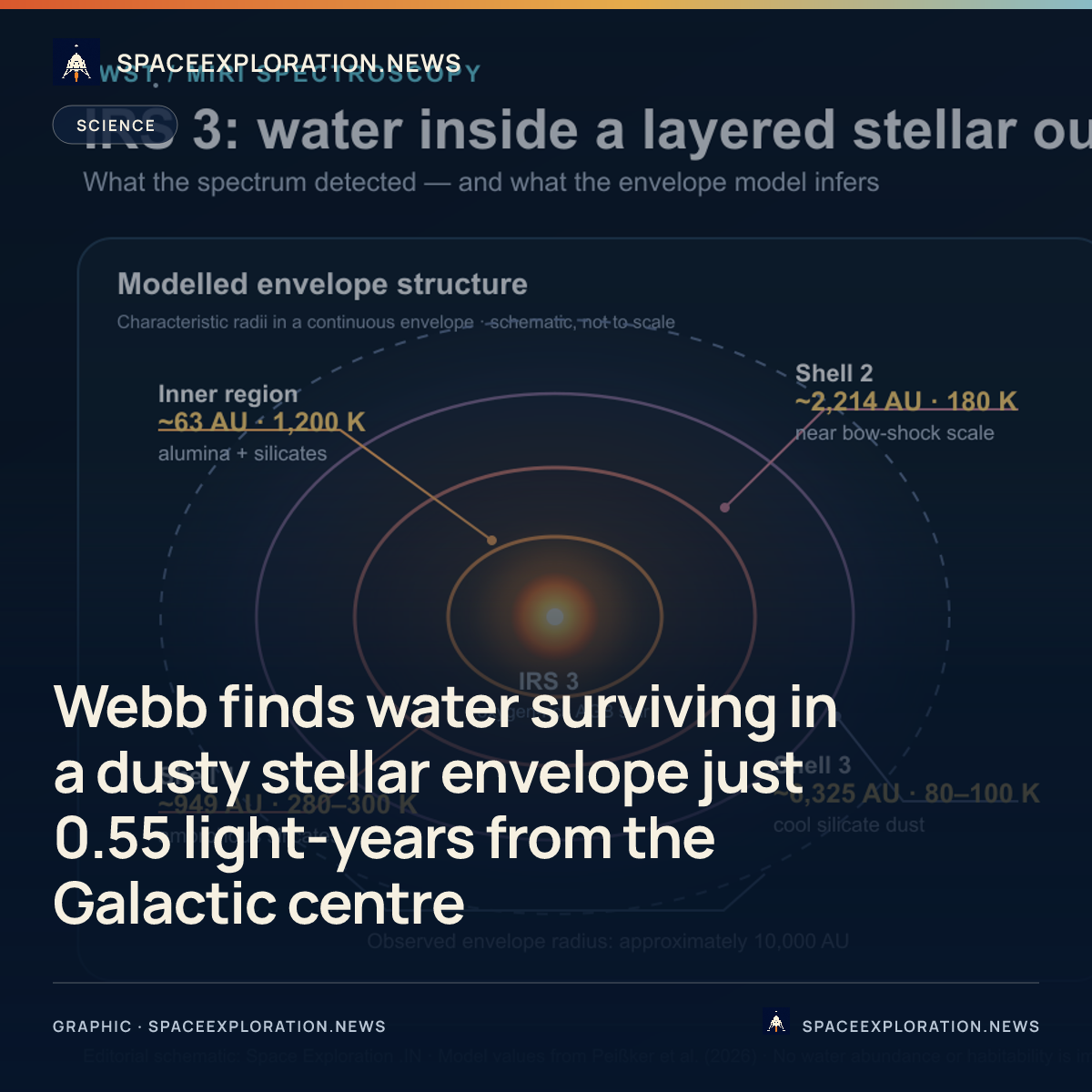
To reconstruct the envelope, the team ran 100,000 radiative-transfer models. Its preferred setup has a warm inner region near a characteristic radius of 63 AU at about 1,200 kelvin, followed by three progressively cooler shell components: roughly 949 AU at 280–300 K, 2,214 AU at 180 K and 6,325 AU at 80–100 K. These are modelled characteristic radii within a continuous envelope, not photographed shell boundaries with sharp edges. The observed envelope itself extends to an estimated radius of about 10,000 AU.
The dust composition changes across that model. Alumina and silicates occupy the hot inner region, while amorphous silicates dominate the three cooler shells. The second shell overlaps in scale with IRS 3's observed bow-shock stand-off distance, so some of its enhanced density may be compressed material where the stellar wind meets the surrounding interstellar medium. That association is an interpretation of the model rather than a direct mapping of each shell by JWST.
The model does not decide how the layered structure formed. The paper lists variable mass-loss episodes, a possible companion and interaction with the environment around Sagittarius A* as possible contributors. Earlier ALMA observations had already resolved two shells around IRS 3, supporting a layered envelope, but the authors say additional shells may remain below the available detection or resolution limits.
What survives near Sagittarius A*
IRS 3's 0.17-parsec separation from Sagittarius A* is a projected distance on the sky, not its full three-dimensional distance from the black hole. Even with that geometric limit, the star lies within the Milky Way's crowded inner parsec, where intense radiation and interactions with surrounding gas can erode circumstellar material. Finding both water absorption and freshly produced oxygen-rich dust there demonstrates that those processes have not completely stripped or chemically erased this envelope.
The team also estimated that IRS 3 is losing about 6 × 10^-5 solar masses per year, assuming a stellar-wind speed of 15 kilometres per second. That rate is characteristic of the high-loss superwind phase of an oxygen-rich AGB star and is consistent with previous estimates that used different wind speeds. Because the calculation depends on the bow shock, ambient density and assumed wind velocity, it should be read as a model-dependent rate, not a direct weighing of ejected material.
Material expelled by AGB stars can enter the interstellar medium, so IRS 3 offers a local test of whether evolved stars can continue supplying dust and molecules in galactic nuclei. The detection answers that question for one conspicuous star: its envelope contains water and silicate dust despite the nearby radiation field. It does not show that planets are forming around IRS 3, that liquid water exists there or that conditions close to Sagittarius A* are suitable for life.
What remains unresolved
The result opens narrower follow-up questions than the headline reference to water might suggest. The broad absorption components near 6 micrometres still need to be separated from foreground contamination and possible ices, and the total amount and spatial distribution of water have not been established. Higher-resolution modelling or observations that isolate different parts of the extended envelope could test whether the water signal follows the warm inner outflow, the cooler shells or material compressed near the bow shock.
The same work leaves the origin and future of the shells unsettled. A companion has not been confirmed, the influence of Sagittarius A* is not uniquely identified, and the paper notes that envelope stripping may not be balanced by IRS 3's mass loss indefinitely. What JWST has established is more specific: molecular water and oxygen-rich dust remain observable in the outflow of an evolved star within the Milky Way's central parsec.
Reporting trail
Primary sources
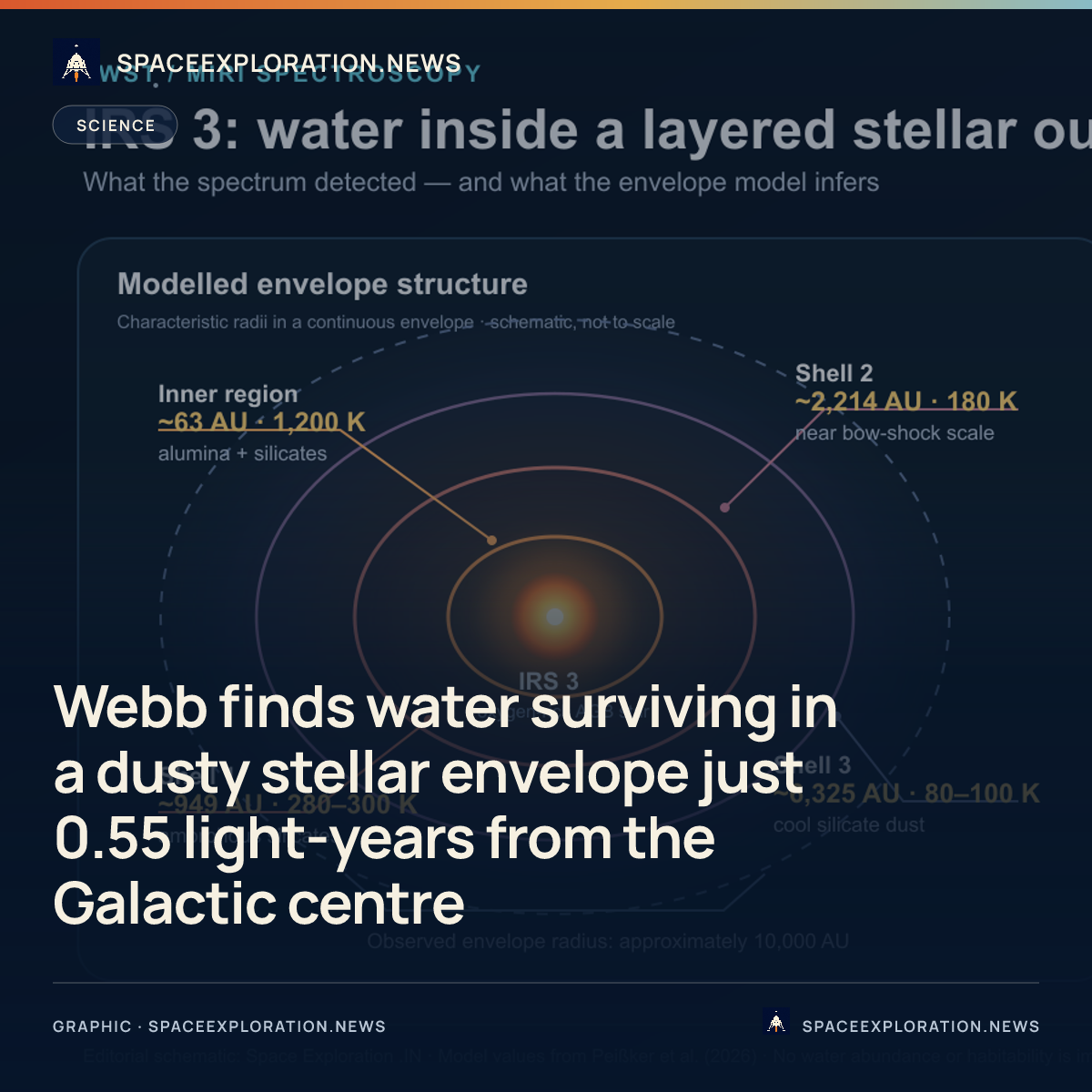
For an image post, download the card and copy this suggested caption.
Water absorption and oxygen-rich silicate bands appear in a modelled, multi-shell outflow only 0.55 light-years in projection from Sagittarius A*. The result is about molecular survival, not habitability. Read the full report: https://www.spaceexploration.in/news/jwst-irs-3-water-silicate-envelope #SpaceExplorationNews #SpaceNews #SpaceScience