Star formation
NASA releases Webb view of jets in stellar nursery
The October 6 release uses December 2025 observations of NGC 7129 to show how stars at different stages shape atomic and molecular gas.
Add us as a preferred source on Google Add us as a preferred source on Google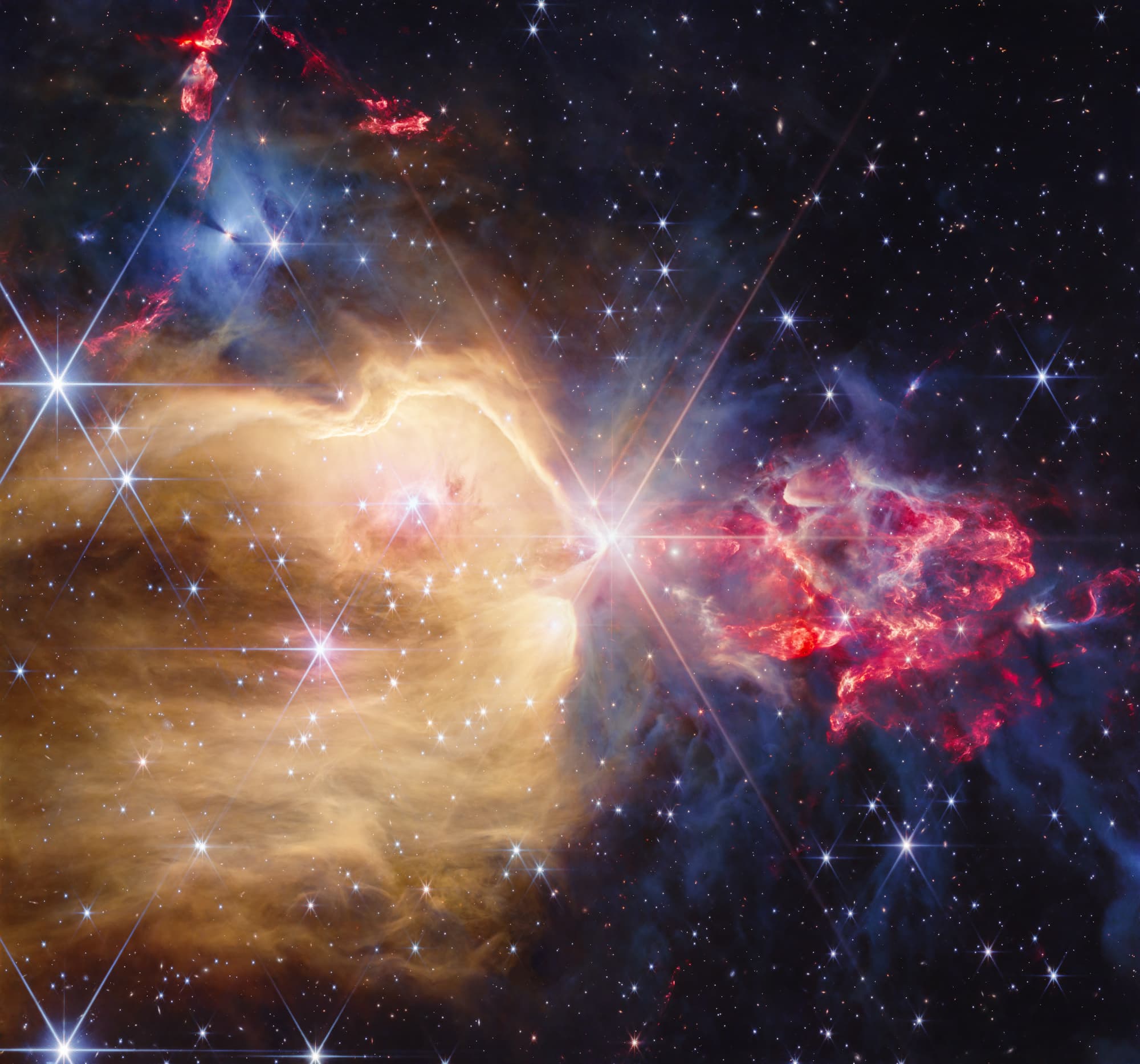
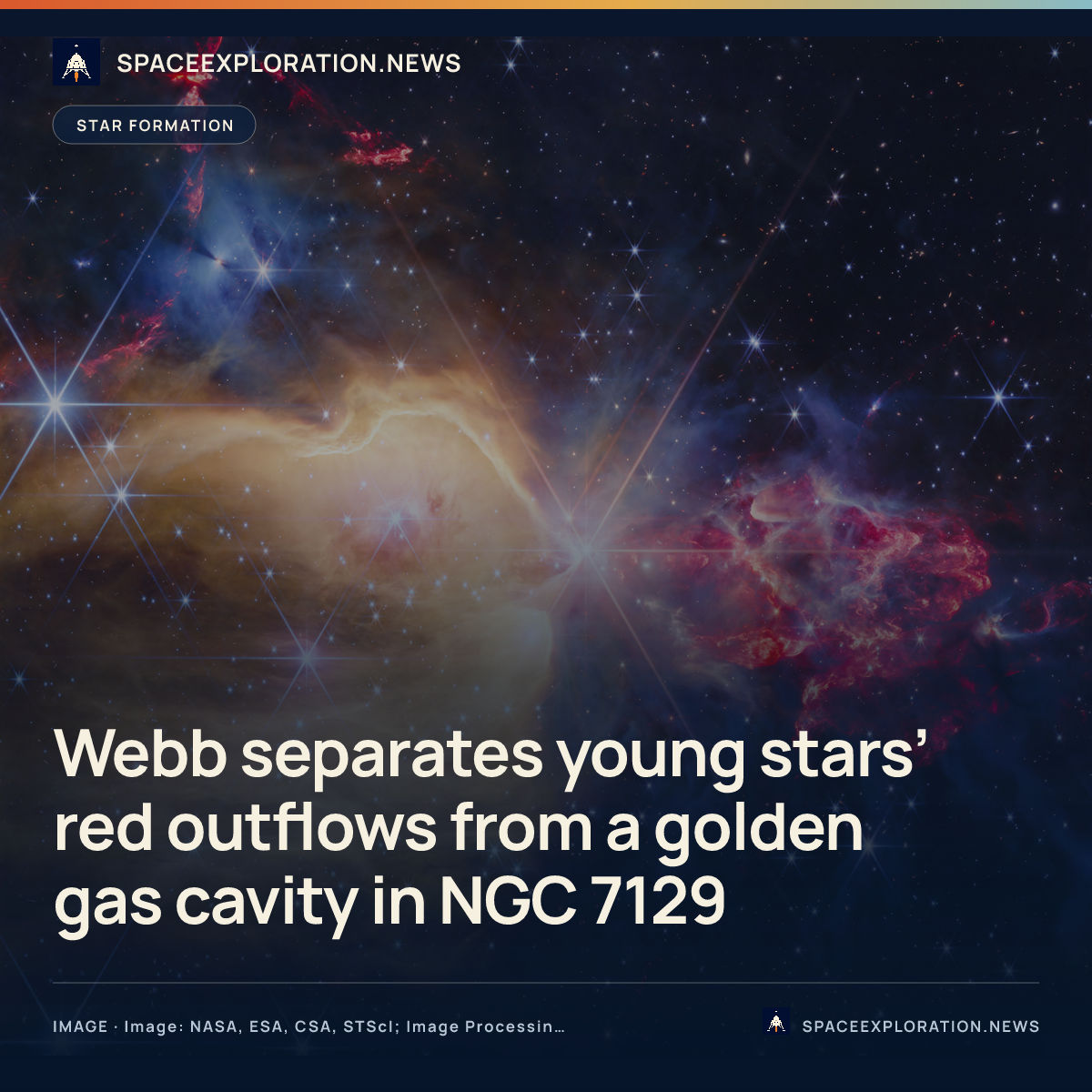
NASA released a James Webb Space Telescope image on October 6 showing young stars and jets in NGC 7129, a star-forming region about 3,300 light-years away in Cepheus. The agency’s accompanying account distinguishes a cavity shaped by more mature stars from dense gas containing younger protostars. The image was made from observations taken on December 17, 2025; October 6 is its release date.
Webb’s Near-Infrared Camera recorded the region through six filters. NASA’s image notes explain that the colors were assigned to separate monochrome exposures, so the gold, red and blue are representations of infrared measurements rather than a view in visible light. The field spans about 5.7 light-years.
The golden region to the left of the central star contains hot atomic hydrogen. NASA identifies the central object as LkH(alpha) 234, a pre-main-sequence star estimated to have five to eight times the Sun’s mass. Such a star has largely finished gathering material and is contracting under gravity, heating up before it begins fusing its own hydrogen.
According to NASA’s release, outflows from an earlier stage of that star’s development carved the cavity, which extends about 3.5 light-years. The outflows and starlight energize the gas. Other stars within the cavity produce winds that push into it, forming curved regions of compressed gas called bow shocks. At the cavity’s upper edge, radiation from the stars breaks hydrogen molecules into atoms.
The red, clumpy region to the right contains younger protostars still accumulating matter, NASA explains. Their outflows strike the surrounding dense material, producing shocks and heating molecular hydrogen. Several outflows overlap along the line of sight. The image notes identify the gray regions as colder, denser gas where protostars have yet to form.
NASA also released a comparison with an earlier Spitzer Space Telescope view. Spitzer had identified protostars within the gas and dust, while Webb resolves more of their effects on the surrounding material, including bow shocks and structures within the cavity. The comparison notes also identify faint infrared emission from cold gas and distant background galaxies in Webb’s view.
The release describes the image as material for continued study of how stars and protostars affect nearby gas and dust. Its new public presentation builds on earlier observations of the region; the agency’s dated exposure record places the Webb data collection in December 2025.
Reporting trail
Primary sources
For an image post, download the card and copy this suggested caption.
The October 6 release uses December 2025 observations of NGC 7129 to show how stars at different stages shape atomic and molecular gas. Read the full report: https://www.spaceexploration.in/news/webb-ngc-7129-stellar-jets #SpaceExplorationNews #SpaceNews #SpaceScience