Planetary science
JWST clay signatures point to shattered interiors around Neptune
Larissa, Galatea and the rings carry a 2.72-micrometre feature associated with magnesium-rich phyllosilicates, but missing water ice and a shredded dwarf-planet alternative keep their origin unsettled.
Add us as a preferred source on Google Add us as a preferred source on Google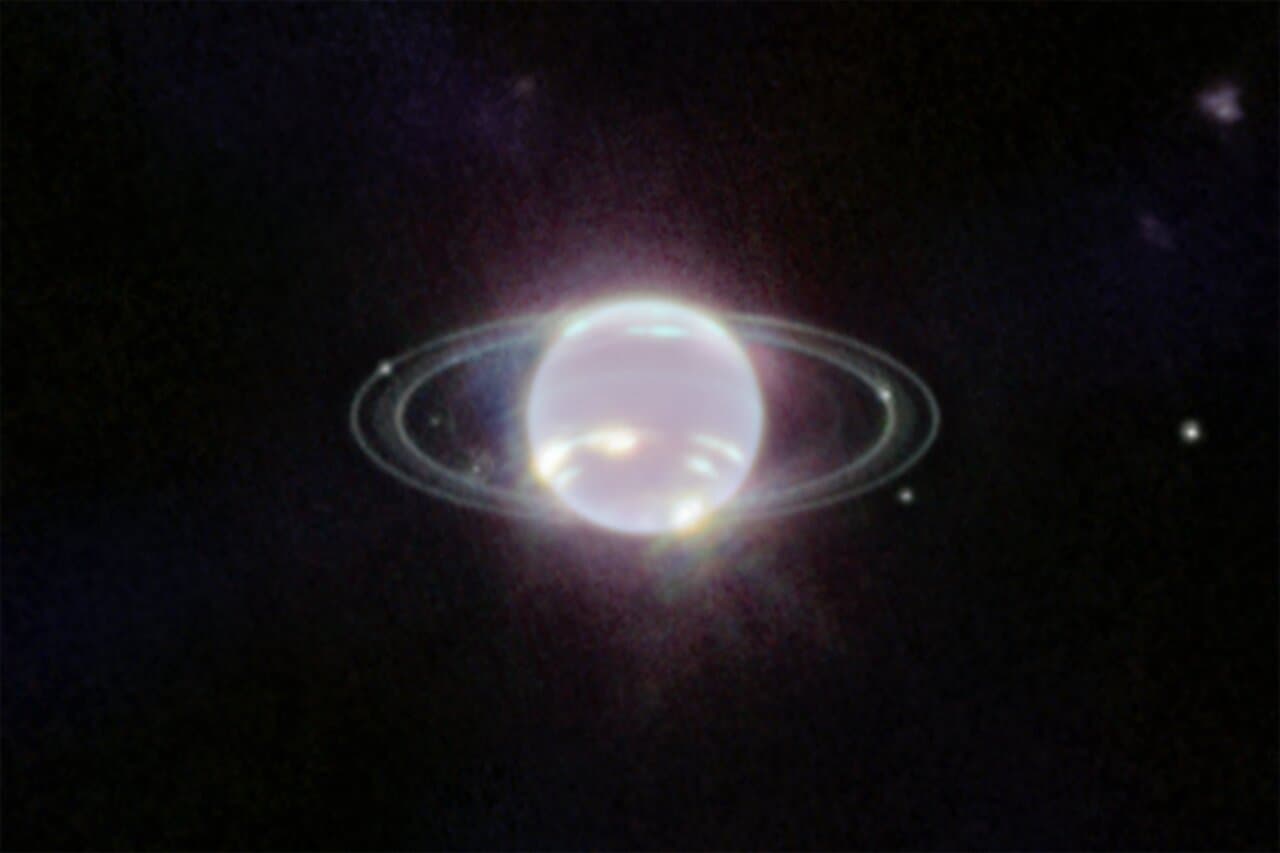
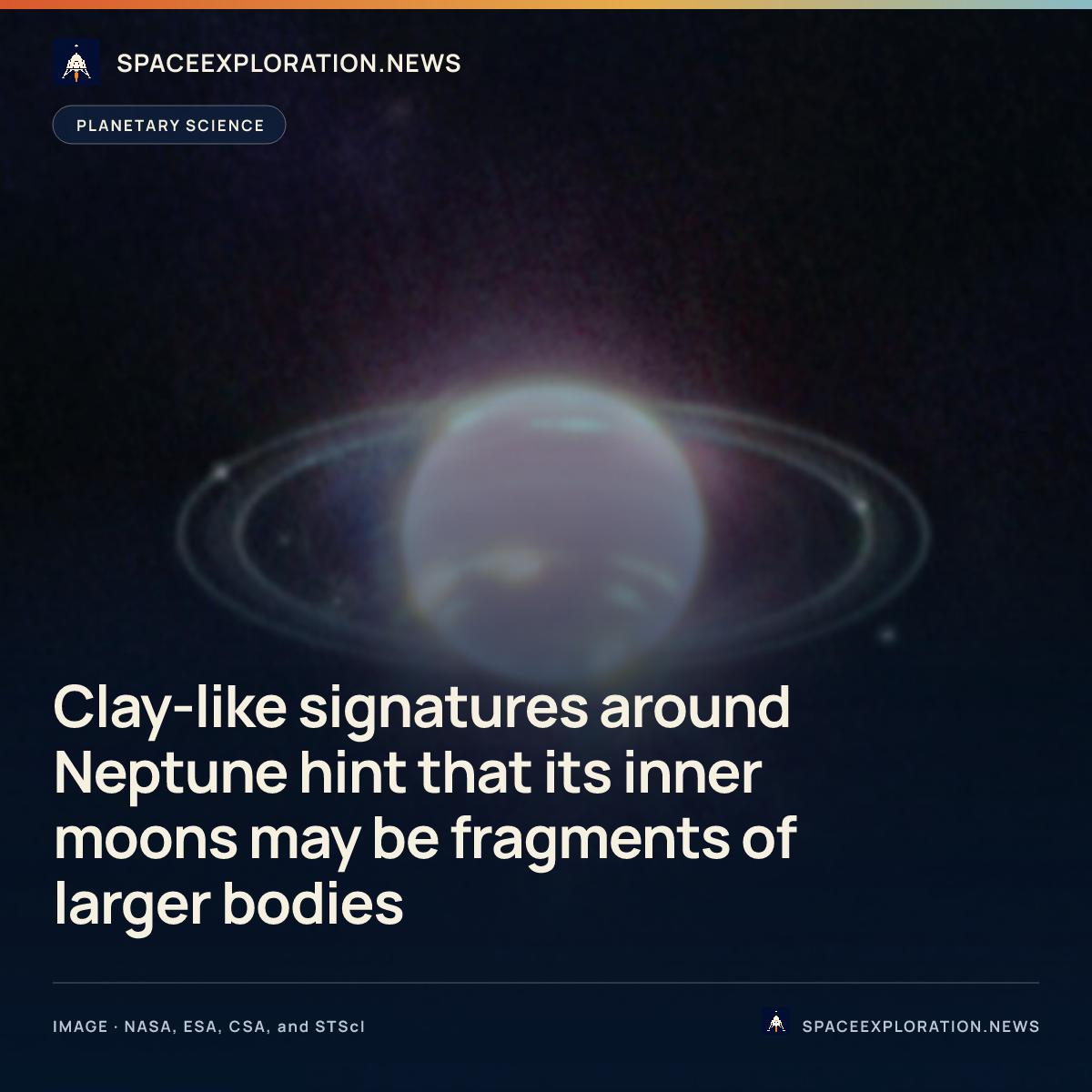
Spectra collected by the James Webb Space Telescope from Larissa, Galatea and Neptune's rings carry a narrow 2.72-micrometre absorption feature consistent with magnesium-rich phyllosilicates. The feature points to rock altered by liquid water inside a much larger body, because the present moons are too small and cold to plausibly manufacture so much of the material themselves. That finding gives the moons a new role in origin models: they may be rubble that exposes once-buried interiors. It does not, by itself, identify which larger body was destroyed.
M. Ryleigh Davis and four co-authors published the result in Science Advances on July 29, 2026. Caltech released its account the same day, and ScienceDaily published a fresh public report on August 14. The measurements and interpretations in this article come primarily from the peer-reviewed paper; Space Exploration .IN has not independently reprocessed the JWST spectra.
A chemical clue out of place
The team used the integral field unit on JWST's Near-Infrared Spectrograph, or NIRSpec, in a prism mode spanning 0.6 to 5.3 micrometres. It combined repeated observations of Proteus, Larissa and Galatea with light extracted from the faint rings. All three moons and the rings have broad hydroxyl, or OH, absorption bands near 3 micrometres, about 70% deep on the moons, yet none shows the clear 1.5-, 1.65-, 2.0- or 4.5-micrometre bands or 3.1-micrometre peak expected from water ice.
Larissa, Galatea and the rings add a sharp checkmark-shaped feature at 2.72 micrometres that is absent or much weaker on Proteus. The researchers isolated it by scaling the spectra to the same depth at 3.1 micrometres and dividing them by the Proteus spectrum. Its position and shape match magnesium-bearing, serpentine-like phyllosilicates in heavily altered CM2 carbonaceous chondrites. In the paper's comparisons, the match is closer to Ceres than to asteroid Bennu, and the authors report no previous detection of a similar band on a body beyond Jupiter.
That is a record of past water-rock chemistry, not evidence for liquid water on Larissa or Galatea today. The paper links the altered material to at least 1–10 million years of exposure to liquid water at temperatures no higher than roughly 300–400 kelvin. Neptune's inner moons have surface temperatures near 50 kelvin. Producing the observed minerals therefore requires sustained interior heating in an earlier body, followed by disruption that moved the altered rock to the surfaces now seen by JWST.
Why the present moons are unlikely factories
Larissa is about 194 kilometres across and Galatea about 176 kilometres. The authors compare them with Miranda, a roughly 470-kilometre Uranian moon that thermal models struggle to differentiate without substantial tidal heating. Local impact heating does not solve the problem cleanly: craters 20–30 kilometres wide can raise temperatures by only about 100–200 kelvin in the cited models, and their hydrothermal systems persist far less than the alteration interval inferred for the clays. An impact large enough to do more would threaten to destroy moons this small.
The study therefore treats formation inside today's Larissa and Galatea, or alteration produced mainly by later impacts on them, as implausible. Its central inference is that the phyllosilicate-bearing fragments came from deep within one or more differentiated icy bodies large enough to melt internal ice. The question shifts from how the current moons warmed themselves to which larger predecessor supplied their rock.
Two ways to build the wreckage
The authors favour a lost regular-satellite system. Triton's retrograde, highly inclined orbit indicates that Neptune captured it after it formed elsewhere. Dynamical models have long allowed that capture and Triton's inward evolution to destroy earlier moons, leaving a debris disc from which the present inner satellites and rings could reaccrete. Companion JWST work on Nereid, whose spectrum and orbit are consistent with a displaced survivor of an earlier regular system, gives that reconstruction an additional line of support. It also requires no disruptive encounter beyond events already used to explain Triton and Nereid.
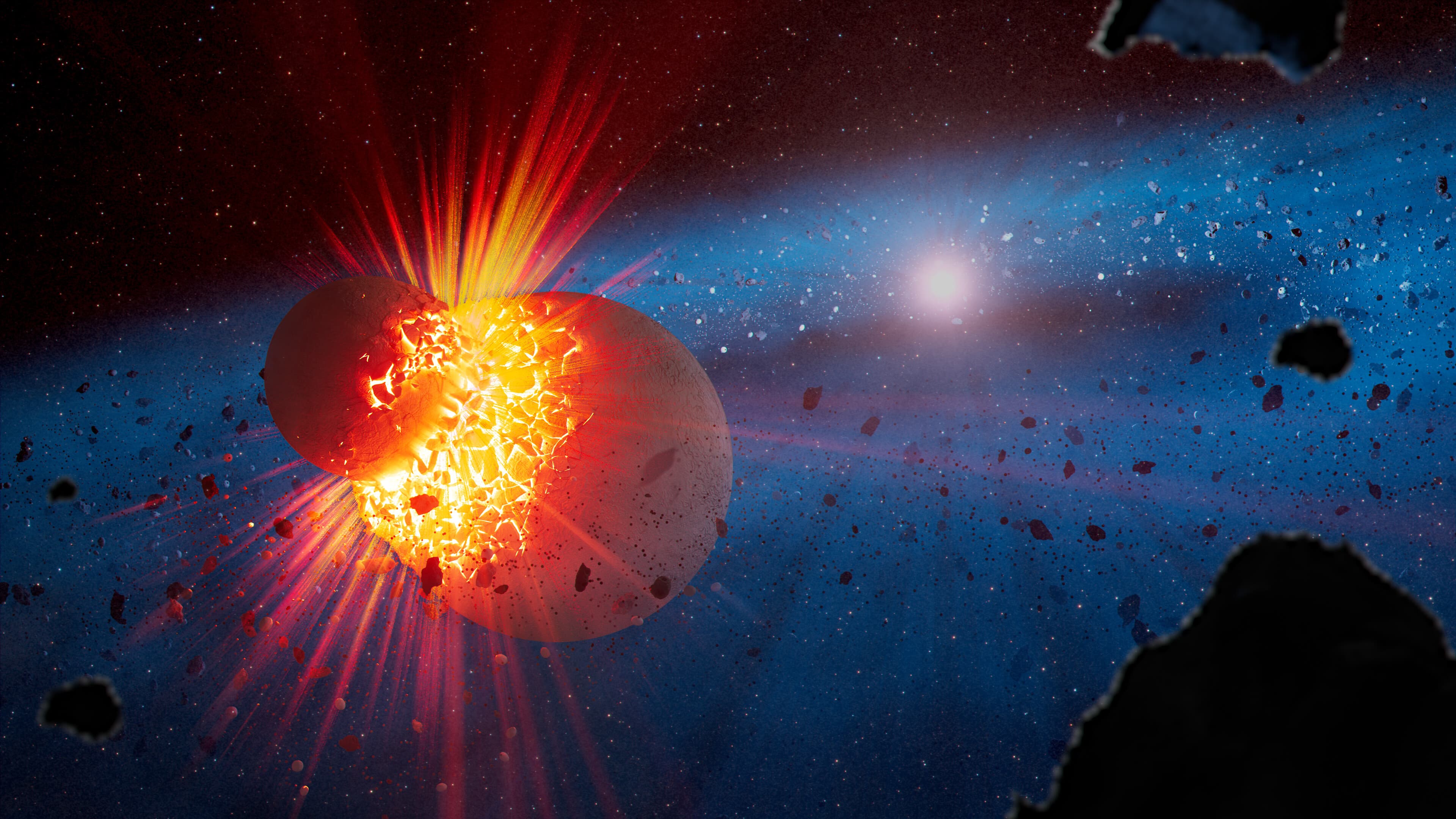
A different route remains viable. A large, differentiated Kuiper Belt object could have passed within Neptune's Roche limit, where tides would pull it apart and put some of its interior material into orbit. Simulations cited in the paper allow an unusually massive object to leave silicate-rich reaccreted debris, potentially helping with the missing ice. The trade-off is dynamical: the authors say the initially massive debris disc from such an encounter would probably destabilise Triton. A hybrid history, in which disrupted dwarf-planet material first built Neptune's primordial moons, would be difficult to distinguish spectroscopically.
The water-ice non-detection complicates both routes. Differentiated regular moons should have had ice-rich outer shells, while a tidally shredded Kuiper Belt object should usually contribute abundant ice. The paper estimates that Neptune's entire present inner satellite system contains only about 1% of the combined mass of Uranus's five large regular moons, assuming a density of 2 grams per cubic centimetre. The surviving material may have been volatile-poor, or later collisions may have removed most of its ice. The spectra establish no clear surface ice bands; they do not prove that water is absent at every depth.
Proteus adds another caution against treating the debris as uniform. It shares the deep 3-micrometre OH band but is poor in the 2.72-micrometre phyllosilicate signature. The paper says Proteus may have reaccreted from a different zone or parent body, or later heating may have dehydrated minerals on its surface. All three moons and the rings also carry an unidentified hydrated component for which the team found no clear match in several laboratory spectral libraries. Its identity could reveal whether the material records relatively unaltered feedstock or a hotter, deeper layer of the predecessor.
What the spectra change—and what they do not
The spectral result gives origin models chemical constraints that orbital architecture alone cannot provide. A source body had to remain warm enough for prolonged aqueous alteration, yet much of the magnesium-rich phyllosilicate material must also have avoided later heating above roughly 700 kelvin, where the paper says those phases would dehydrate. Models of Triton's capture, satellite collisions and debris reaccretion now have to produce both outcomes: excavation of deep altered rock and survival of its mineral signature.
Those constraints strengthen the case that Neptune's rings and small inner moons contain exposed interior material, but they stop short of proving a single catastrophe. The authors say better laboratory spectra of the unidentified 3-micrometre carrier, along with detailed simulations of how a Triton-perturbed debris disc evolves, are needed to separate a destroyed moon system from a shredded Kuiper Belt object. Until those tests exist, the 2.72-micrometre band changes what any origin theory must explain while the missing water ice keeps the identity of the parent body open.
Reporting trail
Primary sources
For an image post, download the card and copy this suggested caption.
Larissa, Galatea and the rings carry a 2.72-micrometre feature associated with magnesium-rich phyllosilicates, but missing water ice and a shredded dwarf-planet alternative keep their origin unsettled. Read the full report: https://www.spaceexploration.in/news/jwst-neptune-inner-moons-phyllosilicates #SpaceExplorationNews #SpaceNews #SpaceScience