Space policy
NASA’s interim NEPA rule takes effect with 19 adopted exclusions
Part 1216 now codifies previously adopted exclusions, one- and two-year review deadlines, page caps and a defined role for commercial project sponsors.
Add us as a preferred source on Google Add us as a preferred source on Google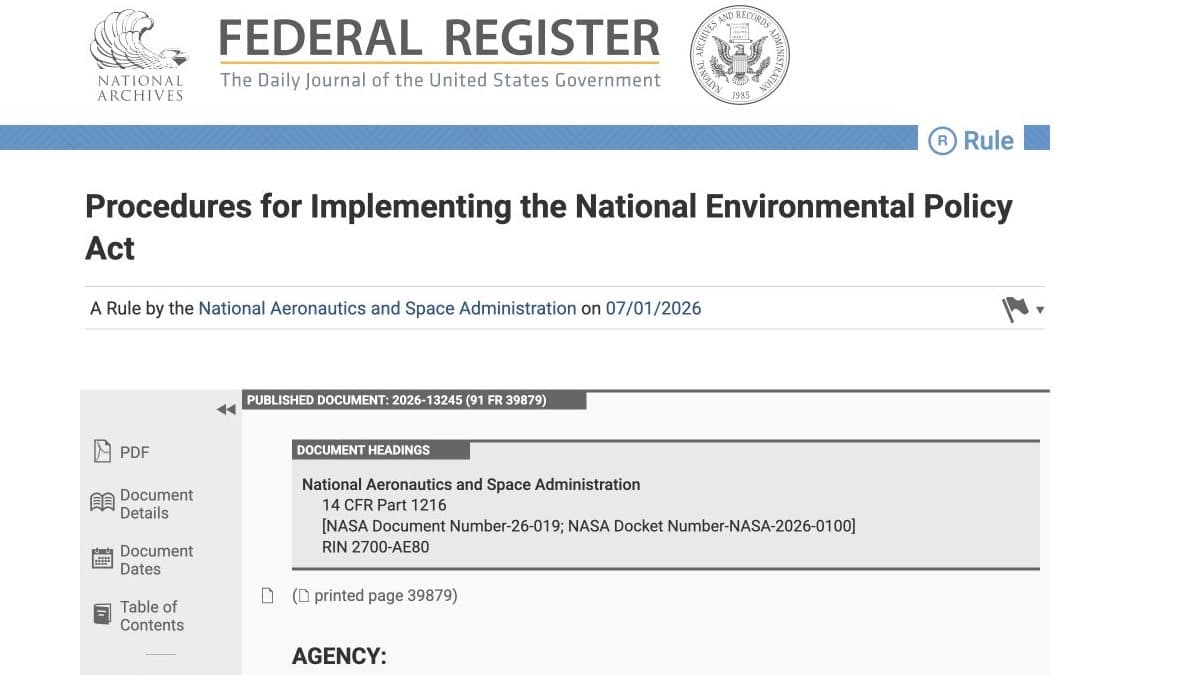
NASA’s rewritten procedures for the National Environmental Policy Act took effect on August 17, replacing the agency’s previous 14 CFR Part 1216 framework. The operative rules put 19 categorical exclusions that NASA had already adopted into the Code of Federal Regulations, set explicit clocks and page limits for longer reviews, and spell out how non-federal project sponsors may help prepare environmental documents under NASA supervision. For mission and facility planners, the practical change is a more prescribed path for deciding whether a proposal can be excluded, needs an environmental assessment or must proceed to an environmental impact statement.
The rule was published July 1 as an interim final rule, not a completed post-comment rule. NASA made it effective August 17 and closed comments July 31; the Regulations.gov docket records four submissions. NASA said it will consider those comments and address them in a later final rule, with revisions if warranted. The procedures now govern in the meantime.
What NASA added to the categorical-exclusion list
The categorical-exclusion list adds no newly invented categories in August. Eighteen came from a February 2026 adoption notice covering exclusions originally used by other federal agencies, and the nineteenth came from NASA’s April 2024 adoption of an Air Force exclusion for certain supersonic flights. Codifying them matters operationally: planners can now find the full list and its conditions in Part 1216 rather than reconstructing it from the two earlier notices.
Several of the adopted exclusions map directly to spaceport work. They cover, subject to stated conditions, power lines about 10 miles or less—or about 20 miles when placed in previously disturbed or developed rights-of-way—pipeline segments generally shorter than 20 miles in disturbed corridors, rooftop or previously disturbed-site solar projects, and controlled outdoor drop, burn, impact or similar tests. NASA’s February notice pointed to evolving power needs at multi-user spaceports, gas and water lines for launch facilities, solar installations, and spacecraft or propellant drop tests as expected uses.
Other entries reach facility and site management: certain new or expanded buildings on no more than five cumulative acres, utility and communications upgrades within existing corridors, radar and telemetry equipment at launch or previously disturbed sites, wetland and water restoration, hazardous-material abatement and demolition, and decommissioning or transferring aging aircraft and vessels. A separate category covers public launch viewing, media, outreach and visitor events when they do not require permanent infrastructure changes. Each has limiting conditions; the list is not a blanket exemption for every project with a similar label.
The supersonic category is narrower than a general clearance for sonic-boom work. It applies to operations over land above 30,000 feet mean sea level, or over water above 10,000 feet and more than 15 nautical miles from land, and requires a Record of Environmental Consideration. NASA adopted it in 2024 for programs including Quesst. Codification does not extend the category to lower flights or operations closer to shore.
NASA also removed two administrative exclusions: one for procedural rules, manuals, directives and requirements, and another for information-gathering work such as inventories, audits and studies. The agency’s explanation is not that those activities now demand fuller environmental review. It says they fall outside NEPA’s statutory definition of a major Federal action, so NEPA does not apply to them in the first place.
A categorical exclusion is not an automatic pass
Before applying any categorical exclusion, NASA must decide that the proposed action fits the category and that no extraordinary circumstance is likely to produce significant effects. The rule lists potential public-health or safety effects, highly uncertain or unique risks, unusual project size or scope, likely legal violations, and effects on sensitive natural, cultural or historic resources among the warning signs. If an extraordinary circumstance exists, NASA may still use the exclusion only when the foreseeable adverse effects are not likely to be significant or the action is modified to avoid them.
NASA may use several exclusions for different parts of one action, but it must consider the parts together for aggregate impacts. When a listed category calls for a Record of Environmental Consideration, NASA must document the exclusion determination and the extraordinary-circumstances review. That distinction is practical: an exclusion can shorten the process, but it remains a documented applicability decision rather than an automatic waiver.
Review clocks and document limits are now explicit
Environmental assessments now have a 75-page text limit and must be completed within one year after NASA posts notice that an assessment will be prepared. Environmental impact statements normally have a 150-page limit, rising to 300 pages for actions of extraordinary complexity, and a two-year deadline from the notice of intent. Citations, appendices, maps, diagrams, graphs and tables do not count toward those page caps, but NASA bars appendices from carrying substantive analysis merely to evade the limit.
NASA may extend either deadline only when publishing the most complete version possible would still be inadequate. The agency must consult a non-federal project sponsor, obtain the sponsor’s consent when practicable, and post the extension length and justification on a public-facing website. The rules also let NASA use a programmatic assessment or impact statement without additional review for five years unless substantial new circumstances or information affect the significance analysis; after five years, NASA must document a reevaluation before relying on it again.
To reduce duplicate work, NASA may rely on another federal agency’s assessment or impact statement after an independent review and may modify that document when needed. Programmatic documents can support later tiered reviews. These provisions do not eliminate analysis; they define when existing work can carry forward and when NASA has to revisit its assumptions.
Sponsors can draft documents, but NASA keeps responsibility
A commercial or other non-federal sponsor may prepare an assessment or impact statement, but only under NASA’s supervision. The sponsor must account for the project lifecycle—including construction, operation and decommissioning—and support agency coordination and public engagement. NASA determines the scope, independently evaluates the document, remains responsible for its analytical and legal sufficiency, and issues any finding of no significant impact or record of decision. A sponsor considering a fee-based expedited deadline must consult NASA before asking the Council on Environmental Quality.
The rule retains a hierarchy for proposals that cannot use an exclusion or an existing review. NASA says a new agency-developed launch vehicle or space transportation system, a Restricted Earth Return sample mission, or substantial construction likely to cause significant effects outside an existing master plan would normally require an impact statement. Launching a spacecraft with a space nuclear system and major facility, master-plan or land-use changes would normally receive an assessment.
NASA says recent agency data put 98% of actions under categorical exclusions, 1.4% under assessments with findings of no significant impact and 0.16% under impact statements with records of decision. Those proportions explain why the revised exclusion process will be the part most planners encounter. The operative text is in force, but its next formal checkpoint is NASA’s response to the closed docket in the later final rule.
Reporting trail
Primary sources
Federal RegisterProcedures for Implementing the National Environmental Policy Actfederalregister.gov
eCFR14 CFR Part 1216—Environmental Qualityecfr.gov
Federal RegisterCategorical Exclusion Adoption Public Noticefederalregister.gov
Federal RegisterAdoption of a Department of the Air Force Categorical Exclusion Under the National Environmental Policy Actfederalregister.gov
Regulations.govNASA-2026-0100: Procedures for Implementing the National Environmental Policy Actregulations.gov
For an image post, download the card and copy this suggested caption.
Part 1216 now codifies previously adopted exclusions, one- and two-year review deadlines, page caps and a defined role for commercial project sponsors. Read the full report: https://www.spaceexploration.in/news/nasa-nepa-procedures-categorical-exclusions #SpaceExplorationNews #SpaceNews #SpacePolicy