Commercial weather data
NOAA buys 4,200 daily radio-occultation profiles from PlanetiQ
The $2.73 million, 74-day bridge order also assigns PlanetiQ 500 ionospheric tracks a day while NOAA prepares a two-year successor procurement under a broader $2.35 billion vehicle.
Add us as a preferred source on Google Add us as a preferred source on Google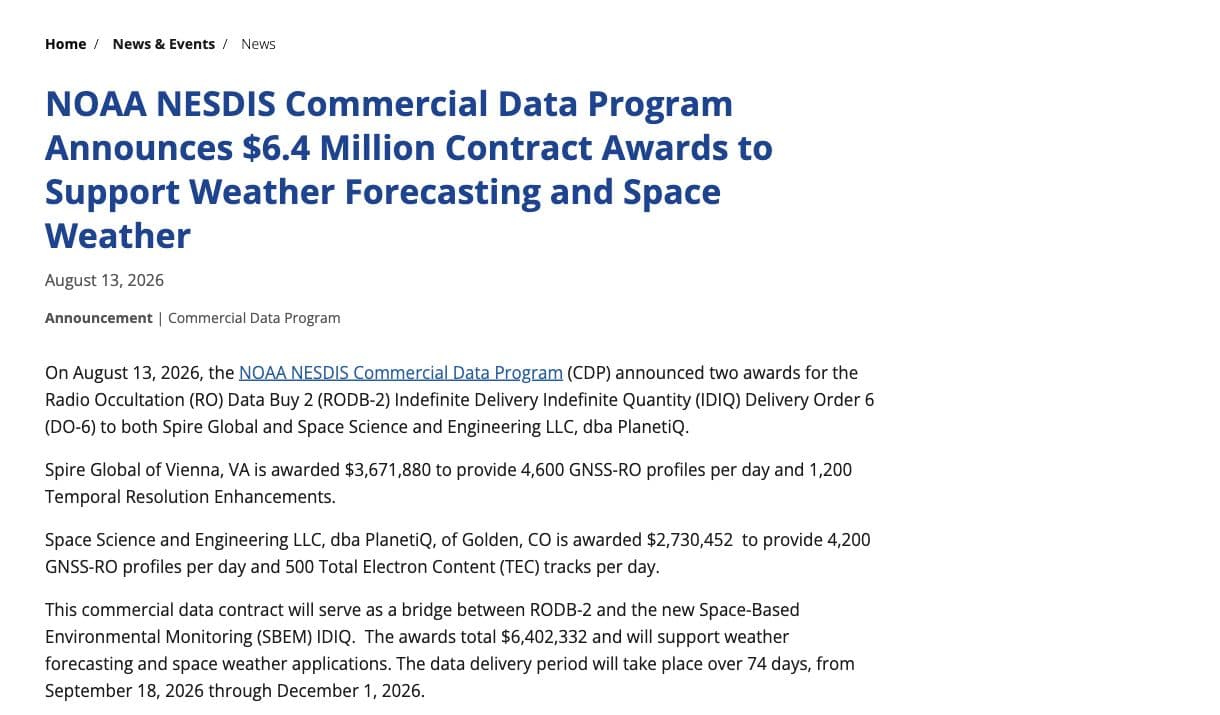
NOAA has awarded PlanetiQ a $2,730,452 firm-fixed-price order for commercial weather and space-weather data, the agency announced on August 13. From September 18 to December 1, 2026, the company is due to provide 4,200 Global Navigation Satellite System radio-occultation profiles and 500 Total Electron Content tracks each day. The 74-day order keeps data flowing while NOAA moves between procurement vehicles.
PlanetiQ is one of two suppliers in Radio Occultation Data Buy 2 Delivery Order 6. NOAA awarded Spire Global $3,671,880 for 4,600 daily GNSS-RO profiles and 1,200 Temporal Resolution Enhancements, taking the combined order to $6,402,332. PlanetiQ therefore receives 42.6% of the announced value and is assigned 4,200 of the 10,000 profiles NOAA counts across the daily package, as well as all 500 TEC tracks listed in the notice.
What $2.73 million buys
Using NOAA's stated 74-day duration, PlanetiQ's contracted daily rates correspond to 310,800 radio-occultation profiles and 37,000 TEC tracks over the performance period. Those totals describe scheduled delivery volume, not a disclosed unit price. The award bundles two different data products, and NOAA did not publish the pricing split, so dividing $2.73 million by either count would misstate what the agency agreed to pay for each product.
Radio occultation uses signals from navigation satellites as they pass through Earth's atmospheric limb. NOAA says the way those radio waves bend and slow can be used to calculate vertical profiles of temperature, pressure and humidity for weather forecasting. TEC tracks measure the total electrons along a signal path through the ionosphere, supplying a different observation for space-weather applications. The two products are related by their use of navigation signals but are not interchangeable measurements.
NOAA says it, NASA, the U.S. Air Force and the U.S. Navy will ingest the purchased data into numerical weather-prediction systems and space-weather applications. The combined order carries unlimited data rights for the 500 daily TEC measurements. Because PlanetiQ is the only Delivery Order 6 vendor assigned TEC in the agency notice, that ionospheric component sits entirely in its package; the notice does not publish separate acceptance thresholds or payment milestones.
A smaller bridge, not a new annual baseline
The comparison with the order now ending shows why the $2.73 million figure needs its 74-day context. Delivery Order 5 ran for 365 days from September 18, 2025, and gave PlanetiQ $24,345,500 for 7,000 GNSS-RO profiles and 2,500 low-latency TEC tracks per day. The bridge order cuts PlanetiQ's daily profile allocation by 40% and its daily TEC allocation by 80%, while shortening the performance period to about one-fifth of a year.
Across both vendors, however, NOAA still counts 10,000 radio-occultation profiles per day in Delivery Order 6, the same headline total as Delivery Order 5. What changed is the mix: the earlier order put 7,000 profiles and all 2,500 TEC tracks with PlanetiQ, whereas the bridge assigns Spire 4,600 profiles plus 1,200 temporal enhancements and leaves PlanetiQ with 4,200 profiles and 500 TEC tracks. This suggests a reallocation inside a short transition order, not a simple retreat from commercial radio occultation.
The procurement structure makes those shifts possible. NOAA established the current RODB-2 pool in March 2023 with PlanetiQ and Spire, a shared maximum value of $59,312,954 and a five-year ordering period. That ceiling was never guaranteed revenue for either company; individual fixed-price delivery orders determine the funded work. Delivery Order 6 demonstrates the commercial consequence: the same two suppliers remain in the pool, but their volumes and award shares can change from one order to the next.
The market beyond this bridge
NOAA's intended successor is materially broader. In April 2026, the agency sought proposals for a Space-Based Environmental Monitoring IDIQ with a stated estimated value of $2.35 billion over 10 years. It covers pilots and operational deliveries across radio occultation, GNSS reflectometry, microwave sounders, multispectral imagery, infrared sounders, thermospheric neutral-density measurements, active sensors and future environmental data. NOAA also said a company could enter with a plan to put an asset in orbit rather than an already operational satellite.
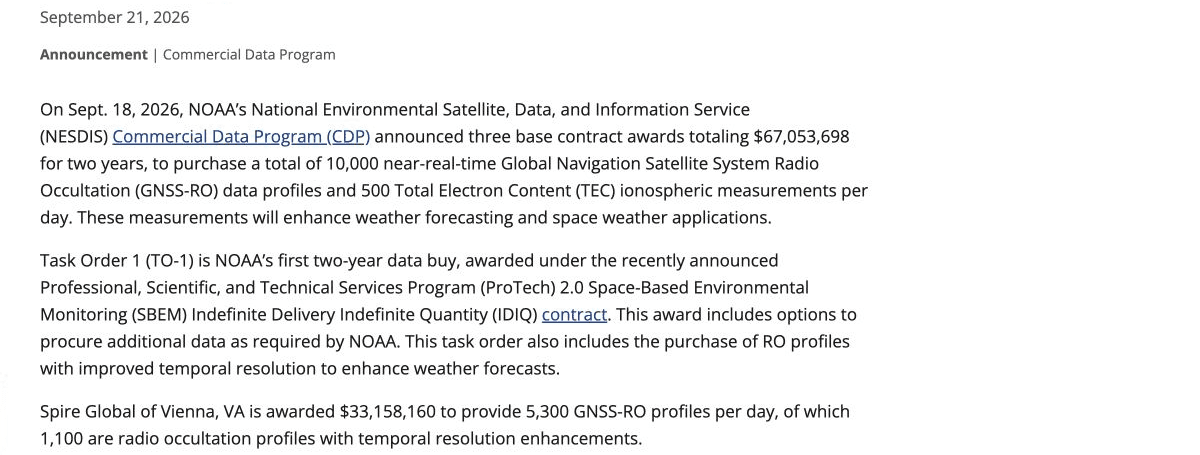
Radio occultation remains the first named task order under that successor. NOAA solicited a two-year SBEM Task Order 1 running from December 1, 2026, to December 1, 2028. Delivery Order 6 ends on that same December 1 start date. Read together, the dates support NOAA's description of the current awards as a bridge designed to avoid a delivery gap; the reviewed NOAA pages did not identify the Task Order 1 winners or its awarded value as of August 20.
PlanetiQ says it is preparing multiple next-generation GNOMES satellites for launch later in 2026 and expects them to increase its radio-occultation capacity for SBEM. That schedule and capacity forecast come from the company's August 17 release, not from NOAA, and no launch provider, mission date or resulting daily output was stated. The $2.73 million bridge order therefore confirms near-term demand, but it does not establish PlanetiQ's share of the successor programme.
The core award figures, delivery volumes and transition dates are confirmed by NOAA, while PlanetiQ's release supplies its fleet plan. No full Delivery Order 6 contract, product-level price schedule, quality specification or acceptance record was publicly available in the reviewed sources. The next material market evidence will be NOAA's SBEM awards: they will show which vendors convert the much larger acquisition vehicle into funded work after the bridge ends on December 1.
Reporting trail
Primary sources
NOAA NESDISNOAA NESDIS Commercial Data Program Announces $6.4 Million Contract Awards to Support Weather Forecasting and Space Weathernesdis.noaa.gov
PlanetiQPlanetiQ Awarded $2.73 Million NOAA Contract to Provide GNSS-RO and TEC Dataprnewswire.com
NOAA NESDISNOAA CDP Announces RODB-2 IDIQ Delivery Order-5 Contract Awardsnesdis.noaa.gov
NOAA NESDISNOAA Awards Radio Occultation Data Buy II Indefinite Delivery/Indefinite Quantity Contracts Under CWDPnesdis.noaa.gov
NOAA NESDISNOAA/NESDIS Solicits New IDIQ for Space-Based Environmental Monitoring Datanesdis.noaa.gov
NOAA NESDISNOAA/NESDIS Solicits Radio Occultation Task Order under new IDIQnesdis.noaa.gov

For an image post, download the card and copy this suggested caption.
The $2.73 million, 74-day bridge order also assigns PlanetiQ 500 ionospheric tracks a day while NOAA prepares a two-year successor procurement under a broader $2.35 billion vehicle. Read the full report: https://www.spaceexploration.in/news/planetiq-noaa-ro-tec-contract #SpaceExplorationNews #SpaceNews #SpaceIndustry