Galactic archaeology
Pristine paper details metallicity catalogue for 15 million stars
The October 14 paper describes a deeper sample for studying the Milky Way’s halo. Its metal-poor candidates are photometric estimates, with counts that depend on uncertainty cuts.
Add us as a preferred source on Google Add us as a preferred source on Google
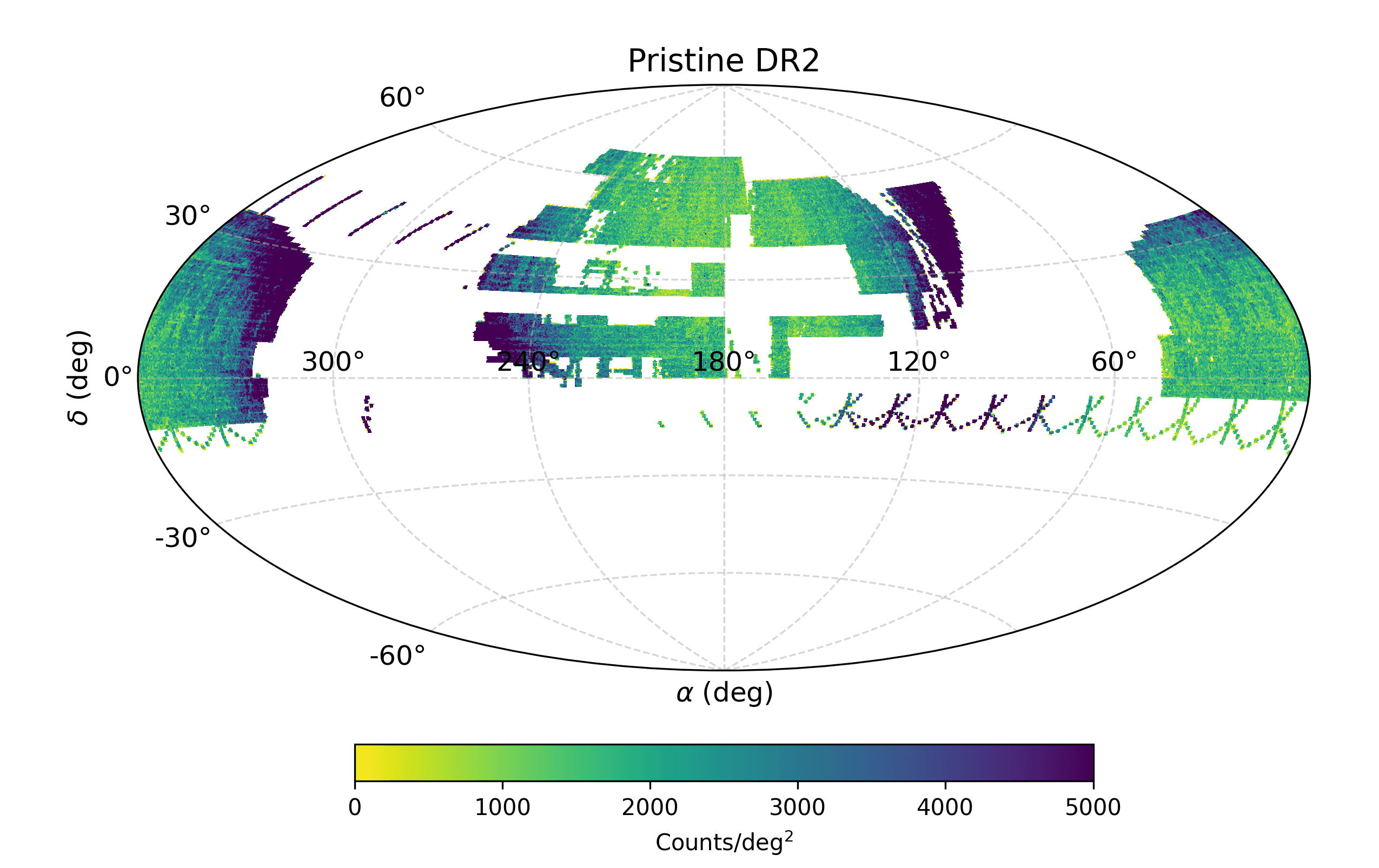
A paper posted on October 14 details the Pristine survey’s second public catalogue, with estimates of stellar metal content for about 15 million stars across roughly 8,000 square degrees of sky. The research team, led by Zhen Yuan and Anke Ardern-Arentsen, describes a deeper sample for finding metal-poor stars in the Milky Way’s halo.
The paper analyses observations collected from March 2015 through January 2025. The data archive itself predates the paper: Zenodo lists July 1, 2026 as the publication date of its version v2 record. October 14 marks the paper’s submission to arXiv, rather than the catalogue’s first public availability.
Pristine uses the MegaCam imager on the Canada-France-Hawaii Telescope with a narrow filter around calcium’s H and K absorption lines. The team combines those brightness measurements with Gaia photometry to estimate metallicity. Its paper describes metal-poor stars as probes of early stellar systems and their formation; these estimates help select targets for spectroscopic follow-up.
The survey’s release page identifies the catalogue as Data Release 2 and documents its greater depth: it reaches approximately G=20.5 in Gaia’s brightness scale, compared with the earlier release’s limit of G=17.65. It also adds about 1,500 square degrees of coverage. The paper notes that depth varies across the survey footprint and with stellar colour.
The candidate totals depend on the uncertainty allowed. Applying its looser metallicity-uncertainty cut, the team counts 232,707 very metal-poor and 6,648 extremely metal-poor candidates. A tighter cut reduces those totals to 118,005 and 1,472. The paper warns that the looser selection admits more contamination from stars with higher metal content whose measurement errors push them into the candidate list. Those counts therefore describe photometric candidates, rather than confirmed abundances for every star.
For users assessing individual targets, the catalogue provides metallicity estimates under separate giant-star and dwarf-star models, uncertainty percentiles and quality flags, according to the paper. The authors recommend quality cuts to remove unreliable measurements and caution that the model performs less well for more metal-rich stars.
The Pristine release page links both the paper and the public Zenodo archive, making the catalogue accessible to researchers beyond the survey team. Zenodo offers the 6.6 GB Pristine_DR2_v2.fits file under a Creative Commons Attribution 4.0 licence. The paper’s catalogue description and quality criteria accompany that download route.
Reporting trail
Primary sources

For an image post, download the card and copy this suggested caption.
The October 14 paper describes a deeper sample for studying the Milky Way’s halo. Its metal-poor candidates are photometric estimates, with counts that depend on uncertainty cuts. Read the full report: https://www.spaceexploration.in/news/pristine-second-public-star-catalogue #SpaceExplorationNews #SpaceNews #SpaceScience