Science
Hubble cluster ages reconstruct the Milky Way’s ancient LKH merger
A separate age–metallicity track among inner globular clusters points to a merger before Gaia-Sausage-Enceladus, while LKH is the authors’ name for a modelled progenitor that unites three earlier clues.
Add us as a preferred source on Google Add us as a preferred source on Google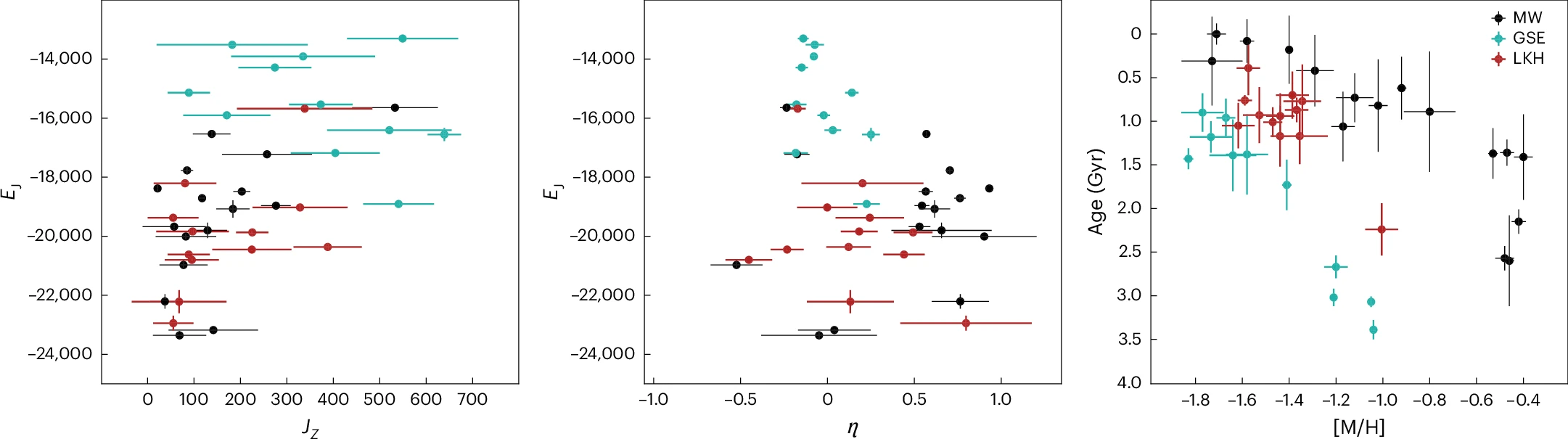
A Hubble-based study published on August 17 in Nature Astronomy reconstructs a major dwarf-galaxy merger from the Milky Way’s first few billion years. The telescope did not observe the collision. Researchers instead used the ages, metal content and present-day motions of ancient globular clusters to infer that at least one substantial external system joined the young Galaxy before the better-known Gaia-Sausage-Enceladus merger. They call the reconstructed progenitor Low-energy-Kraken-Heracles, or LKH.
The central evidence is a third sequence among 39 globular clusters in the inner Milky Way. One sequence matches clusters formed inside the Galaxy, another is associated with Gaia-Sausage-Enceladus, and an intermediate sequence contains 12 clusters assigned to LKH with membership probabilities above 50%. At a given metal abundance, the LKH group is younger than the in-situ Milky Way group and older than the Gaia-Sausage-Enceladus group. The authors interpret that separation as evidence for an independent, earlier accretion event.
How Hubble separates overlapping histories
Globular clusters are dense, old groups of stars whose shared formation histories make their ages easier to compare than those of isolated stars. That matters in the crowded inner Galaxy, where billions of years of mixing and the Milky Way’s rotating bar can erase much of a merger’s dynamical signature. The study concentrated on clusters within about 6 kiloparsecs, or 20,000 light-years, of the Galactic centre, where debris from the earliest mergers is expected to remain.
The team derived new ages for 17 clusters observed by Hubble through its F606W and F814W optical filters, then combined them with earlier measurements made on the same scale to reach 39. The analysis corrected for uneven foreground dust and used proper motions to remove unrelated field stars before fitting one set of stellar-evolution models to every cluster. Its typical relative-age uncertainty was 0.26 billion years, compared with 0.91 billion and 0.43 billion years for overlapping clusters in two earlier studies.
Those are deliberately relative ages. The paper warns that theoretical stellar models can shift the absolute age scale; its oldest fitted cluster has an isochrone age of 14.48 billion years, older than the Universe. That does not mean the cluster predates the Big Bang. For this reconstruction, the useful measurement is how far apart the clusters sit on one consistently derived age scale, not whether every fitted age is an accurate cosmic timestamp.
The researchers then fitted mixtures containing two, three or four progenitors. Their model combined each cluster’s age and metallicity with three orbital quantities calculated over 200 orbits in a Galactic potential that includes the central bar. The three-progenitor case had the strongest Bayesian evidence: the two-component alternative was decisively disfavoured, while the four-component case was also disfavoured under the comparison scales used in the paper. This is a statistical reconstruction built on stated assumptions, not the recovery of an intact dwarf galaxy.
One name for three earlier clues
LKH is a composite name, not a newly photographed object and not evidence that three separately confirmed galaxies merged at once. The Low-energy element refers to a previously identified group of inner globular clusters with tightly bound orbits. Later work connected those clusters to Kraken, a merger progenitor predicted from simulations and clusters of uncertain origin. Heracles was the name given to a chemically primitive, metal-poor population of inner-Galaxy stars whose external origin has remained contested.
The new analysis finds that 12 of the 15 clusters previously assigned to the Low-energy group occupy the intermediate sequence. The authors therefore use Low-energy-Kraken-Heracles for the progenitor represented by those clusters and suggest it could be the largest contributor to the accreted part of the Heracles population. They do not establish that every star labelled Heracles came from LKH. Nor can the method exclude smaller progenitors that formed no globular clusters or whose clusters were completely disrupted.
A relative date, not a timestamp
The paper describes its robust timing result as about 1.8 billion years before Gaia-Sausage-Enceladus. NASA’s public account translates that interval into a merger about 11.8 billion years ago by using a rounded 10-billion-year date for the later event. In the paper’s modelling discussion, the authors instead anchor Gaia-Sausage-Enceladus at about 10.5 billion years ago and obtain an LKH date near 12.3 billion years ago. The two absolute figures should therefore be read as model-dependent conversions of the relative interval, not as competing direct observations of a dated collision.
Even the conversion from cluster chronology to merger chronology has an assumption. The age–metallicity model treats the end of globular-cluster formation in a progenitor as its accretion time. Simulations cited by the authors allow a delay of roughly 0.5 to 1.5 billion years between the end of cluster formation and completion of a merger. They argue that this does not upset the relative ordering because the same method is applied to each progenitor, but it limits how literally any single absolute date can be read.
The progenitor’s mass is inferred in the same comparative way. By relating chemical enrichment to galaxy mass and anchoring the result to Gaia-Sausage-Enceladus, the study estimates that LKH contained roughly 500 million solar masses in stars. Most of its recovered cluster population lies inside 6 kiloparsecs of the Galactic centre. Because the early Milky Way was smaller than it was during the later merger, the authors infer a mass ratio between LKH and the Milky Way greater than about 0.2 to 0.3, making the event especially consequential for the young Galaxy.
What the reconstruction changes
The result supports a picture in which the earliest Milky Way was already a mixture of stars formed locally and stars brought in by other systems. Three Milky Way-like galaxies in the Auriga simulations show qualitatively similar, separated age–metallicity tracks for an in-situ component, a Gaia-Sausage-Enceladus-like merger and an earlier event analogous to LKH. That agreement is a consistency check rather than an observation of the Milky Way’s past, and it does not rule out a more complicated sequence of early mergers.
The next test is to expand the chronology beyond the present cluster sample. The paper points to future precise stellar ages from asteroseismology, including the European Space Agency’s PLAnetary Transits and Oscillations of stars (PLATO) mission, and colour–magnitude fitting with Gaia data. NASA says Hubble is also observing inner globular clusters not previously studied. Those measurements can test whether the LKH sequence remains distinct, refine the relative merger order and show how much of the inner Galaxy can reasonably be assigned to this reconstructed progenitor.
Reporting trail
Primary sources

For an image post, download the card and copy this suggested caption.
A separate age–metallicity track among inner globular clusters points to a merger before Gaia-Sausage-Enceladus, while LKH is the authors’ name for a modelled progenitor that unites three earlier clues. Read the full report: https://www.spaceexploration.in/news/hubble-milky-way-lkh-merger #SpaceExplorationNews #SpaceNews #SpaceScience