Astronomy surveys
SDSS-V DR20 opens more than three million spectra and 18 specialist catalogues
The July 30 release adds the first southern BOSS data, major eROSITA follow-up and six Local Volume Mapper targets; its newly reduced BOSS observations stop at February 2, 2025.
Add us as a preferred source on Google Add us as a preferred source on Google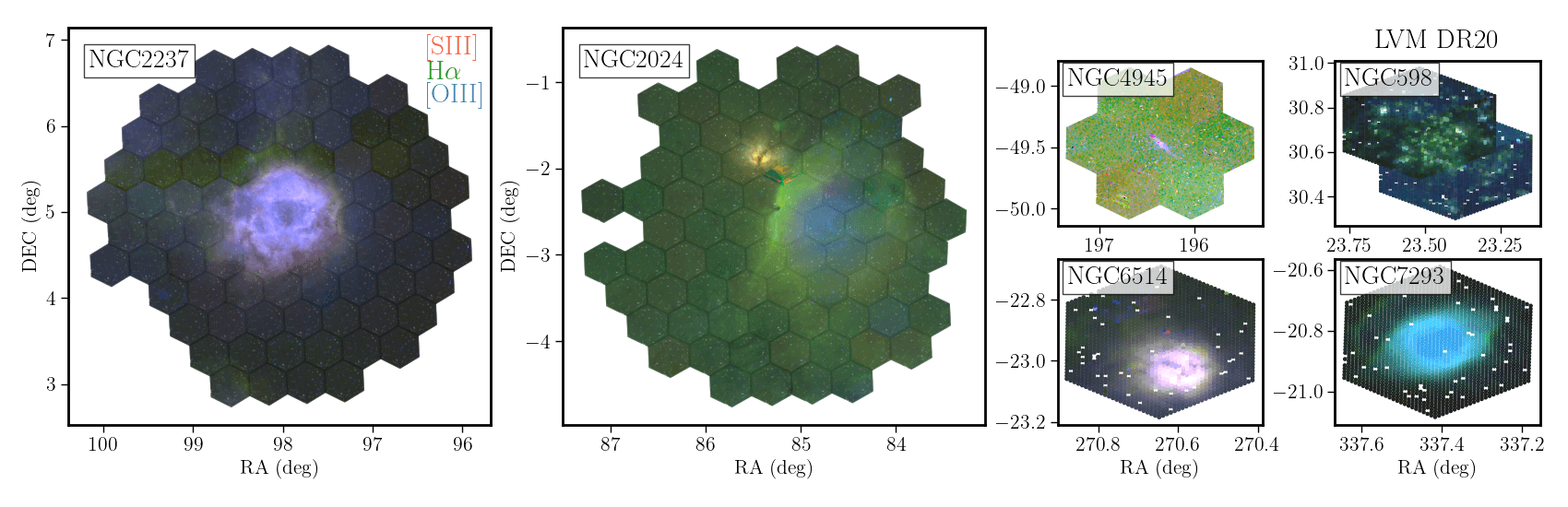
Data Release 20 from the Sloan Digital Sky Survey went public on July 30 with more than three million new low-resolution optical spectra and 18 value-added catalogues. It is the first SDSS-V release to combine BOSS spectra taken in both hemispheres, and it adds material for all three of the survey’s science programmes: the Black Hole Mapper, Milky Way Mapper and Local Volume Mapper. The practical change is not one enormous catalogue but several linked routes into stars, X-ray-selected sources, quasars, black holes and ionised gas.
An August 14 ScienceDaily article is follow-on coverage based on material supplied by Carnegie Science, not the release date. The technical paper was submitted to arXiv on July 28 and SDSS announced public access on July 30. DR20 is cumulative, while its newly reduced BOSS observations run only through February 2, 2025; it also includes older survey spectra and re-reductions of SDSS-V optical data released previously. Publication date, observing cutoff and historical coverage are therefore three different things.
What the three million spectra contain
The new BOSS total divides into more than two million spectra of 1.5 million stars for the Milky Way Mapper and more than one million spectra of about 0.5 million galaxies and quasars for the Black Hole Mapper. Spectra and unique objects are not interchangeable counts. Repeat visits, including observations designed to follow change over time, mean that one target can contribute several spectra. That is why the target totals do not add up to the headline figure.
The southern contribution comes from the du Pont 2.5-metre telescope at Las Campanas Observatory in Chile. DR20 combines it with new and reprocessed observations from the Sloan Foundation 2.5-metre telescope at Apache Point Observatory in New Mexico. This is the first public SDSS-V optical BOSS material from the southern hemisphere, giving the two BOSS-based mappers a common release spanning northern and southern fields. It does not mean every point on the sky has a spectrum; the survey still follows defined target selections.
For the Black Hole Mapper, DR20 contains about 1.1 million BOSS spectra for roughly 500,000 distinct objects, three to four times the DR19 volume. Its SPIDERS programme coordinates with eROSITA’s second data release to connect X-ray sources with optical identifications and redshifts, including active galactic nuclei, galaxy clusters and active stars. All-Quasar Multi-Epoch Spectroscopy and Reverberation Mapping add repeat quasar observations for variability studies and measurements related to the environments and dynamics of supermassive black holes.
The Milky Way Mapper receives more than two million optical spectra of 1.5 million stars. The release paper lists core programmes for young stars, the Galactic halo, a solar-neighbourhood census, white dwarfs and Galactic eROSITA sources. Those samples support work on stellar populations, compact systems and X-ray-emitting stars, with repeated observations available where the targeting strategy called for them. Researchers need the programme definitions and selection files when turning those spectra into population estimates.
What the 18 catalogues add
The 18 value-added catalogues comprise 14 new products and four that update or extend DR19 releases. Six are tied to Black Hole Mapper data and 12 to Milky Way Mapper data. The set includes quasar-spectrum properties; optical and X-ray properties for eROSITA sources; revised classifications for Fermi-detected sources; candidate white-dwarf binaries and cataclysmic variables; stellar rotation ages; parameters for halo stars; measurements for late-K and M dwarfs; and calculated stellar orbits.
A value-added catalogue is a derived layer, not another telescope exposure. Its authors have fitted, classified or cross-matched the survey data for a particular scientific question. That can save users from repeating specialist processing and make a sample easier to query, but each catalogue has its own method, input selection and caveats. The core spectra remain available for researchers who need a different model or want to test the published derivation.
DR20 does not add new infrared observations from APOGEE, the survey’s higher-resolution stellar spectrograph. Previously released APOGEE spectra and associated products remain present, but the paper directs users to the DR19 Astra version for the current APOGEE analysis. The genuinely new stellar spectroscopy in DR20 is the lower-resolution optical BOSS material. The paper says new all-sky infrared products, including the first southern SDSS-V APOGEE spectra, are planned for DR21.
LVM moves from one tile to six targets
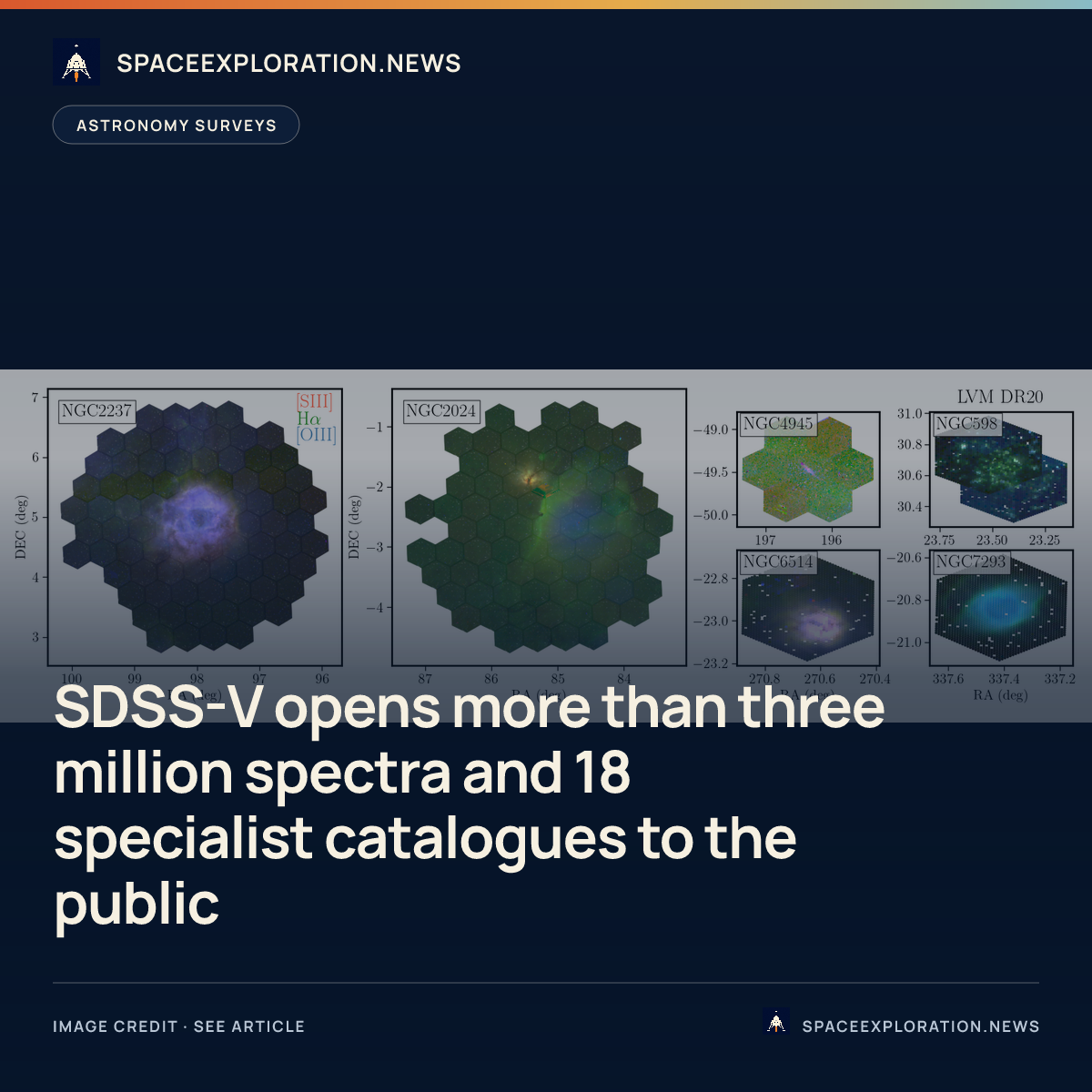
The Local Volume Mapper expands from the single tile previewed in DR19 to 169 tiles across six target regions and about 300,000 spectra. They cover the Flame and Horsehead region, Rosette and Trifid nebulae, the Helix planetary nebula, and the nearby galaxies M33 and NGC 4945. The paper groups them as three Galactic H II regions, one planetary nebula and two galaxies. Integral-field spectroscopy records a spectrum at many positions across each field, allowing gas conditions and motion to be mapped rather than represented by one line of sight.
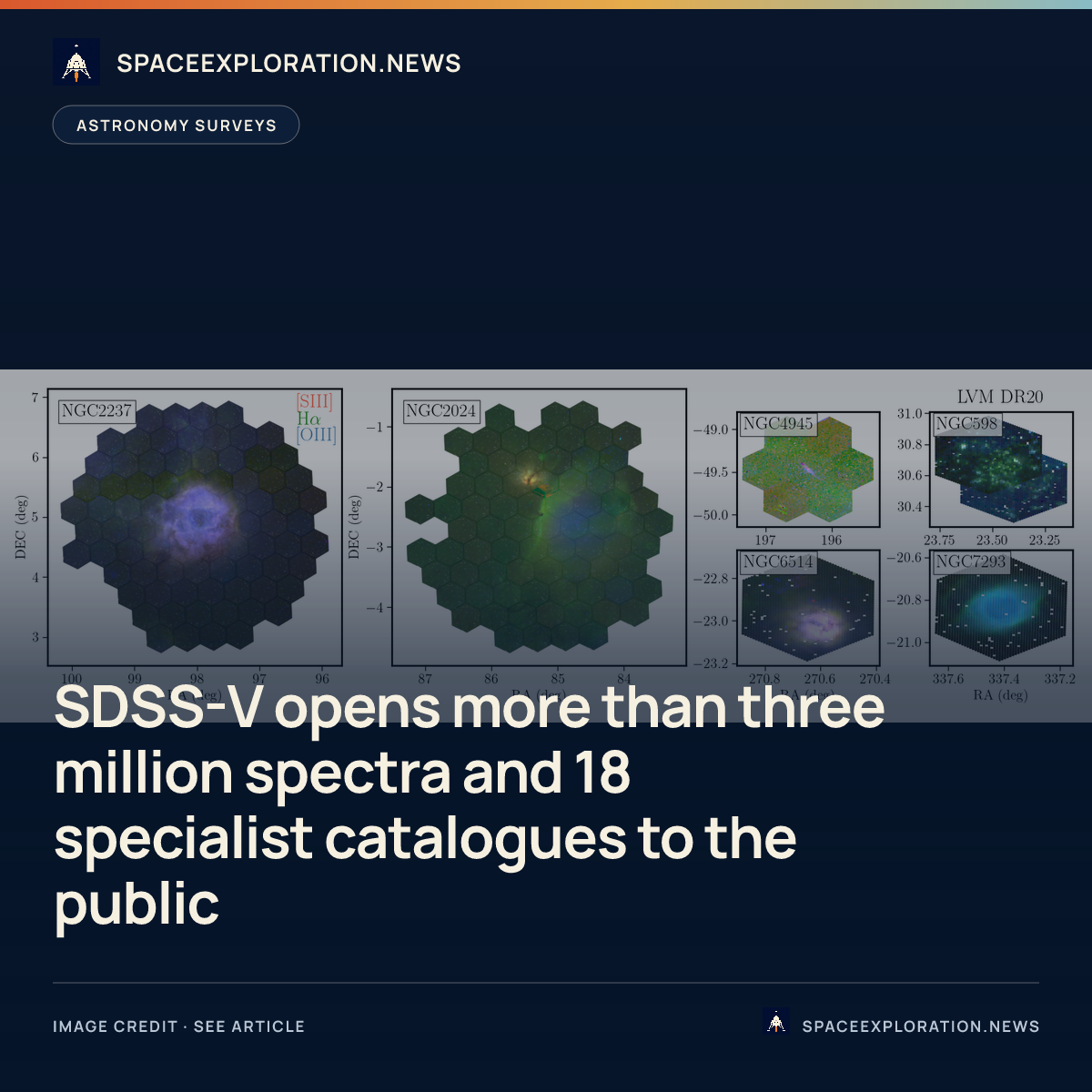
DR20 is also the first release of Local Volume Mapper data-reduction and data-analysis pipeline products. These include calibrated spectra, emission-line fluxes and gas-kinematic measurements. LVMvis provides an interactive view of the mapped regions and an RGB all-sky layer built from selected emission lines. The image accompanying this article is Figure 9 from the release paper: it shows the six released targets through three emission lines, so its colours encode measurements rather than a natural-colour camera view.
How researchers can use the release
The Science Archive Server exposes files and pipeline products, while SkyServer and its catalogue services support database queries. SciServer Compute supplies hosted notebooks close to the archive. Zora and Valis provide newer browser interfaces for spectra, and LVMvis is tailored to spatially resolved Local Volume Mapper data. The DR20 portal links these routes and tutorials. A researcher choosing among them is choosing an access layer: bulk files, catalogue queries, hosted analysis or visual inspection.
Black Hole Mapper teams can now build optical samples around eROSITA sources and analyse repeat quasar spectra; Milky Way Mapper teams can work across the named stellar programmes with both northern and southern BOSS observations; Local Volume Mapper users can study emission-line structure and gas motion in six complete target regions. The catalogues provide ready-made specialist measurements, while the underlying spectra allow re-analysis. Targeting documentation, pipeline versions and quality flags remain part of any defensible scientific use.
DR20 is a public snapshot of a survey still observing beyond its February 2025 cutoff. The release paper says DR21 is planned for 2027 with all-sky high-resolution infrared data, the first southern SDSS-V APOGEE spectra and a larger Local Volume Mapper sample. DR22 is planned for 2028 as the completing SDSS-V release. Until then, work based on the present files should identify DR20 and its pipeline versions rather than assume later observations are already included.
Reporting trail
Primary sources
Sloan Digital Sky SurveySloan Digital Sky Survey Launches Data Release 20sdss.org
arXivThe Twentieth Data Release of the Sloan Digital Sky Survey: First All-Sky BOSS Spectra, eROSITA-SDSS-V Mapper Coordinated Observations, and a Preview of the Local Volume Mapperarxiv.org
Sloan Digital Sky SurveySloan Digital Sky Survey Data Release 20 portaldr20.sdss.org
ScienceDailyA massive new cosmic map is revealing black holes, rare stars, and hidden gassciencedaily.com
For an image post, download the card and copy this suggested caption.
The July 30 release adds the first southern BOSS data, major eROSITA follow-up and six Local Volume Mapper targets; its newly reduced BOSS observations stop at February 2, 2025. Read the full report: https://www.spaceexploration.in/news/sdss-v-data-release-20 #SpaceExplorationNews #SpaceNews #SpaceScience