Science
Saguaro simulation shows how a galaxy could fade around a Webb little red dot
When researchers simulated the redshift-2 spiral at redshift 7, its faint host slipped below Webb-like limits while the compact nucleus remained. It is one analogue, not a universal answer.
Add us as a preferred source on Google Add us as a preferred source on Google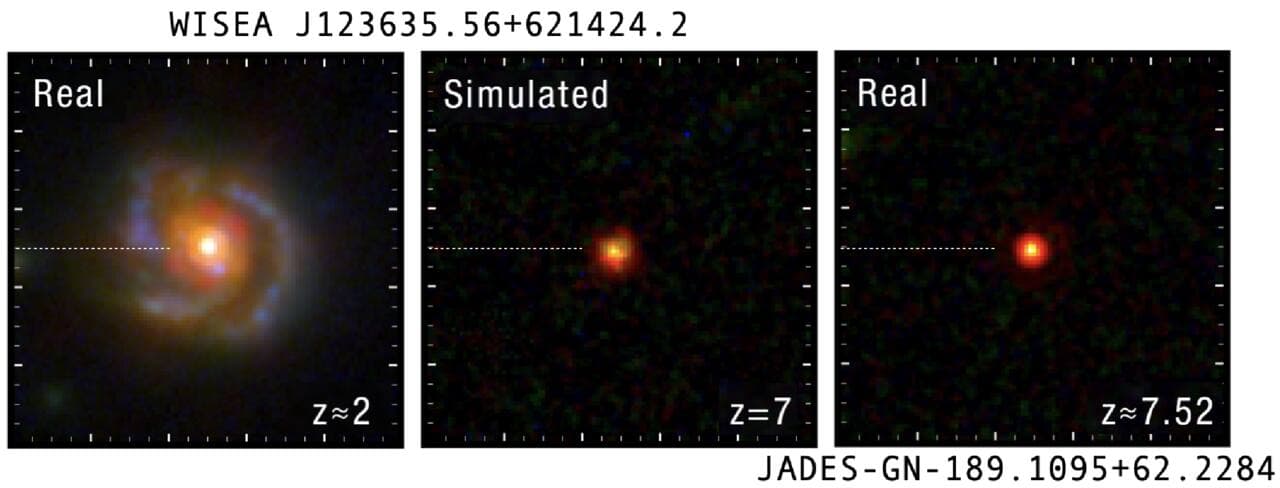
Move a face-on spiral galaxy much farther back in cosmic time, shrink its apparent size and dim each patch according to cosmological rules. In a new case study, most of WISEA J123635.56+621424.2—nicknamed Saguaro—drops into the background, while its compact red centre remains. At an artificial redshift of 7, the surviving point looks much like one of the little red dots found by the James Webb Space Telescope. The exercise offers a concrete way that some dots could be obscured, actively feeding black holes inside host galaxies whose outskirts are too faint to detect. It does not show that every little red dot has this origin.
The peer-reviewed study appeared in The Astrophysical Journal on July 29; an August 17 ScienceDaily report, based on NASA's account, returned it to the news cycle. Saguaro lies in the well-studied GOODS-North field at redshift 2.0145, so its light comes from about 3.3 billion years after the Big Bang. That is substantially closer than the redshift-4-and-beyond population usually called little red dots. The shorter distance lets Hubble and Webb resolve both Saguaro's spiral host and its compact nucleus, making it a useful lower-redshift analogue rather than a member of the same distant sample.
Why the spiral arms disappear
Cosmic expansion reduces an extended object's observed surface brightness in proportion to the fourth power of one plus its redshift. The penalty applies to every patch, but it is easiest to see in a galaxy's diffuse arms and outer disc, which begin close to a telescope's detection limit. A compact nucleus packs more light into less apparent area and can remain measurable after the low-surface-brightness host falls below the noise. Nothing in that calculation removes the stars; it changes which parts of the galaxy an observation can recover.
To demonstrate the effect, the team fit the spectral energy distribution in each Webb NIRCam pixel of Saguaro, then rescaled its angular size, shifted the observed bandpasses and applied the expected surface-brightness dimming. The mock image was matched to the F444W point-spread function and inserted into a real sky background. The researchers also applied uniform evolutionary brightening to keep the visual comparison useful. They call this a toy experiment: a physical forecast would have to let the nucleus and host evolve separately instead of freezing their relative structure and applying one simple correction.
A separate analytic model put numbers on the selection effect. For an exponential host with a central luminosity surface density of 100 solar luminosities per square parsec, a 1.2-kiloparsec scale length and an assumed rest-ultraviolet limit equivalent to 28.5 magnitudes per square arcsecond, the detectable fraction fell from 91.4% at redshift 2 to 31.1% at redshift 7. The model therefore lost about 69% of the host light at redshift 7 and 97.6% at redshift 9. Those percentages describe the authors' chosen profile and depth, not direct measurements of Saguaro or a prediction for every distant galaxy.
Why Saguaro is a useful analogue
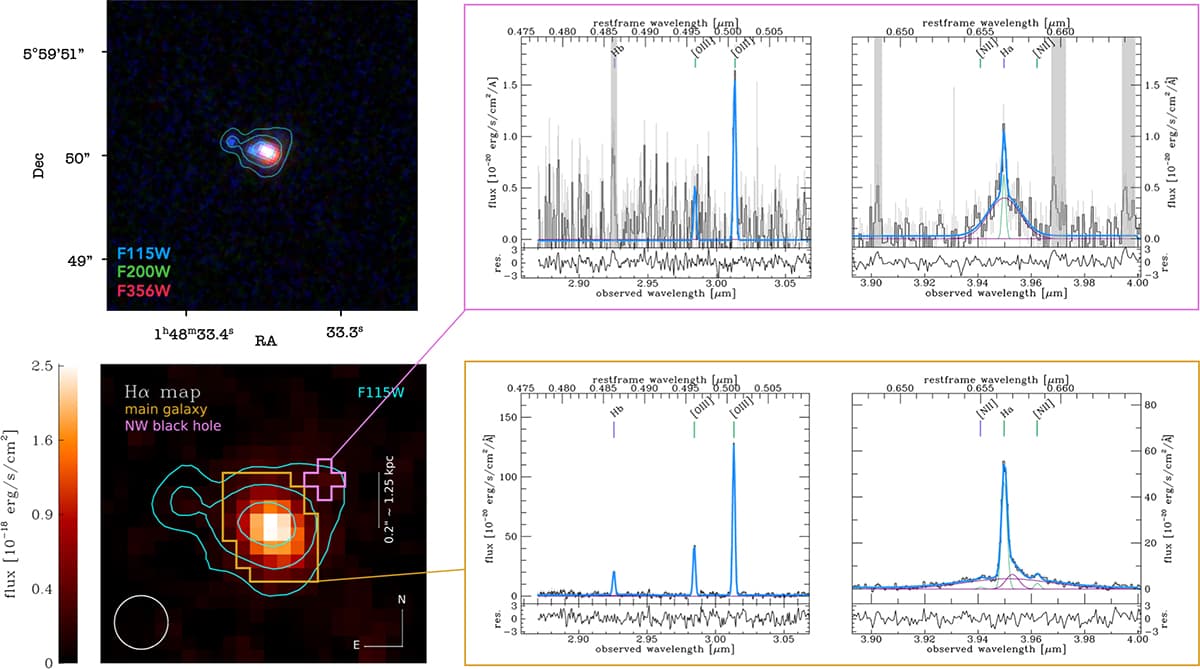
Saguaro supplies more than a convenient spiral picture. Hubble imaging from ultraviolet through near-infrared wavelengths and Webb NIRCam data show an extended face-on host around a bright central source. Image decomposition and spatially resolved Webb NIRSpec spectroscopy locate a V-shaped spectral energy distribution at the nucleus: relatively strong ultraviolet and infrared emission separated by a dip at visible wavelengths. That same broad shape is one of the defining observational features of little red dots. Here it can be tied to the centre of a clearly detected galaxy.
The multiwavelength evidence also supports a buried active galactic nucleus. In nearly 1.96 million seconds of Chandra exposure, the team recovered 246 net X-ray counts. Its spectral model requires a line-of-sight hydrogen column of at least 2.6 × 10²³ atoms per square centimetre, consistent with heavy obscuration, and gives an intrinsic 2–10 kiloelectronvolt luminosity of about 7.5 × 10⁴³ ergs per second. A broad hydrogen-alpha emission line adds evidence for rapidly moving gas near a black hole. These signatures make the analogy physically interesting, but resemblance does not establish that all little red dots contain the same engine.
Even within Saguaro, the blue side of the V is not fully settled. The authors can localise the component to the nucleus, but they cannot yet separate light from the accreting black hole from ultraviolet emission by compact young stars or a circumnuclear starburst. That uncertainty matters because little red dots may be a mixed population, and because both dust-obscured accretion and dense star formation can shape a galaxy's colours. Saguaro is a resolved test case for those possibilities, not a finished template.
The test beyond one galaxy
The paper's population check points in the same direction without proving individual hosts. The researchers stacked rest-ultraviolet images of 99 photometrically selected little red dots at redshifts 4 to 8 after matching their point-spread functions and masking neighbours. The combined image contains excess light beyond the central point source out to about 0.2 arcsecond, corresponding to an extended component roughly 2 to 3 kiloparsecs across. A stack restricted to 26 spectroscopically confirmed objects showed a similar excess. Stacking can reveal a faint average signal, but it cannot say that each object has the same structure, and the full sample need not consist entirely of active nuclei.
Taken together, Saguaro and the stack expose an observational bias: a galaxy can look nucleus-only when its extended light falls below the available depth. The study therefore keeps two interpretations open. Some little red dots may be isolated compact sources; others may sit inside ordinary-looking hosts that current images only partly recover. Their central light may also mix accretion and star formation in different proportions. NASA's account explicitly says Saguaro is not representative of every little red dot, a boundary that the single-object comparison cannot cross.
The next discriminating measurements are spatial, not merely redder. The authors point to planned high-resolution spectroscopy that can separate Saguaro's core from its surrounding galaxy and test what produces each side of the V-shaped spectrum. A larger census of lower-redshift analogues would show whether Saguaro is common or exceptional, while deeper or gravitationally lensed imaging could search for host light around individual distant dots. Until those tests are in hand, the disappearing-host experiment is best read as a mechanism that can work—not a family tree for the whole population.
Reporting trail
Primary sources
The Astrophysical JournalBeyond the Dot: An LRD-like Nucleus at the Heart of an IR-bright Galaxy and its Implications for High-redshift LRDsdoi.org
arXivBeyond the Dot: an LRD-like nucleus at the Heart of an IR-Bright Galaxy and its implications for high-redshift LRDsarxiv.org
NASA ScienceNASA Webb Explores Family Tree of Newly Discovered Distant Objectsscience.nasa.gov
ScienceDailyWebb's mysterious little red dots may be hiding entire galaxiessciencedaily.com

For an image post, download the card and copy this suggested caption.
When researchers simulated the redshift-2 spiral at redshift 7, its faint host slipped below Webb-like limits while the compact nucleus remained. It is one analogue, not a universal answer. Read the full report: https://www.spaceexploration.in/news/saguaro-galaxy-little-red-dot-simulation #SpaceExplorationNews #SpaceNews #SpaceScience