Starship Flight 13
Ship 40 reaches calmer water, giving SpaceX its first intact Starship to inspect
The upper stage survived its July 24 splashdown and about 24 days at sea. Its returned tiles and vehicle hardware can now be compared with reentry imagery and sensor data, although ocean exposure complicates the diagnosis.
Add us as a preferred source on Google Add us as a preferred source on Google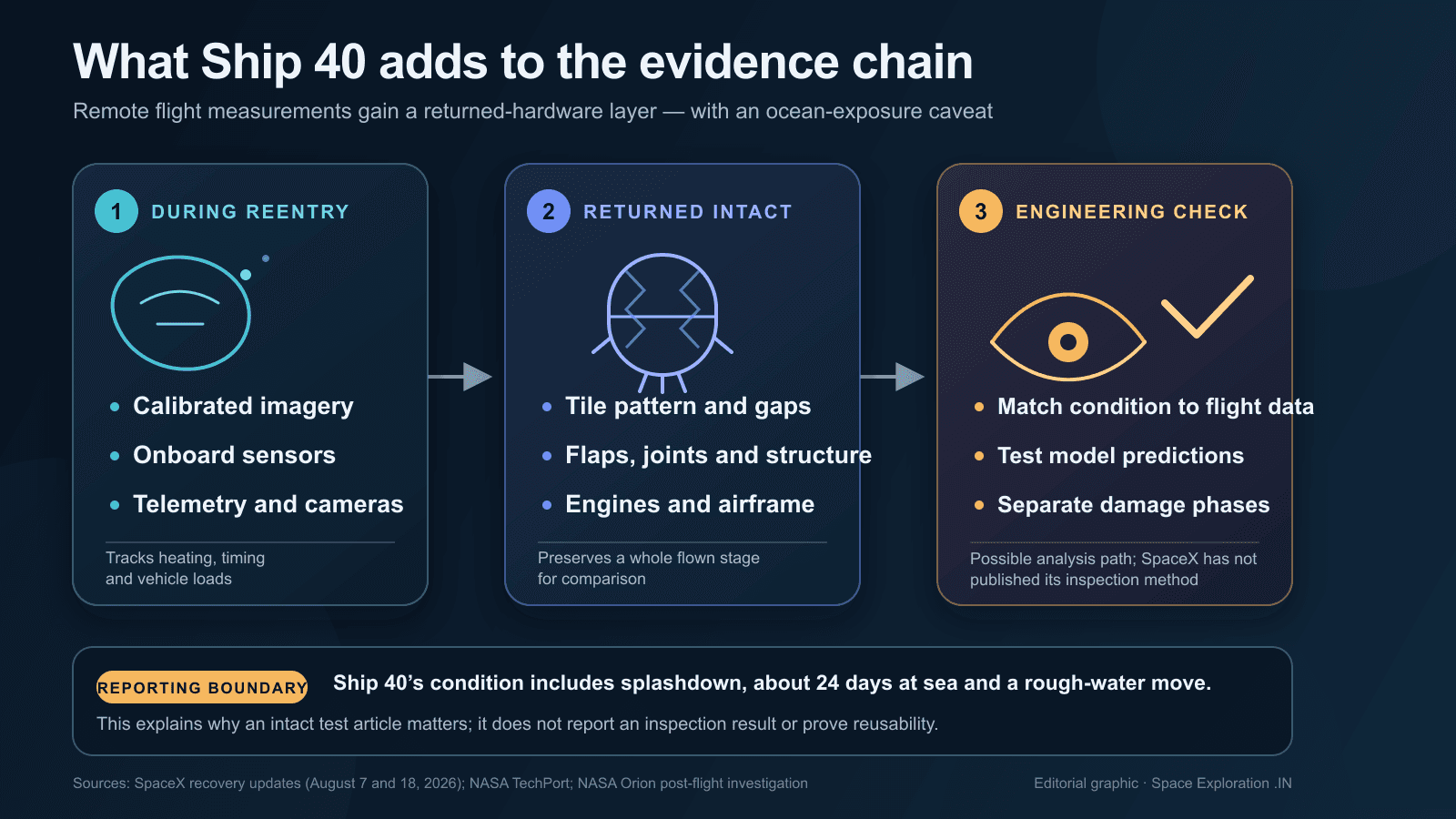
SpaceX’s recovery team guided Ship 40 to calmer water just off Christmas Island after approximately 24 days at sea, the company said on August 18. Engineers were travelling to the site to conduct additional analysis before any attempt to return the vehicle to Starbase. The unusual part is not simply that an upper stage was found after splashdown: Ship 40 is the first Starship upper stage to complete its spaceflight and remain intact in the water, giving SpaceX a flown vehicle rather than fragments or remote observations alone.
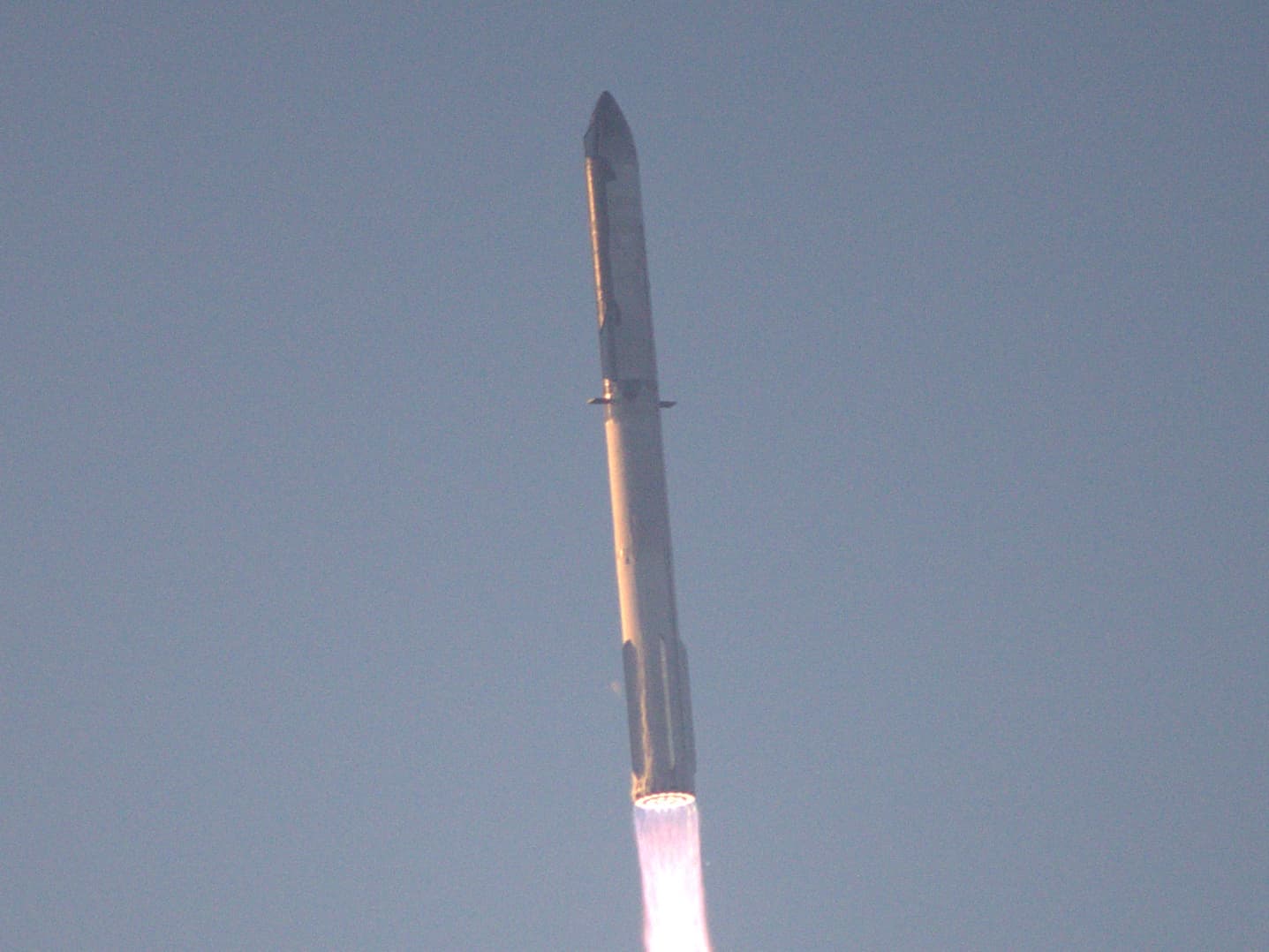
Ship 40 launched from Starbase in South Texas on July 24 during Starship’s 13th flight test, deployed 20 Starlink V3 satellites and made a powered splashdown in the Indian Ocean. Associated Press reporting from the flight said the stage remained afloat as SpaceX’s webcast ended. The recovery then became a separate test of endurance: on August 7, SpaceX said crews were trying to guide the 52-metre vehicle to port while facing challenging conditions and increasingly rough seas.
What an intact ship adds
Flight 13 already produced several kinds of heat-shield evidence. The Associated Press reported that six of the deployed Starlink spacecraft carried cameras that photographed Starship near the end of the flight, while sensors on the heat shield measured conditions during launch. NASA’s Starship reentry-observation project describes the wider engineering method: calibrated temperature imagery is correlated with onboard sensors to quantify aerothermal performance and validate modelling. Recovery does not replace those data. It adds a physical object against which they can be checked.
That distinction matters because cameras and sensors record selected views and measurements, while the returned surface preserves a vehicle-wide pattern. NASA says its Starship imaging work is intended to improve understanding of thermal-protection-system step and gap tolerances and the timing of boundary-layer transition during hypersonic flight. With Ship 40 intact, SpaceX can potentially compare the location and condition of tiles, gaps and neighbouring hardware with the heating patterns and times recorded during reentry. SpaceX has not yet published that comparison or a detailed inspection method.
The opportunity also extends beyond individual tiles. Space.com reported that the intact upper stage can be evaluated for its aerodynamics, hydraulics, thermal-tile performance and vehicle design. Its Flight 13 account said the six engines, flaps and other systems were visible after splashdown. A complete vehicle preserves relationships that isolated debris cannot: whether a damaged area lines up with a flap edge, a structural joint or another local feature. That is an analytical possibility based on the returned condition, not a finding SpaceX has announced.
Why returned hardware can change a diagnosis
NASA’s investigation of the unrelated Orion heat shield shows why post-flight hardware can matter even when a spacecraft has extensive instrumentation. To trace unexpected char loss after Artemis I, investigators combined physical sampling, flight imagery, sensor data, ground testing and analysis. NASA removed about 200 Avcoat samples and used non-destructive evaluation to look inside the heat shield. Orion uses a different thermal-protection material and flew a different mission, so its failure mechanism says nothing by itself about Ship 40. The useful precedent is the evidence chain.
NASA says Orion’s embedded pressure sensors, strain gauges and thermocouples helped reconstruct the environment and timing of the material loss, while the recovered samples showed which local material conditions did and did not crack. The agency then reproduced the behaviour in ground facilities. In the Starship case, NASA’s own project likewise frames reentry imagery and onboard measurements as inputs for validating engineering tools. An intact Ship 40 creates the possibility of connecting those flight records to the condition of actual flown parts instead of relying on images alone.
That comparison was unavailable at the same scale after earlier Starship tests. Space.com reported that Ship 39 performed a landing burn on Flight 12 but exploded after toppling into the water, while Ship 40 was the first upper stage to survive splashdown intact. The Associated Press similarly noted that earlier vehicles had exploded at splashdown or broken up in flight. Ship 40 therefore offers a more complete sampling frame: engineers can examine how conditions vary across one returned stage, rather than drawing conclusions only from telemetry, external images or pieces that survived destruction.
The ocean is part of the evidence now
The 24-day recovery also limits what the hardware can say without careful reconstruction. Ship 40’s present condition combines ascent, spaceflight, reentry, the landing burn, splashdown, prolonged ocean exposure and the effort to move it through rough seas. Any missing tile, deformation or system damage found now cannot automatically be assigned to hypersonic flight. Investigators would have to compare its location and appearance with imagery and sensor timing to separate damage that was present at splashdown from changes that may have followed. SpaceX has not said publicly how it will make those distinctions.
Reaching calmer water makes close inspection more practical, but it is not the same as completing recovery to a controlled facility. SpaceX’s August 18 statement said engineers were on their way and described a return to Starbase only as a later attempt. It gave no inspection schedule, list of tests or preliminary findings. The current development is therefore access to an unusually complete test article, not a declaration that the heat shield, engines or airframe are ready to fly again.
What to watch next
NASA’s Starship research record says rapid reusability depends in part on a thermal-protection system that can return without extensive rework, and that correlated flight measurements are meant to improve design tools. Ship 40 can strengthen that process only after engineers determine what survived the flight and what changed during nearly four weeks at sea. The next meaningful evidence will be a completed move to Starbase or published inspection results that connect physical condition with Flight 13 imagery and sensors. Until then, the intact vehicle is an opportunity to learn, not proof of reuse.
Reporting trail
Primary sources
NASA TechPortSCIFLI Starship Reentry Observation (SSRO-ACO)techport.nasa.gov
NASANASA Identifies Cause of Artemis I Orion Heat Shield Char Lossnasa.gov
Space.comStarship lives! SpaceX craft arrives at Christmas Island after 24-day ocean ordealspace.com
Associated PressSpaceX launches Starship on another test flight, this time with the most advanced Starlinksapnews.com
Space.comSpaceX's Starship megarocket makes the 'softest splashdown' ever after launching next-gen Starlink satellites in Flight 13 test (video)space.com

For an image post, download the card and copy this suggested caption.
The upper stage survived its July 24 splashdown and about 24 days at sea. Its returned tiles and vehicle hardware can now be compared with reentry imagery and sensor data, although ocean exposure complicates the diagnosis. Read the full report: https://www.spaceexploration.in/news/starship-ship-40-recovery-inspection #SpaceExplorationNews #SpaceNews #SpaceMissions