Space Physics
TRACERS data favour spatial variation in magnetic reconnection
The first study classifies 207 paired cusp encounters, but its authors call the result preliminary: the sample is about one tenth of that planned.
Add us as a preferred source on Google Add us as a preferred source on Google
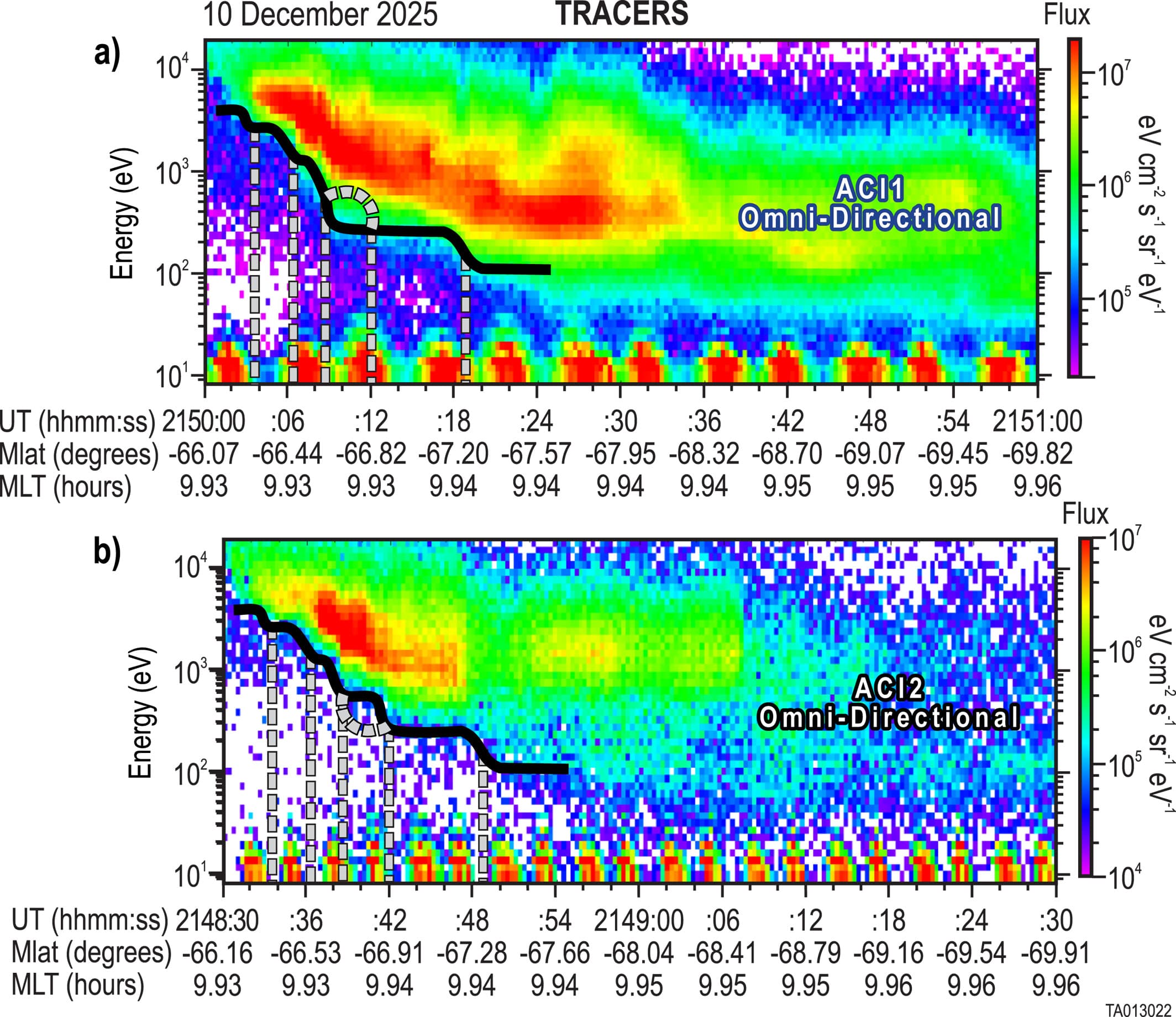
Initial observations from NASA’s twin TRACERS satellites favour differences across space over changes with time as the dominant source of magnetic reconnection variability at Earth’s magnetic boundary. The study, first published in the Journal of Geophysical Research: Space Physics on October 29, 2026, examines how solar-wind particles enter the near-Earth environment.
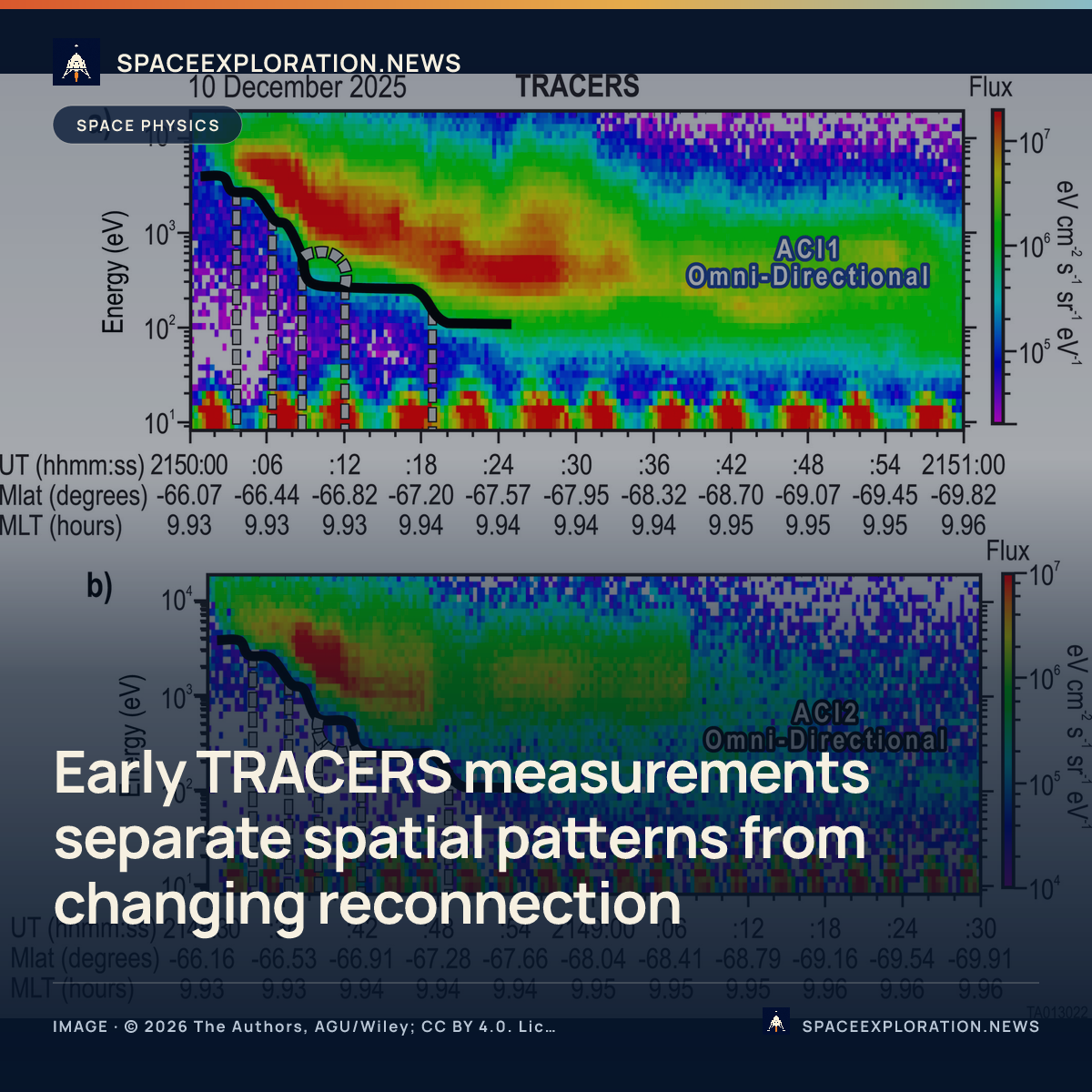
The paper classifies 207 paired encounters with the southern polar cusp between November 2025 and February 2026. Its main table assigns 129 encounters to spatial variability, 48 to temporal variability and 30 to an ambiguous category. Spatial variability predominates in each magnetic-field orientation and solar-wind pressure group examined, the researchers find.
Magnetic reconnection transfers energy and particles across the magnetopause, the boundary of Earth’s magnetic shield. NASA’s October 29 account describes TRACERS as a mission to investigate that link between the solar wind and Earth’s space environment. The polar cusps concentrate incoming particles into regions the two satellites can sample one after the other.
The distinction depends on comparing particle structures along the same orbital track. The paper’s authors interpret structures that remain at nearly the same magnetic latitude between spacecraft passes as evidence of spatial variability. Structures that shift latitude in the expected direction of field-line motion indicate temporal variability. The satellites were at least 30 seconds apart in this preliminary dataset.
The categories overlap in practice. Almost every encounter dominated by spatial variability also contains signs of temporal variability within its larger structures, the authors report. Their result therefore does not mean reconnection stops changing with time.
The sample is smaller than planned because one spacecraft lost battery charge-storage capability after the July 2025 launch, the paper records. It operates in sunlight, and the team shifted paired observations from the northern to the southern cusp. That left the early dataset at about one tenth of the intended number of cusp encounters.
The authors also describe an element of subjectivity in classifying encounters. Electric-field measurements can test whether structures should have moved, but sufficiently accurate spacecraft-orientation information was available for that calculation in only about half the encounters. More events are needed to separate the effects of solar-wind pressure from magnetic-field direction.
NASA reports that the spacecraft now routinely observe the southern cusp several times daily. The agency approved a prime-mission extension in September to continue observations into spring 2027. The researchers say additional paired encounters are needed to verify the preliminary finding and complete the mission’s other science objectives.
Reporting trail
Primary sources
For an image post, download the card and copy this suggested caption.
The first study classifies 207 paired cusp encounters, but its authors call the result preliminary: the sample is about one tenth of that planned. Read the full report: https://www.spaceexploration.in/news/tracers-first-reconnection-results #SpaceExplorationNews #SpaceNews #SpaceScience