Policy
Government data puts private space investment at $618.5 million
The latest Parliament figures show capital and approvals rising after the 2020 reforms, while official documents leave key definitions unresolved and publish conflicting authorisation totals.
Add us as a preferred source on Google Add us as a preferred source on Google
India’s government says cumulative private investment in the country’s space sector reached $618.5 million by March 31, 2026, with $187 million reported during 2026. In a written reply described by the Press Information Bureau on July 23, Minister of State Jitendra Singh also said the Indian National Space Promotion and Authorisation Centre, or IN-SPACe, had issued 105 authorisations to non-government entities as of July 14. The figures are the newest official snapshot of an industry the government opened to wider private participation through reforms announced in 2020.
The numbers point to a larger pool of private capital and more regulatory activity, but they do not by themselves show the size, revenue or commercial health of India’s private space market. The July release calls the $618.5 million figure cumulative private funding and traces it from $100.5 million in 2021-22 to $348.5 million in 2023-24. It does not define which financing instruments, company stages or transactions are included, and it does not explain how the $187 million described as reported during 2026 relates to a cumulative total dated March 31.
Investment is not the same as market size
That distinction matters because official documents treat funding, revenue and the wider space economy as different measures. A February 2026 Parliament reply said an assessment of revenue and economic value from private participation was being conducted with the Ministry of Statistics and Programme Implementation. A January message from IN-SPACe chairman Pawan Goenka separately listed the development of a consistent method for measuring India’s space economy and tracking its growth as work still to be done. Neither document supplies a completed methodology that would turn the latest investment total into a measure of sector output.
The government’s own 2033 strategy illustrates the difference. IN-SPACe has set a goal of expanding India’s space economy from an estimated $8.4 billion to $44 billion by 2033, while the July Parliament release reports private funding accumulated over several years. One is a target for economic activity; the other is a capital-flow figure. Comparing the two as though they measure the same thing would overstate what the new disclosure proves. The investment number records money reported as raised, not sales delivered, exports won, missions completed or returns produced.
The authorisation count is also unsettled
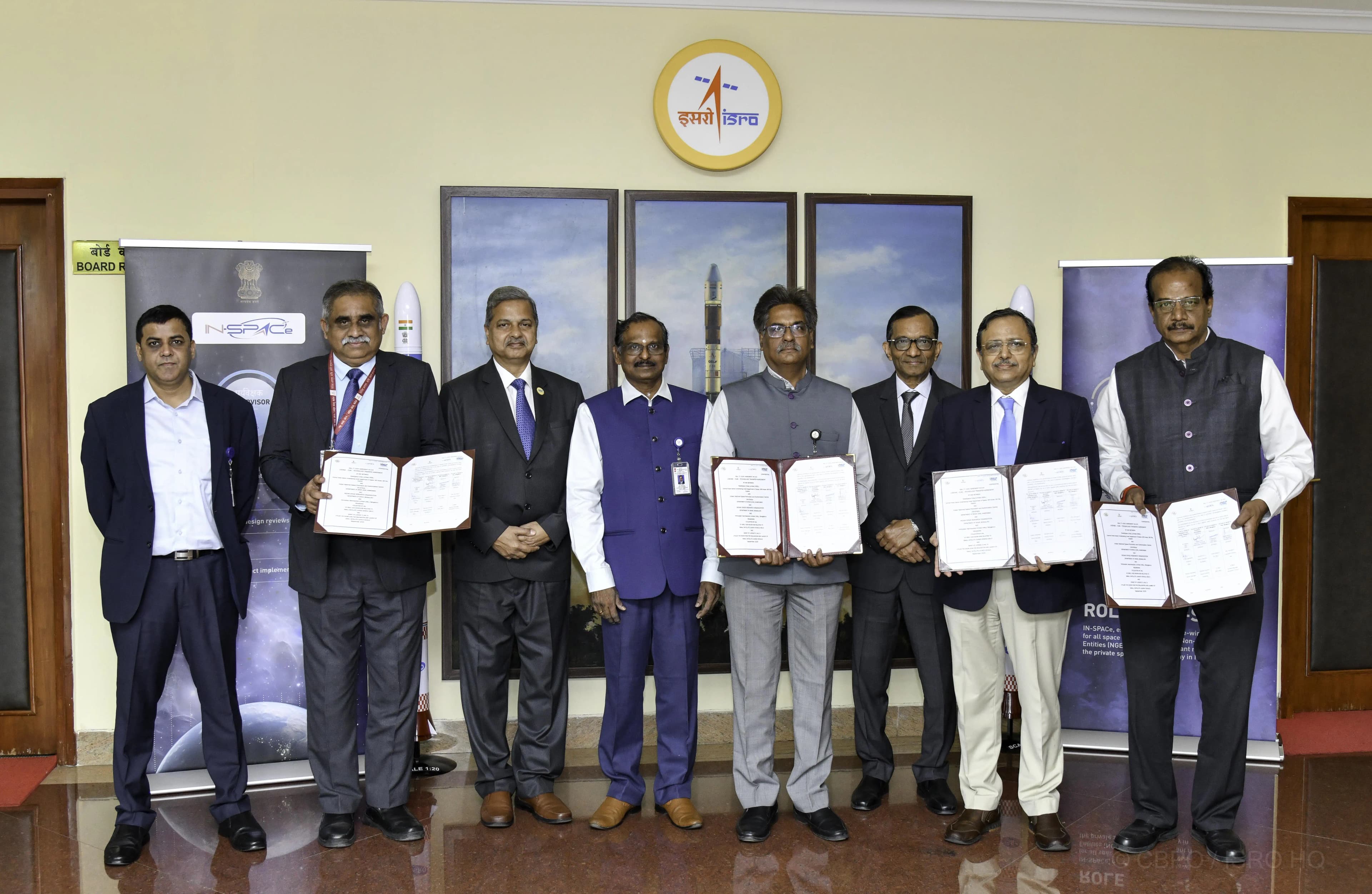
The latest authorisation total requires even more caution because recent government publications disagree. The July 23 Parliament release says 105 authorisations had been granted by July 14. A separate PIB release on April 26 said IN-SPACe had granted 129 authorisations, a larger number at an earlier date. The two pages do not explain whether they use different scopes, whether one counts authorisations while another counts authorised entities, or whether either figure was revised. Without a reconciliation from IN-SPACe, 105 should be reported as the number in the latest Parliament reply, not as an independently verified cumulative ledger.
An authorisation is also not a proxy for one startup. The Indian Space Policy gives IN-SPACe authority over a wide range of activities: establishing or operating space objects, launching vehicles, running launch pads, planning re-entry, operating tracking and control stations, disseminating high-resolution Earth-observation data and transferring space objects in orbit. The May 2024 norms say any eligible Indian entity may apply and require a fresh authorisation in some changes of control. The July release itself says only 17 space startups had been authorised, underscoring that the headline total spans more than a simple company count.
The February Parliament table shows why the composition matters. It separated authorisations for amateur satellites, ground systems, remote-sensing satellites, hosted payloads, non-Indian satellite systems and launch vehicles. It recorded 94 authorisations across 2022 through early 2026, including 36 for non-Indian geostationary or non-geostationary satellite systems and 22 for hosted payloads. Those are regulatory permissions across categories, not 94 newly financed Indian businesses. A useful scorecard would publish both the number of distinct entities and the number, type, duration and status of their authorisations.
Security checks already exist; another layer is coming
IN-SPACe is not starting from a blank sheet on security. The Indian Space Policy directs it to authorise activities with safety, national security, international obligations and foreign-policy considerations in view. The 2024 norms require applicants to demonstrate managerial, operational, technical and financial capacity. They also say space activity must not threaten defence, intelligence and security operations, foreign relations, public order, people, property, public health or the environment. Applicants must report changes in management, control or shareholding within 48 hours, and IN-SPACe may amend, revoke or require a fresh authorisation.
What is new is the government’s statement that IN-SPACe is preparing dedicated Safety and Security Guidelines in consultation with stakeholders. The July release does not provide a draft, publication date, implementation schedule, appeal process or new technical thresholds. It therefore supports reporting that another set of guidelines is being developed, but not that new rules are already operative. Until a document is published, the existing policy and 2024 norms remain the clearest public account of how strategic and security considerations enter an authorisation decision.
Capital incentives and regulatory independence
The investment push sits alongside wider policy tools. A March 2024 foreign-investment amendment allows up to 74% automatic foreign direct investment in satellite manufacturing and operations, with government approval above that level; the automatic limit is 49% for launch vehicles and spaceports, while manufacturing satellite, ground-segment and user-segment components permits 100% through the automatic route. The July release also lists a ₹1,000 crore venture-capital fund and a ₹500 crore Technology Adoption Fund. Those policy ceilings and committed public funds can enable investment, but they are not evidence that every available rupee has been deployed or produced revenue.
Independent policy analysis has also questioned the institutional design behind the scorecard. In a July 2024 paper, the Takshashila Institution argued that IN-SPACe’s mandate to promote the industry conflicts with its role as regulator, and called for statutory backing, greater independence and a dispute-settlement mechanism. The paper also identified government procurement as an important source of anchor demand. That critique does not negate the reported investment, but it highlights why authorisation volume and promotional programmes should be evaluated separately from regulatory performance and durable customer demand.
What the next scorecard should disclose
The July disclosure is evidence of activity after the reforms, not a complete verdict on their economic outcome. A clearer update would define private investment, separate equity from debt and public co-investment, identify the period covered by the $187 million figure, and publish a reconciled authorisation register by entity and activity. Revenue, exports, order books, launch and satellite operations, procurement, business failures and follow-on funding would show whether capital is turning into sustained capability. Until those measures are available, $618.5 million and 105 authorisations are useful official markers—with important limits attached.
Reporting trail
Primary sources
Press Information BureauDr. Jitendra Singh Informs Parliament that Private Space Sector Gains Strong Momentum as Investment Crosses USD 618 Million; Government Reinforces National Security Frameworkpib.gov.in
Press Information BureauParliament Question: Private Sector Participation Facilitated by IN-SPACepib.gov.in
Press Information BureauDr Jitendra Singh reviews plan to set up Space laboratories in Universities and Colleges across Indiapib.gov.in
IN-SPACeNorms, Guidelines and Procedures for Implementation of Indian Space Policy-2023 in respect of Authorization of Space Activitiesinspace.gov.in
ISROIndian Space Policy 2023isro.gov.in
Department for Promotion of Industry and Internal TradeReview of Foreign Direct Investment Policy on Space Sectordpiit.gov.in
IN-SPACeMessage from Chairman, IN-SPACe — 1 January 2026inspace.gov.in
IN-SPACeDecadal Vision and Strategy for Indian Space Economyinspace.gov.in
The Takshashila InstitutionSpace Reforms in India: A Job Half Donetakshashila.org.in

For an image post, download the card and copy this suggested caption.
The latest Parliament figures show capital and approvals rising after the 2020 reforms, while official documents leave key definitions unresolved and publish conflicting authorisation totals. Read the full report: https://www.spaceexploration.in/news/india-private-space-investment-scorecard #SpaceExplorationNews #SpaceNews #SpacePolicy