Earth science
INSPYRE aircraft sample Widemouth 2 smoke from inside and above
An NSF/NCAR Gulfstream V crossed the resulting plume at 12 kilometres on August 3; NASA’s ER-2 later logged ten fire overpasses while the campaign was still gathering data.
Add us as a preferred source on Google Add us as a preferred source on Google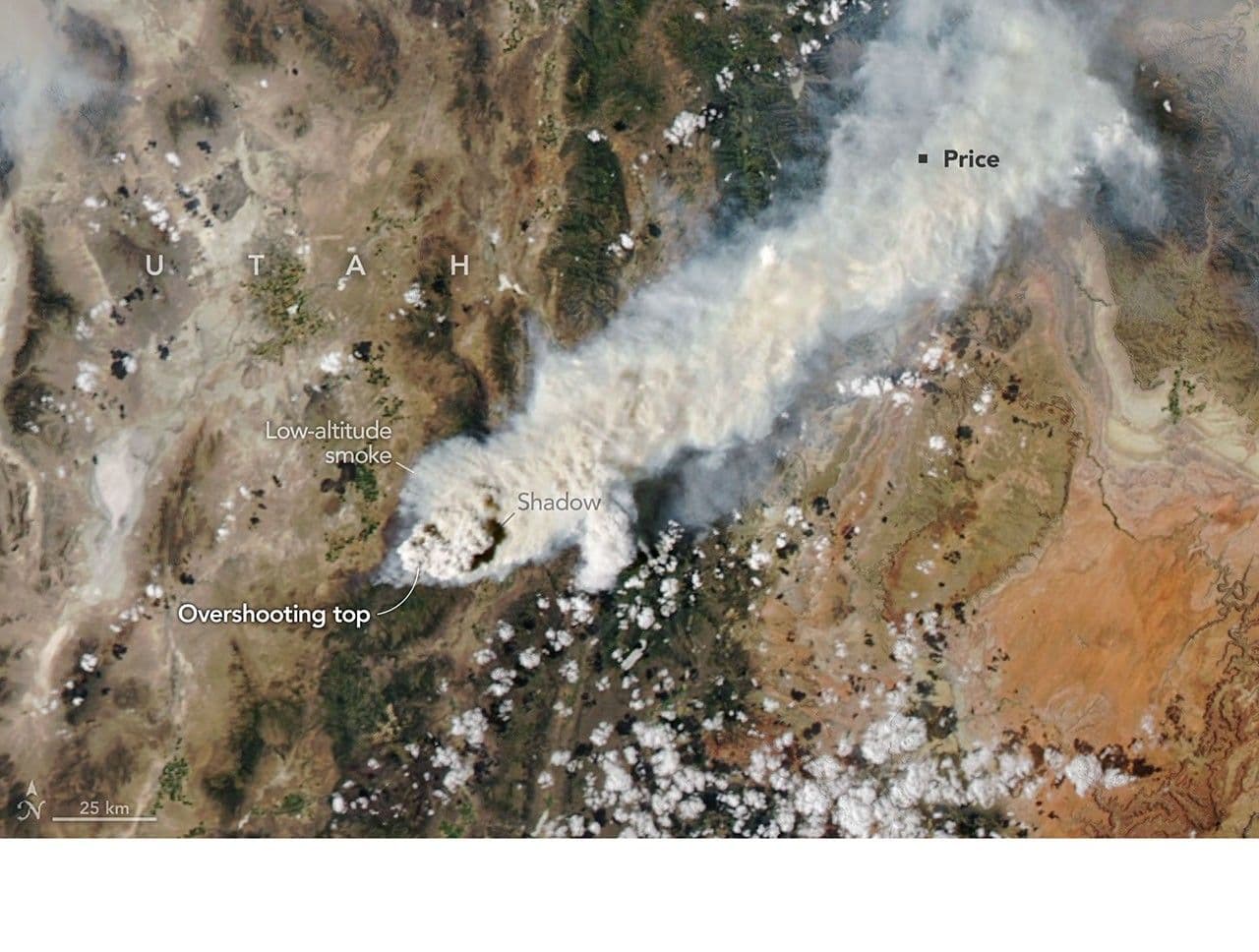
Aircraft in the NASA-funded INjected Smoke and PYRocumulonimbus Experiment (INSPYRE) have now collected two complementary sets of observations around Utah’s Widemouth 2 fire. The National Science Foundation/National Center for Atmospheric Research (NSF/NCAR) Gulfstream V crossed a high-altitude smoke pulse on August 3, 2026, and NASA’s ER-2 later made ten listed passes over the fire between August 7 and 8. NASA Earth Observatory published its account on August 17 while the field campaign was still operating. That account did not include calibrated measurements or scientific conclusions from the flights, so this is a report on what was sampled and what the instruments are meant to resolve—not a result from the study.
Lightning ignited the Widemouth 2 fire on July 27. NASA says it remained relatively small until August 2, when it more than doubled in size amid intense winds and hot, dry conditions. The fire generated a pre-dawn pyrocumulonimbus, or pyroCb, followed by two more bursts that afternoon. A pyroCb is a thunderstorm produced when an intense fire drives a convective column of smoke and cloud high into the atmosphere. Aqua’s Moderate Resolution Imaging Spectroradiometer (MODIS) recorded the afternoon scene, including a tall smoke-and-cloud column whose shadow fell across lower smoke.
First, the plume met the Gulfstream V
The Gulfstream V departed Colorado on August 3 to intercept the high-altitude smoke pulse as it drifted over New Mexico. NASA says instruments aboard the aircraft sampled the plume at roughly 12 kilometres (8 miles) above the surface. The ownership distinction matters: the aircraft belongs to NSF/NCAR and was operating within the NASA-funded campaign; it was not a NASA aircraft. Before deployment, the U.S. Naval Research Laboratory (NRL), which leads INSPYRE, described the Gulfstream’s assignment as direct, in-situ sampling inside pyroCb plumes. NASA’s August 17 account did not name the instruments used or publish their readings from this sortie.
The campaign assigns different jobs to each observing platform. The Gulfstream supplies measurements from within elevated smoke, the ER-2 carries a remote-sensing payload above weather systems, and ground teams deploy radar and lidar near active fires. NASA says the August 3 samples came from an altitude that is not typically incorporated into forecast models. INSPYRE’s plan is to combine such observations with satellite measurements and modelling to examine smoke injection and its atmospheric effects. The source material does not say how much Widemouth 2 smoke entered the stratosphere, how its composition changed or whether the flight improved a forecast.
Then the ER-2 watched from above
NASA’s active flight archive records a separate ER-2 sequence over Widemouth 2. Flight 26-679-00 made ten listed fire overpasses from 22:56 UTC on August 7 to 00:49 UTC on August 8, with passes spaced roughly 11 to 19 minutes apart. The archive calls them fire overpasses; it does not describe them as penetrations of the smoke plume. NASA operates the single-seat ER-2 at altitudes up to 70,000 feet (21.3 kilometres), above more than 95% of the atmosphere, where its sensors can view Earth in ways that approximate instruments on orbiting satellites.
The active INSPYRE archive lists AirHARP-2, broadband radiometers, the Cloud Physics Lidar, two cloud radars, iSTORM, the Lightning Instrument Package and imaging systems among the ER-2 sensors. The campaign design assigns radars and lidar to plume-top height and updraft structure, multispectral and infrared observations to fire geometry and radiative power, polarimetry to aerosol properties, broadband radiometers to radiative flux, and electrical instruments to lightning and electric fields. Those are intended measurement roles. The payload list does not establish that every instrument returned usable data on every Widemouth 2 pass.
NRL singles out iSTORM as an instrument designed to measure terrestrial gamma-ray flashes associated with lightning. Principal investigator David Peterson has framed the unresolved problem this way: some pyroCbs produce substantial lightning while others produce little, and lightning can ignite new fires. Measurements from above an active storm are intended to examine that difference. Neither NASA’s Widemouth 2 account nor its flight archive reports an iSTORM detection over this fire, so the instrument’s presence should not be read as a finding.
MODIS fixed the storm in time
Before either aircraft reached the smoke described in NASA’s account, Aqua supplied the event’s orbital context. MODIS measured cloud-top brightness temperatures well below −40°C on August 2, a threshold commonly used to identify pyroCbs. NASA interpreted the temperature field as two discrete afternoon pulses; the younger western pulse also stood out in natural colour because its high cloud cast a shadow. Such cold tops indicate cloud growth toward the top of the troposphere and, in some events, into the stratosphere. NASA did not publish a measured injection altitude for the Widemouth 2 plume in this account.
Truck-based observations were intended to cover the lower part of the same system. NRL said a University of Nevada, Reno-led ground team would place mobile radar and lidar near active fires, while NASA’s mission outline describes scanning remote sensors and other in-situ measurements. The planned combination spans the fire and lower convective column, direct smoke sampling aloft, remote sensing from the ER-2, and the satellite view. It is designed to connect conditions at the fire with the height and downstream path of lofted smoke, but the August 17 article reports the collection effort rather than that completed connection.
The unanswered questions are the point
INSPYRE organises those measurements around three stated questions: which fires produce pyroCbs and why; what controls whether a pyroCb injects smoke directly into the stratosphere and how large that plume becomes; and how injected smoke changes the composition and radiation budget of the upper troposphere and lower stratosphere. The Widemouth 2 observations touch each part of that chain—fire behaviour, a cold-topped storm, smoke sampled aloft and repeated remote-sensing passes—but observations alone do not answer the questions. Calibration, combination with other platforms, modelling and analysis still have to follow.
The campaign remained in progress in NASA’s archive on August 20, and the agency lists the 2026 ER-2 flight window through September 10. NRL describes a second field deployment in 2027, followed by three years devoted to analysis and publication. The flight descriptions and campaign status available for this report come from NASA and NRL mission sources; no independently released Widemouth 2 flight dataset or research paper was available for review. The next milestone is therefore more collection and analysis, not a claim that the Utah flights have already resolved how fire clouds loft smoke or generate lightning.
Reporting trail
Primary sources
NASA Earth ObservatoryChasing Fire Clouds in Utahscience.nasa.gov
NASA Airborne Science ProgramMASTER INSPYRE 2026asapdata.arc.nasa.gov
NASA Airborne Science ProgramER-2 - AFRCairbornescience.nasa.gov
U.S. Naval Research LaboratoryNRL Leads NASA Wildfire Research Mission to Better Predict Pyrocumulonimbus Storm Hazardsnrl.navy.mil
NASA Earth Science Project OfficeINSPYREespo.nasa.gov
NASAINSPYRE White Paper: EVS-4 NASAairbornescience.nasa.gov
For an image post, download the card and copy this suggested caption.
An NSF/NCAR Gulfstream V crossed the resulting plume at 12 kilometres on August 3; NASA’s ER-2 later logged ten fire overpasses while the campaign was still gathering data. Read the full report: https://www.spaceexploration.in/news/inspyre-widemouth-2-pyrocb-sampling #SpaceExplorationNews #SpaceNews #SpaceScience