Solar science
ISS, Proba-3 and weather satellites reveal different sides of August’s eclipse
NASA’s WB-57 followed the corona, an astronaut saw 18% coverage, Proba-3 caught a double eclipse, and MTG-I1 and GOES-19 tracked the Moon’s shadow across Earth.
Add us as a preferred source on Google Add us as a preferred source on Google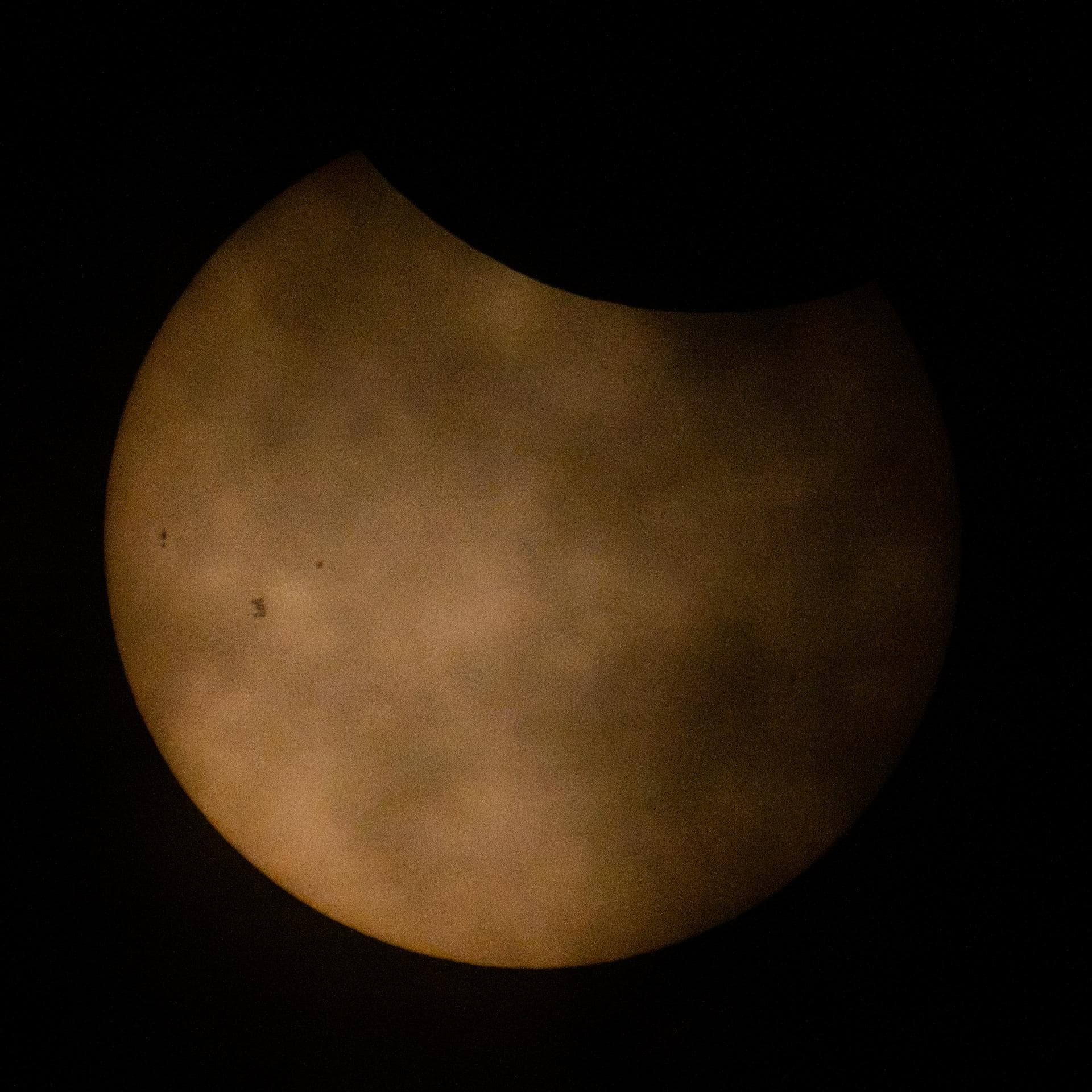
Images released around the August 12 total solar eclipse show that there was no single view from above Earth. NASA’s WB-57 aircraft followed the Sun’s corona from the stratosphere; the International Space Station saw a partial eclipse; ESA’s Proba-3 watched the Moon cross an artificial occultation; and the MTG-I1 and GOES-19 weather satellites recorded the shadow on Earth. Their pictures are not interchangeable. Sun-facing cameras show the occultation and corona, while Earth-facing imagers show where the loss of sunlight travelled.
The records also arrived on different schedules. Jessica Meir posted her ISS photographs and NASA released WB-57 imagery on August 12. ESA published MTG-I1’s animation on August 13. NASA Earth Observatory, ESA’s Proba-3 team and NOAA’s satellite account added material on August 14, and Space.com assembled a wider spacecraft roundup on August 18. The sequence matters because the later articles interpret observations that were made on eclipse day; they are not additional eclipses or simultaneous views from one platform.
A ground baseline and an aircraft above it
NASA photographer Bill Ingalls recorded totality from a sunflower field at San Millán de los Caballeros, about 40 kilometres south of León in northwestern Spain. His composite follows the Sun before, during and after totality as it descended towards the horizon. A second frame shows a prominence extending into the corona. In León, NASA lists totality from 8:28 p.m. to 8:30 p.m. local time. That ground record fixes the human-scale geometry: a camera inside the umbra looked towards a Sun that the Moon completely covered for about two minutes.
NASA’s WB-57 changed that geometry without leaving Earth’s atmosphere. The aircraft flew at 50,000 feet with the SCIFLI Multispectral Airborne Imager, or SAMI, in its nose. Four cameras were set to take at least 20 frames per second in several visible and infrared wavelengths. At 460 miles per hour along the eclipse path, NASA expected the aircraft to remain in totality for nearly three minutes, compared with a maximum of two minutes and 18 seconds from the ground. Its altitude also put the instruments above clouds and much of the water vapour that absorbs some infrared wavelengths.
NASA’s post-eclipse media collection confirms that SAMI captured the corona from the skies over Iceland. The imagery establishes that the observing run took place, but it is not itself a report of the experiment’s scientific findings. Before the flight, the team said it would examine coronal structures, outflows and rapid changes, and would use the different wavelengths to study prominences, coronal heating and the relationship between coronal material and the solar wind. Those aims should remain separate from results that will require calibrated analysis.
The ISS was both observer and foreground
From a window in the International Space Station’s Russian segment, NASA astronaut Jessica Meir photographed the Moon covering part of the Sun. Meir reported a peak of about 18% coverage because of the station’s location at the time. The orbital vantage point did not automatically put the crew in the Moon’s umbra; the station was moving through low Earth orbit while the narrow path of totality crossed a different part of the planet. Her images therefore preserve the eclipse as a local partial event, just as a ground observer outside the umbra would record it.
Near Hodgdon, Maine, NASA photographer Joel Kowsky used the opposite line of sight. The station became a foreground silhouette as it crossed a partially eclipsed, cloud-obscured Sun at roughly five miles per second. NASA’s catalogue says seven people were aboard. Space.com later presented eight frames of the transit together, making the station’s motion visible against the solar disc. The spacecraft is the observer in Meir’s photographs and the moving subject in Kowsky’s sequence; the change comes entirely from which side of the camera the station occupies.
Proba-3 saw a natural eclipse inside an artificial one
Proba-3 was built around a different kind of shadow. The European Space Agency flies two spacecraft about 150 metres apart near the top of their orbit, roughly 60,000 kilometres above Earth. The Occulter spacecraft blocks the bright solar disc for the Coronagraph spacecraft, whose ASPIICS instrument images the faint inner corona. The pair therefore makes an artificial eclipse on demand. The long separation between the external occulter and the camera is intended to expose coronal regions that are difficult for a conventional coronagraph to see close to the Sun.
On August 12, the Moon crossed that already occulted field. ESA assembled ASPIICS images taken over three hours and reported that the Moon covered the solar disc for eight minutes and 40 seconds, creating a shadow slightly larger than Proba-3’s own occulting disc. Because the spacecraft were closer to the Moon than observers on Earth, the natural occultation lasted far longer than the ground maximum of two minutes and 18 seconds. The resulting double eclipse is a direct demonstration that eclipse duration and apparent size depend on the observer’s distance and alignment, not only on the Moon’s motion.
The overlap also had an engineering use. ESA says the Moon’s shadow removed parasitic light normally produced when sunlight diffracts around the edge of Proba-3’s occulter. Scientists used the nearly nine-minute interval to calibrate ASPIICS and briefly observe the corona with less of that stray light. ESA calls it a one-off full double eclipse for this mission: Proba-3 is expected to see the Moon pass through its field during the August 2, 2027 and July 22, 2028 eclipses, but only as partial occultations.
MTG-I1 and GOES-19 watched Earth, not the Sun
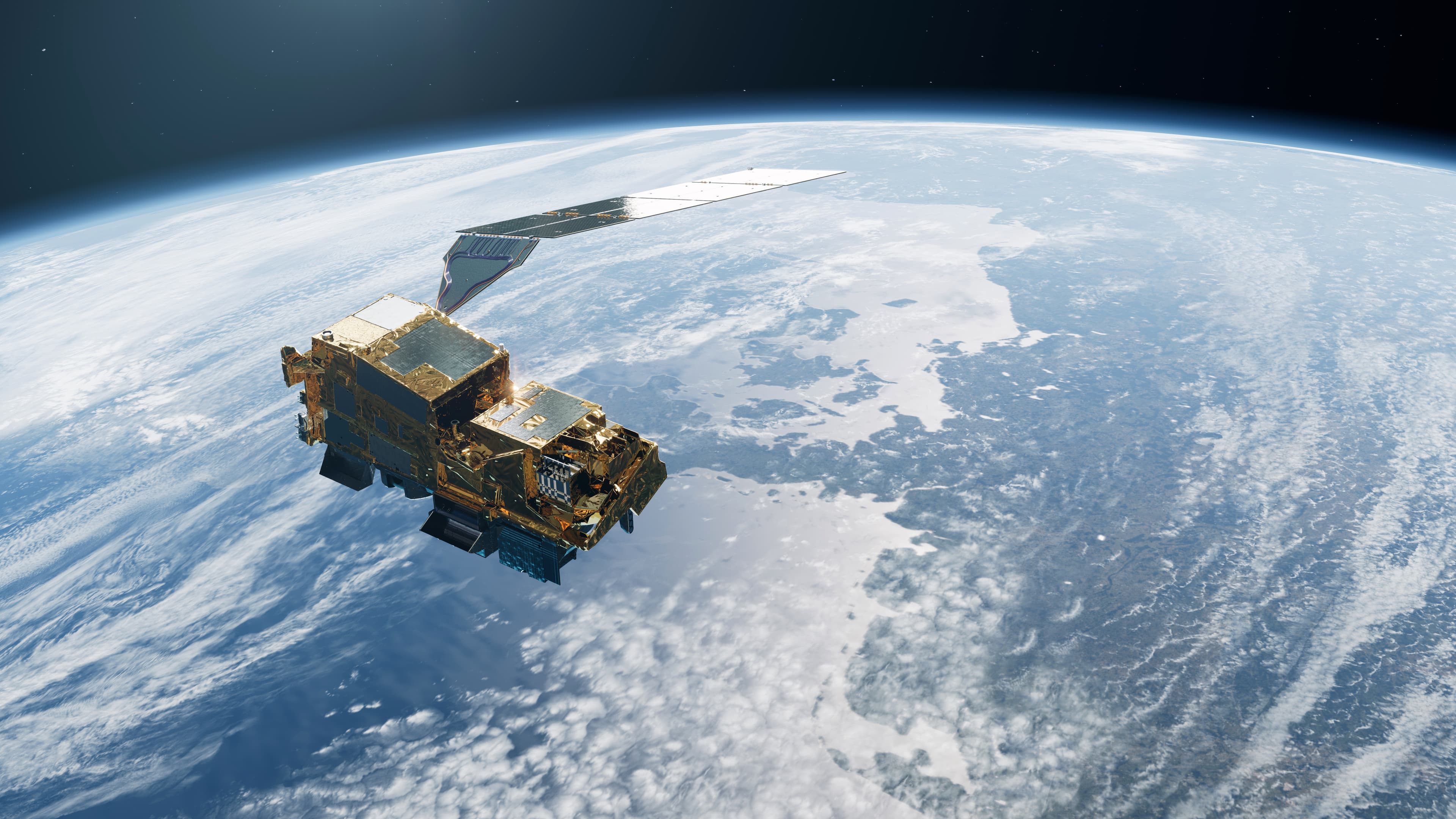
MTG-I1 kept its imager pointed at Europe and northern Africa from geostationary orbit about 36,000 kilometres above Earth. ESA’s animation shows the Moon’s dark shadow moving over the surface as the path ran across Greenland, Iceland, northeastern Portugal and Spain. Over the Iberian peninsula, totality occurred between 20:26 and 20:34 CEST. The eclipse shadow then converged with the advancing twilight boundary as dusk reached Europe. This view sacrifices detail in the corona but supplies geographic context: it shows the umbra as a moving patch within a full-disc weather image.
NOAA’s GOES-19 supplied another full-disc angle from the GOES East position at 75.2 degrees west longitude. The agency’s August 14 sequence follows the shadow over Greenland, Iceland and Spain. Read beside MTG-I1, the two geostationary records observe the same travelling shadow from fixed stations at different longitudes. That pairing makes the path easier to follow across the North Atlantic, although NOAA’s post presents imagery rather than a separate eclipse science result.
Taken together, the records divide the event by scale. The Spanish ground photographs show totality and a prominence at one place; WB-57 adds fast, filtered coronal imaging above much of the atmosphere; the ISS supplies a moving low-orbit viewpoint and a target for ground cameras; Proba-3 turns the natural eclipse into a coronagraph calibration; and the weather satellites map the umbra against an entire hemisphere. The next test of these geometries comes on August 2, 2027, when a new total eclipse crosses southern Spain, North Africa, Saudi Arabia and Yemen and Proba-3 is expected to see only a partial lunar passage.
Reporting trail
Primary sources
NASA Earth ObservatoryA Sunflower’s View of Totalityscience.nasa.gov
NASA ScienceNASA Science Soars During August Total Solar Eclipsescience.nasa.gov
NASA Scientific Visualization Studio2026 Total Solar Eclipse Imagery - Science Experimentssvs.gsfc.nasa.gov
NASA Image and Video Library2026 Partial Solar Eclipse - ISS Transitimages.nasa.gov
European Space AgencyA double eclipse for Proba-3esa.int
European Space AgencyMTG-I1 captures eclipse path of totality over Europeesa.int
NOAA GOES-R SeriesGOES-19 Transition to Operationsgoes-r.noaa.gov
Space.comSee gorgeous views of the Aug. 12 total solar eclipse captured from spacespace.com
Space.comISS photobombs the sun during solar eclipsespace.com
For an image post, download the card and copy this suggested caption.
NASA’s WB-57 followed the corona, an astronaut saw 18% coverage, Proba-3 caught a double eclipse, and MTG-I1 and GOES-19 tracked the Moon’s shadow across Earth. Read the full report: https://www.spaceexploration.in/news/august-12-eclipse-spacecraft-views #SpaceExplorationNews #SpaceNews #SpaceScience