Launch
Kulasekarapattinam operator search opens as construction continues
The latest project reply puts spending at ₹588.70 crore of ₹985.96 crore, while IN-SPACe seeks a private manager and leaves the commissioning date unstated.
Add us as a preferred source on Google Add us as a preferred source on Google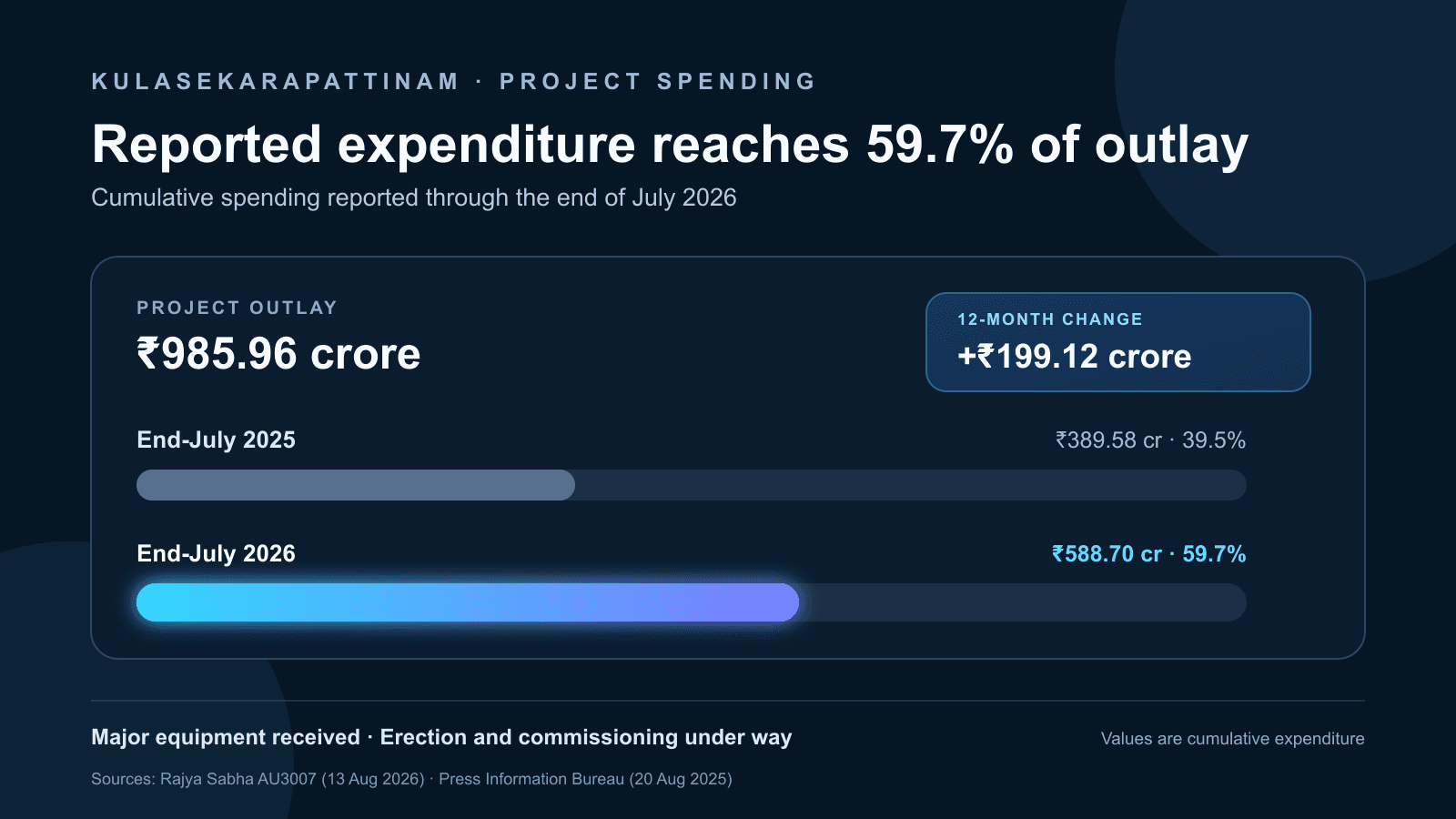
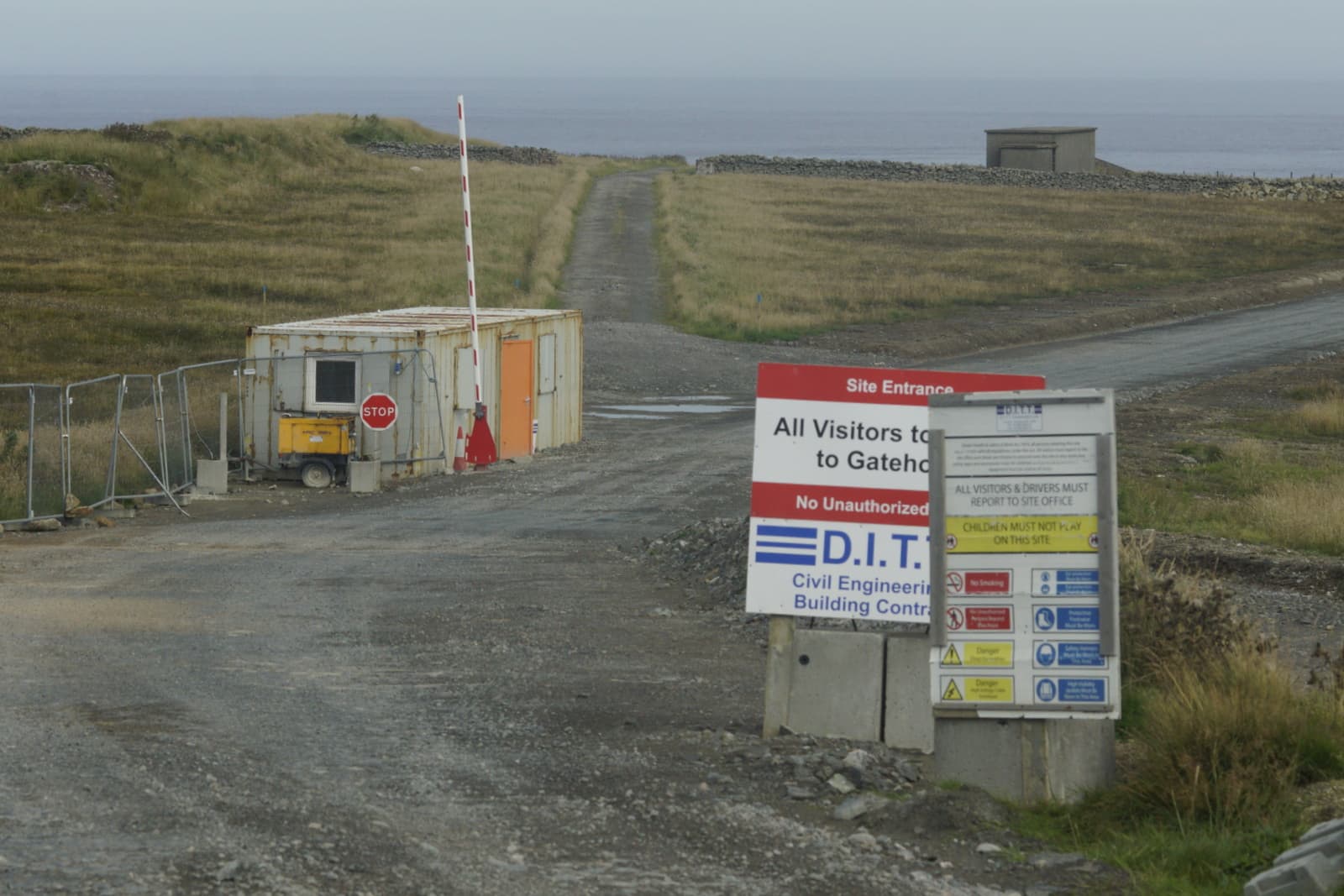
Construction at India’s new small-satellite launch complex at Kulasekarapattinam has moved into equipment erection and commissioning, with several buildings close to completion and ₹588.70 crore spent by the end of July, the Department of Space told the Rajya Sabha on August 13. Separately, the Indian National Space Promotion and Authorisation Centre, or IN-SPACe, is inviting eligible Indian companies to compete to operate and manage the government-built complex. The disclosures connect the site’s physical build-out to its planned operating model, but neither gives a revised date for commissioning.
The latest expenditure equals 59.7% of the project’s ₹985.96 crore financial outlay. A year earlier, the government reported that ₹389.58 crore had been used by July 31, 2025. On those like-for-like official figures, cumulative spending increased by ₹199.12 crore over 12 months. The new reply does not divide the expenditure among civil packages, equipment and range systems, or state how much of the full outlay has been contracted but not yet paid.
Construction has shifted from fabrication to installation
Work remains active across every civil-work package, according to the August 13 reply. It says the magazine, Technical Service Building, Launch Service Building and base fire station are among the buildings close to completion. Purchase orders have been released for most equipment, while the mobile launch structure, bogie, rails, radar subsystems and material-handling equipment have reached the site. Erection and commissioning of those systems are in progress; the reply does not say they have completed acceptance tests.
That is a more advanced stage than the position disclosed in August 2025. The earlier Parliament account said site-development work was complete, construction of technical facilities had started, and equipment and structures were being fabricated at different work centres. ISRO said later that month that construction was progressing on 32 of 33 major facilities. The latest reply now records major hardware at Kulasekarapattinam and being installed, although it still describes all civil packages as works in progress.
ISRO’s 2025 project description lists stage-preparation and vehicle-integration buildings, the launch pad and rail tracks, checkout, telemetry, telecommand and range systems, firefighting facilities and civic infrastructure. The complex is intended primarily for the Small Satellite Launch Vehicle, or SSLV, and rockets operated by non-government entities. The government says the Tamil Nadu site permits a southward route to polar orbits without the land-avoidance manoeuvre required from Sriharikota, improving useful payload capability for this class of vehicle.
The handover is for operations and management
IN-SPACe’s public Expression of Interest, or EOI, proposes handing responsibility for operating and managing the complex to one Indian private firm. IN-SPACe says it will work through ISRO to transfer the use of the established facilities to the selected party, which would provide commercial launch services and associated ground and range operations to launch-vehicle operators. The invitation does not identify an operator or announce an award. Its glossary says respondents screened through the EOI would enter a later request-for-proposals process, where the selected bidder would be chosen.
The public eligibility thresholds favour large infrastructure operators. A respondent must be a non-government entity under Indian ownership and control and must have operated for at least seven years. It must show at least ₹3,500 crore in qualifying infrastructure payments or revenue over the preceding seven years, an average annual turnover above ₹2,000 crore for any three of the past five years, and net worth of at least ₹1,000 crore at the response deadline. The page defines Indian ownership and control as more than 50% cumulative beneficial ownership and majority control held by Indian citizens.
Interested firms must register and pay ₹50,000 before the detailed EOI document is released to them. The public schedule sets August 24 as the registration deadline for the pre-EOI conference, September 10 for a visit to Kulasekarapattinam, September 15 for the meeting in Ahmedabad, and October 5 for responses. IN-SPACe marks those dates as subject to change. The page does not publish a date for the subsequent request for proposals, contract award or operational handover.
ISRO’s support would continue into the selected firm’s first operations rather than end when the facilities are handed over. IN-SPACe promises technical guidance, operational support, training and handholding for a defined period ending after the firm completes three launch services or after one year, whichever occurs first. That condition links the transition to initial launches, but it does not guarantee support through all three if they take longer than a year. The public page also does not say when the one-year clock would start.
The commissioning date remains unresolved
Earlier official documents used several milestones for the site. The government said in August 2025 that commissioning was targeted in the 2026–27 financial year, while ISRO separately described completion by the end of 2026. A March 2026 Parliament reply again expected commissioning during 2026–27 and placed SSLV launches from the second site in 2027–28. Those dates distinguish physical completion, commissioning and the first orbital launches, which need not happen at the same time.
The August 13 Rajya Sabha question specifically asked whether the commissioning timeline had changed and, if so, why. The answer said only that efforts were being made to complete commissioning “within the timeframe.” It did not name that timeframe, repeat the earlier 2026–27 target or give reasons for a revision. The EOI’s conference, site-visit and response dates are procurement milestones, not a replacement commissioning schedule. The current record therefore does not establish either a delay or a new deadline.
The government also reported about 1,000 people employed during construction and forecast a workforce of at least 300 to 400 for operations, maintenance and launch activity. It said related industries were expected to develop around the complex and create further jobs and economic activity. Those are projections rather than a measured local-impact account: the reply provides no breakdown of local hires, wages, supplier contracts or businesses created so far.
As of August 17, the clearest combined picture is of a public launch complex still under construction and a private operating process only at the expression-of-interest stage. Buildings are nearing completion and major systems are being installed, while IN-SPACe is testing the market for a manager large enough to take over early launch services with temporary ISRO support. The operator selection, handover date, commissioning date and first orbital launch remain separate milestones, and none of them has yet been tied to a new public calendar in the latest disclosures.
Reporting trail
Primary sources
Rajya SabhaInfrastructure Development at Kulasekarapattinam Spaceport Project (Unstarred Question No. 3007)sansad.in
IN-SPACeEoI for Operations and Management of SLCinspace.gov.in
Press Information BureauParliament Question: Kulasekarapattinam Spaceportpib.gov.in
ISROFoundation Stone Laid for Launch Pad at SSLV Launch Complex (SLC), Kulasekarapattinamisro.gov.in
Press Information BureauParliament Question: Development of Satellite Launch Facilities in Indiapib.gov.in
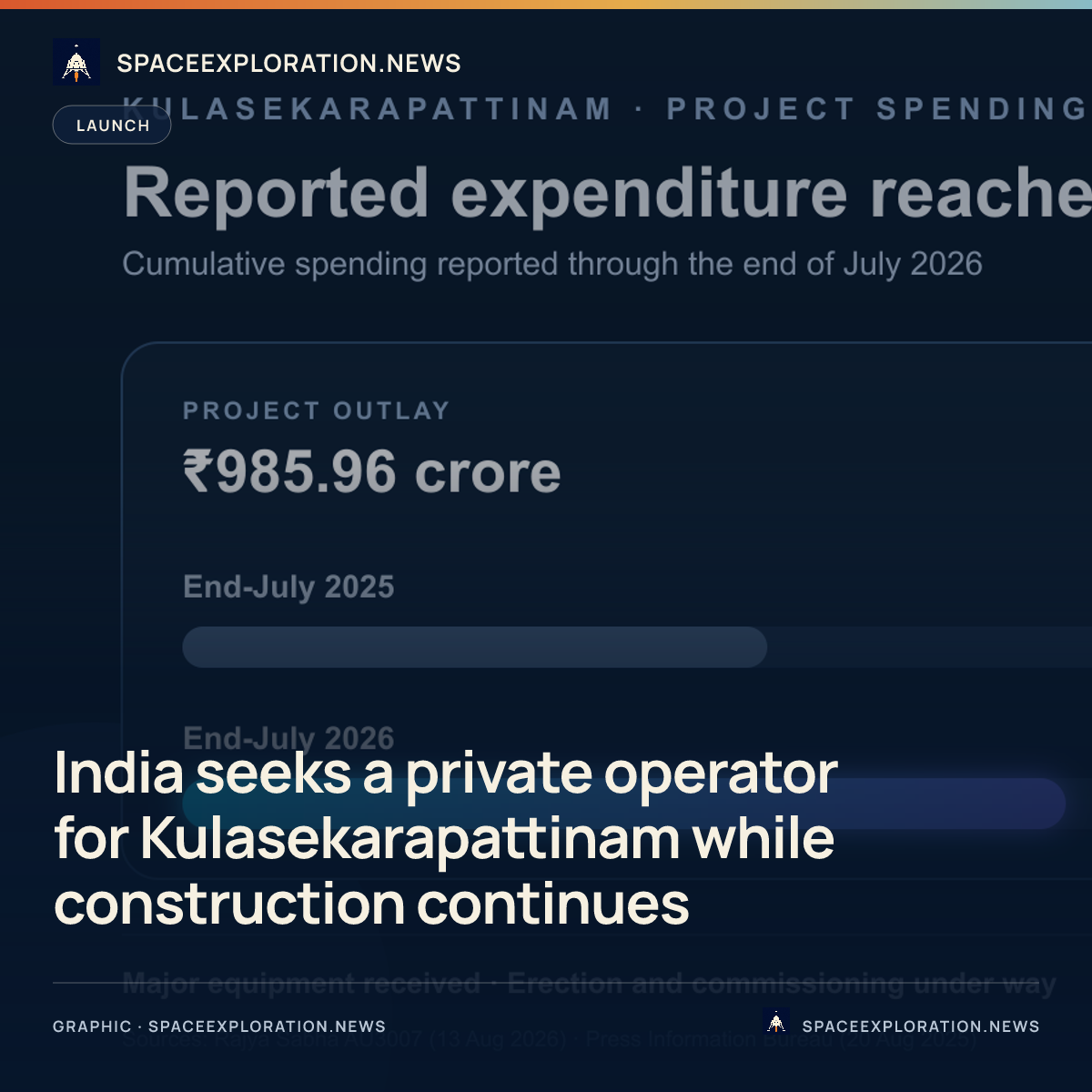
For an image post, download the card and copy this suggested caption.
The latest project reply puts spending at ₹588.70 crore of ₹985.96 crore, while IN-SPACe seeks a private manager and leaves the commissioning date unstated. Read the full report: https://www.spaceexploration.in/news/kulasekarapattinam-spaceport-construction-operator-eoi #SpaceExplorationNews #SpaceNews #RocketLaunch