Science
AstroRad study models up to 60% solar-storm dose cut from Artemis I data
Orion encountered no major solar particle event. Researchers validated a transport model against radiation measured inside two manikins, then substituted spectra from the 1972 and 1989 storms.
Add us as a preferred source on Google Add us as a preferred source on Google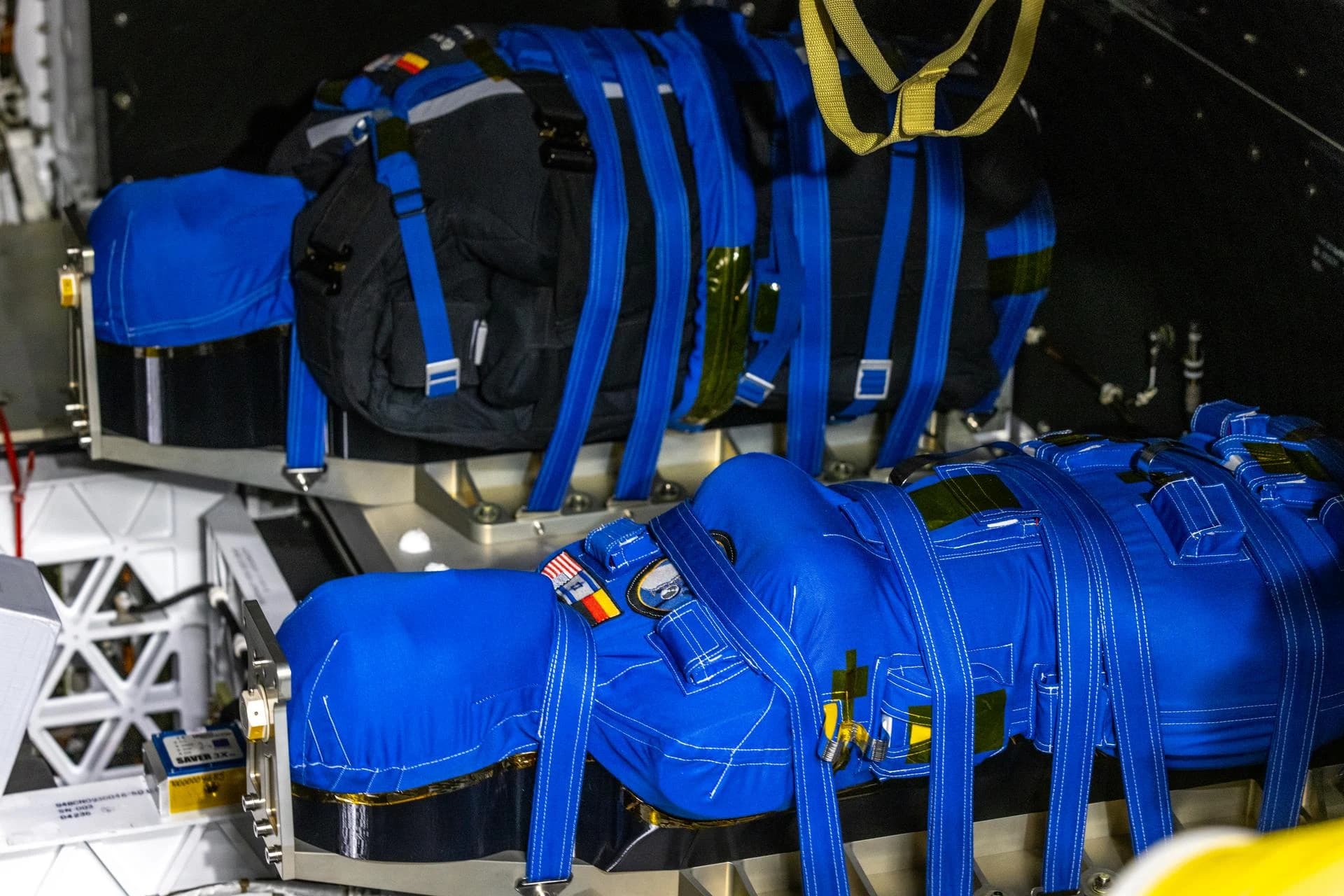
A radiation vest flown around the Moon on Artemis I could cut an astronaut's effective dose by about 60% in a solar particle event resembling the major August 1972 storm, and by nearly 40% in an October 1989-like event, according to a Science Advances study published August 12. Those percentages were not measured during a storm. Artemis I encountered no such event, so the researchers used radiation recorded inside Orion to test a computer model and then replaced the measured environment with the two historical proton spectra.
That distinction defines the result. Solar particle events are bursts dominated by protons that can raise radiation levels for hours or days, with little warning. Their lower-energy particles are more amenable to material shielding than the persistent, more penetrating galactic cosmic-ray background. The new paper is therefore evidence that a flight-anchored model predicts substantial protection in two severe scenarios, not a direct demonstration of the vest during a major solar outburst.
What Orion actually measured
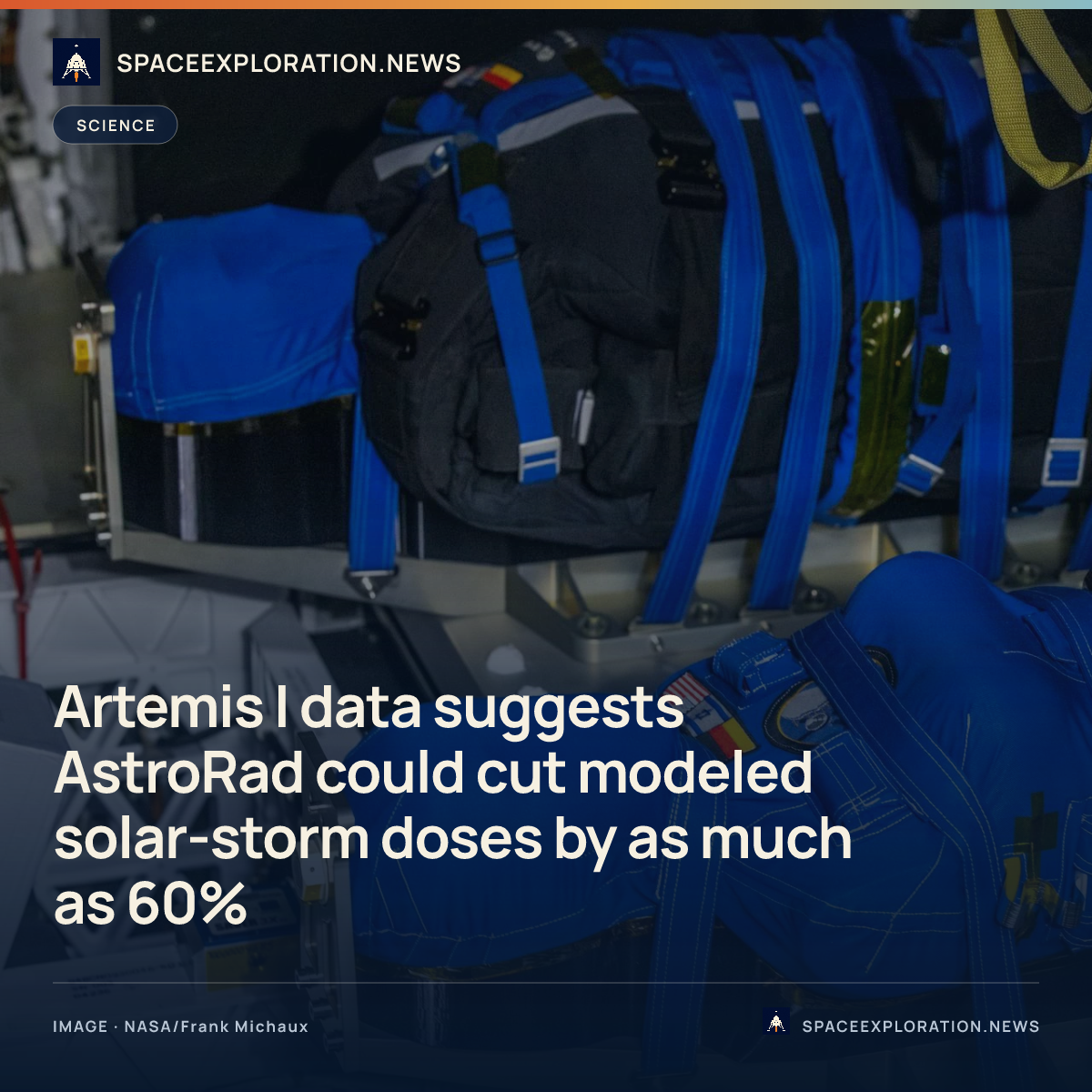
The uncrewed Artemis I mission carried two instrumented female torso phantoms in Orion. Zohar, in seat 3, wore the roughly 26-kilogram AstroRad vest; Helga, in seat 4, did not. The phantoms reproduce bone, soft tissue and organ geometry, allowing detectors to sample dose within a body-shaped target instead of only at points around the cabin. Across the pair, the Matroshka AstroRad Radiation Experiment, or MARE, carried 34 active detectors as well as passive dosimeters.
For the new analysis, the crucial flight measurements came from the active detectors during Orion's ascent through Earth's inner Van Allen belt. The team built a GEANT4 radiation-transport model of the phantoms, vest and shielding seen from each seat, then compared its predicted detector doses with the readings. Correlations ranged from 0.974 to 0.993 across four detector groups, while the mean signed difference across all detectors was -4.7%. No individual simulated value differed from its measurement by more than 29.5%, the authors reported.
A separate Nature paper on Artemis I had already shown why cabin geometry and orientation matter: dose rates at differently shielded Orion locations varied by as much as a factor of four during the proton-belt passages, and turning the spacecraft by 90 degrees reduced dose rates by about half. In the vest study, Helga was not a perfect experimental control because her seat had slightly different vehicle shielding from Zohar's. The storm calculation therefore did not simply subtract one manikin's flight reading from the other's.
How the storm estimates were made
After validating the model against the belt transit, the researchers removed the seat-to-seat shielding difference, accounted for an astronaut rotating rather than remaining strapped forward for an entire storm, removed experimental support hardware and used human-tissue properties. They then swapped the Van Allen belt input for parameterised proton spectra from August 1972 and October 1989. The belt and solar-event spectra cover a similar energy range, the paper says, although the trapped-belt spectrum is biased toward more penetrating energies.
Effective dose combines organ and tissue doses using weights for their different radiation sensitivities. For the torso phantom, the model reduced that measure from 222.3 to 87.5 millisieverts in the 1972 case, a 60.7% decrease, and from 233.5 to 143.6 millisieverts in the 1989 case, a 38.5% decrease. A second simulation using a median adult female whole-body model produced similar but slightly smaller reductions of 58.2% and 36.9%. The authors translated the largest amount of dose spared into up to 193 days of background deep-space exposure for the 1972 case and 131 days for the 1989 case, with the equivalence depending on the solar cycle.
AstroRad is not a uniform body shield. Its hydrogen-rich polyethylene is concentrated over red bone marrow and organs including the lungs, colon, stomach, breasts and ovaries, with thickness adjusted for the body's own shielding. That selective design lowers mass but leaves the head and extremities uncovered. The paper attributes the smaller percentage benefit in the 1989 scenario to that event's harder, more penetrating proton spectrum.
A vest and a storm shelter solve different problems
Orion already has a storm-shelter concept. NASA says crew members can move into the central portion of the capsule, between the floor and heat shield, and use two large stowage lockers plus bags of supplies to put more mass around themselves. That approach reuses material already aboard rather than adding a dedicated 26-kilogram garment, but it confines the crew when a storm may last for hours or days. A vest can preserve mobility for essential work and can also be worn when leaving the shelter.
The paper cites an internal NASA analysis that estimated a cargo-bay shelter could reduce dose equivalent by 36% in an October 1989-like event, close to the vest study's 38.5% torso estimate. That is not a head-to-head flight comparison: the shelter number came from a separate model, and the vest result compares a vested astronaut with the normally configured cabin. The practical choice is therefore not necessarily vest or shelter. Used together, the shelter supplies broad vehicle shielding while the garment protects selected organs when movement is required.
What remains uncertain
The calculation still depends on simplifications. The validation model represented Orion's hull with aluminium and polyethylene and omitted shielding from many non-structural cabin objects. Its Van Allen input came from climatological trapped-radiation models that do not reproduce the exact spectrum or directionality Orion encountered. Historical 1972 and 1989 spectra are useful design cases, but a future event could have a different intensity and energy distribution. The whole-body calculation also represents one median female geometry, not the range of crew bodies and vest fits.
The authorship requires context as well. Four researchers worked for AstroRad developer StemRad; co-author Oren Milstein is the company's chief executive, a co-founder and minority shareholder, and two authors are named on patents covering vest concepts. The paper also includes scientists from NASA, the German Aerospace Center, Lockheed Martin and other institutions, and says its data and code are available in the paper or supplements. Independent reporting by the Associated Press says the vest is not planned for Artemis II, citing the mission's short duration and limited room.
The clearest outcome is narrower than a claim that AstroRad has survived a solar storm. Artemis I supplied real measurements with which to check the transport model, and the model then predicted large dose reductions for two historical events. For future lunar crews, that makes the vest a candidate layer in a radiation plan whose fixed refuge remains the storm shelter. A flight decision would still have to weigh dedicated mass, fit, mobility and mission duration against the probability and consequences of a solar particle event.
Reporting trail
Primary sources
Science AdvancesFirst evaluation of wearable radiation protection for human deep space exploration, as flown on Artemis Iscience.org
NASAArtemis I — Matroshka AstroRad Radiation Experimentnasa.gov
NatureSpace radiation measurements during the Artemis I lunar missionnature.com
Associated PressRadiation vest tested on NASA moonshot can cut astronauts' exposure in solar storms, study suggestsapnews.com
Space.comRadiation-shielding vest aced Artemis I lunar test, could protect astronauts on moon and Mars missionsspace.com
For an image post, download the card and copy this suggested caption.
Orion encountered no major solar particle event. Researchers validated a transport model against radiation measured inside two manikins, then substituted spectra from the 1972 and 1989 storms. Read the full report: https://www.spaceexploration.in/news/artemis-i-astrorad-solar-storm-estimates #SpaceExplorationNews #SpaceNews #SpaceScience