Commercial Earth observation
GalaxEye loses contact with Drishti before OptoSAR payload test
The spacecraft proved early-orbit systems and in-house mission operations, but GalaxEye says imaging never began; its solar-storm explanation remains preliminary as two larger follow-on satellites are planned.
Add us as a preferred source on Google Add us as a preferred source on Google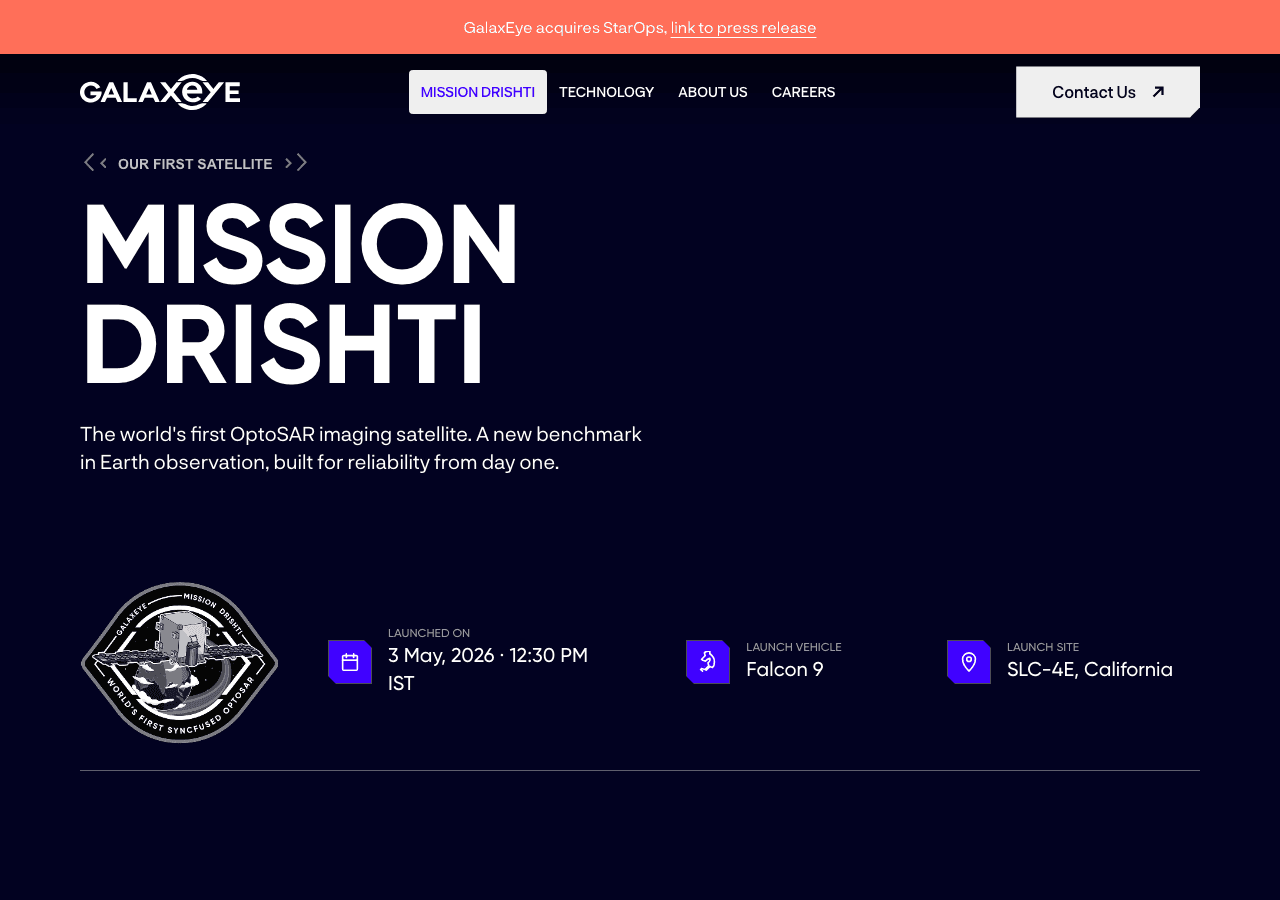
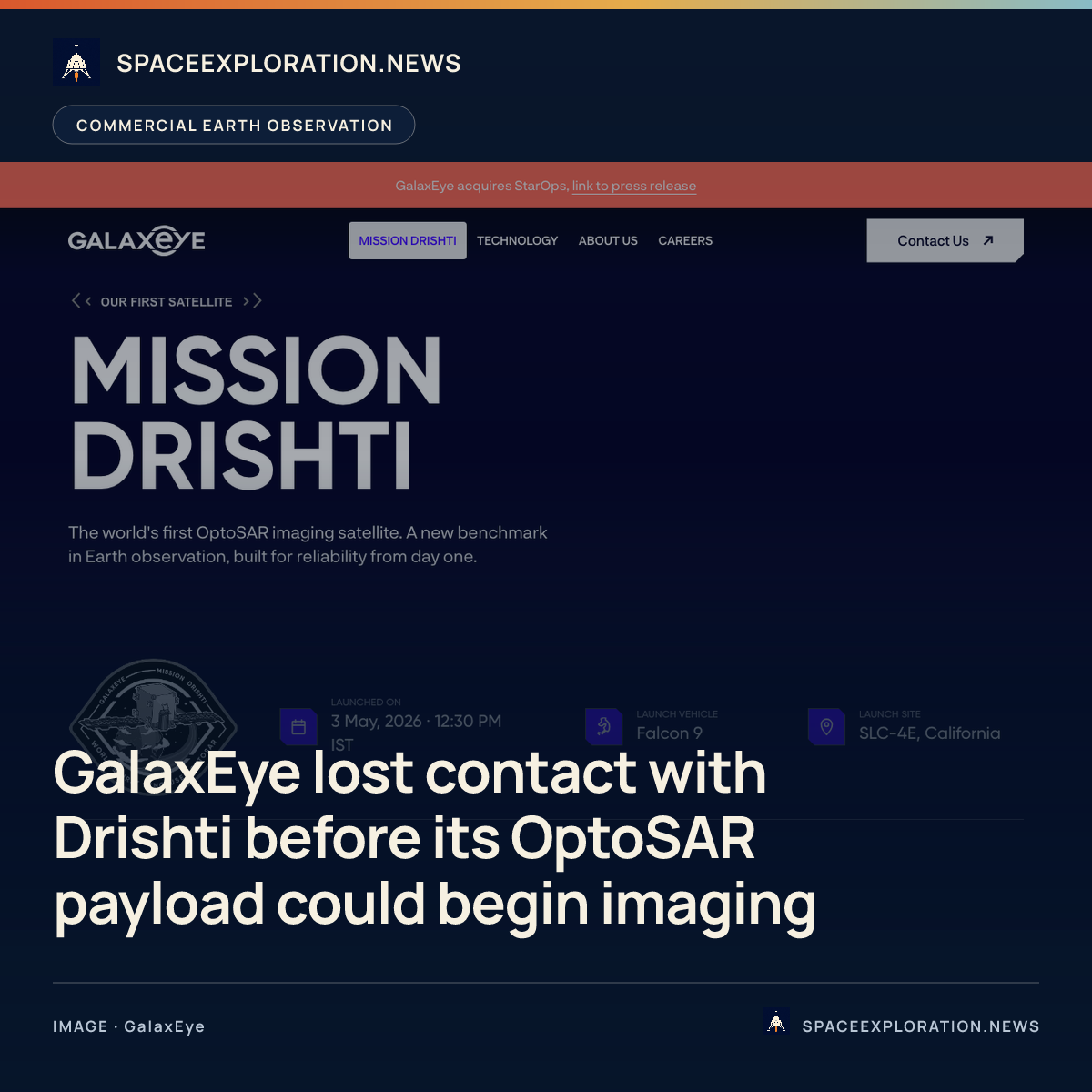
GalaxEye says it has lost communication with Mission Drishti, its first Earth-observation satellite, after contact became intermittent during the final stage of launch and early-orbit operations. The Bengaluru company disclosed the setback on July 7, 2026, and said recovery work was continuing but the likelihood of restoring the spacecraft appeared low. Drishti had launched on May 3 aboard a SpaceX Falcon 9, leaving the mission operating for only a few weeks before the anomaly interrupted commissioning.
The cause is not settled. GalaxEye said its initial analysis indicated that radiation associated with a geomagnetic solar storm likely affected a critical onboard system, but it has not published a completed root-cause report or identified the component. The US National Oceanic and Atmospheric Administration independently recorded a brief G2, or moderate, geomagnetic storm late on May 4. That establishes disturbed space weather during Drishti's early-orbit period; it does not prove which effect reached the spacecraft or caused the communications loss.
What Drishti proved before contact was lost
GalaxEye's account shows that the mission did complete meaningful spacecraft work. The company says Drishti established communication after launch, completed a major portion of its planned launch and early-orbit phase, carried out deployment activities and demonstrated attitude control. It also operated onboard computing and communications systems. On the ground, GalaxEye says its Bengaluru mission control centre demonstrated the company's ability to conduct in-house mission operations rather than relying entirely on an outside operator.
Those achievements stop short of the mission's central imaging claim. NDTV reported, attributing the information to GalaxEye, that the company did not get to operate the payload because the anomaly occurred before imaging began. No image from Drishti was publicly released. The available record therefore supports an in-orbit demonstration of parts of the spacecraft bus, commissioning sequence and operating organisation, but not an in-orbit demonstration of fused OptoSAR imagery or a customer-ready data product.
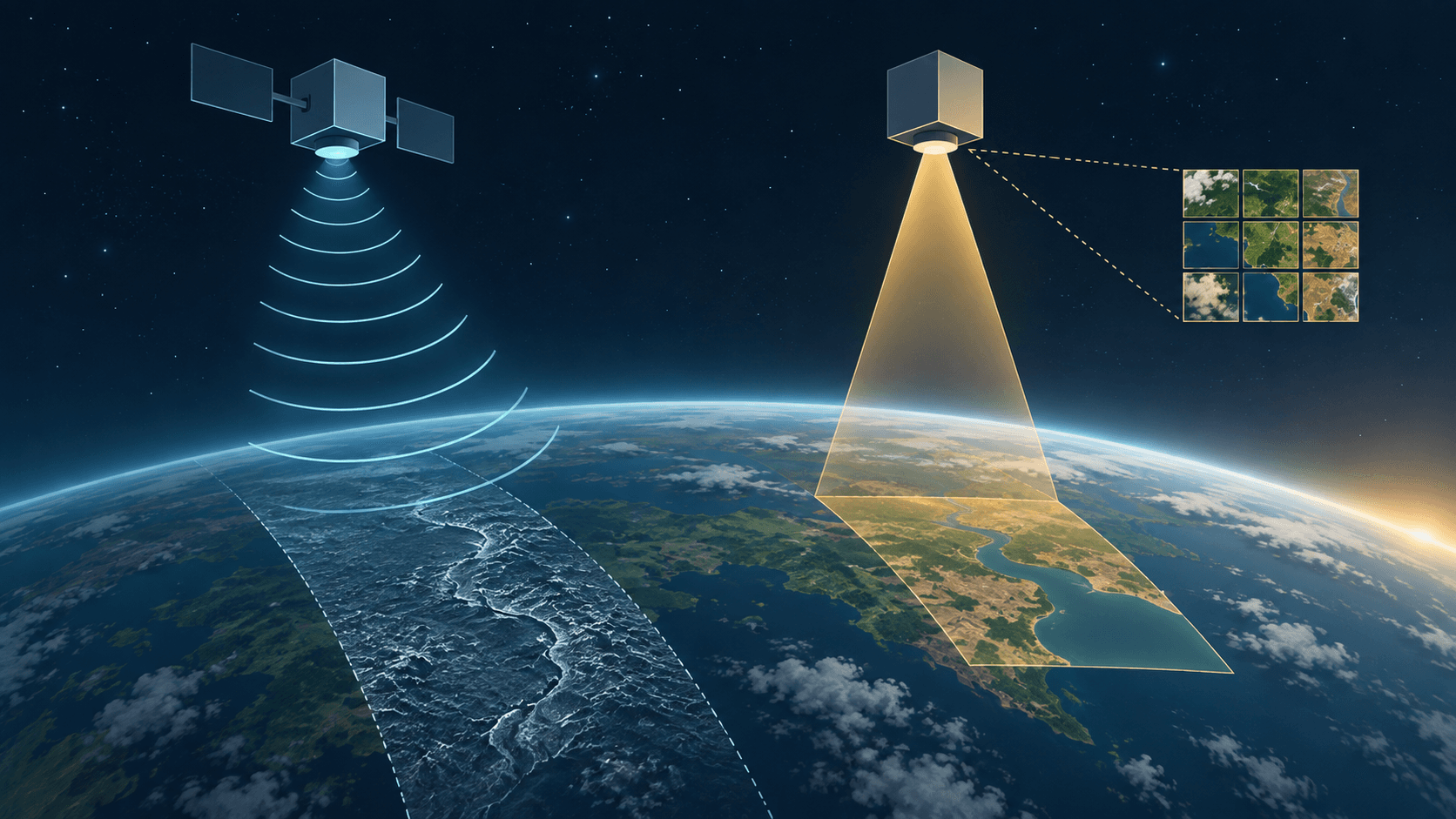
That distinction matters because OptoSAR was the reason for the mission. GalaxEye designed Drishti to place synthetic aperture radar and a multispectral optical imager on the same platform so both sensors could observe a target in the same pass. Radar supplies observations through cloud and darkness; the optical instrument supplies imagery that is more immediately interpretable. GalaxEye's commercial thesis is that co-locating the sensors produces data that is inherently aligned, avoiding the timing and geometry differences that arise when a customer combines scenes from separate satellites.
The company's mission page describes Drishti as a roughly 190-kilogram spacecraft intended for a sun-synchronous orbit at 500 kilometres, plus or minus 10 kilometres. Its payload paired an X-band radar with a seven-band multispectral imager covering panchromatic, visible, near-infrared, coastal-blue and red-edge observations. GalaxEye advertised fused resolution of about 1.8 metres and a four-day revisit. Those are design and service claims from the company; because payload operations never began, Drishti did not publicly establish them with imagery from orbit.
The spacecraft loss does not validate or disprove OptoSAR
Losing the spacecraft before payload commissioning leaves GalaxEye's product thesis unresolved rather than disproved. The mission did not run long enough to show whether the radar and optical instruments could collect, align, process and deliver imagery at the advertised quality and cadence. It also did not produce public evidence that those steps could support regular customer orders. Conversely, the communications loss alone does not show that the paired-sensor concept failed; the company has attributed the anomaly to a critical onboard system without saying that either imaging instrument caused it.
Before launch, founder and chief executive Suyash Singh described Drishti as the proof point for a planned commercial constellation. He told Moneycontrol that one spacecraft would have limited availability because of its orbit cycle, while more satellites would improve revisit and supply. The company was then discussing a ten-satellite second generation and a larger Bengaluru manufacturing facility. With Drishti unable to begin imaging, the next spacecraft now carry both jobs: demonstrating the fused product in orbit and showing that GalaxEye can repeatably build and operate the service.
Two larger satellites now carry the next test
GalaxEye says it is responding by bringing more of its supply chain, manufacturing and satellite-development work in-house, which Singh said would give the company greater visibility and control over the value chain. The company has not publicly detailed the design changes arising from the anomaly, the failed component or the measures intended to protect the follow-on spacecraft. Until a root-cause report or equivalent technical account is released, it is not possible to assess whether the announced organisational changes address the specific failure mode.
Singh said in a subsequent post that GalaxEye is working toward two 300-kilogram-class satellites in the next 20 to 24 months. That is a company schedule rather than a confirmed launch booking, and it represents a substantial step up from the approximately 190-kilogram Drishti. GalaxEye separately said the next two OptoSAR spacecraft would incorporate lessons from the first mission. The company has not announced their launch vehicles, exact launch dates or whether both satellites will use the same configuration.
For now, the verified outcome is narrower than either a total technical failure or a successful OptoSAR demonstration. GalaxEye reached orbit, communicated with Drishti and exercised several spacecraft and ground-operation functions; it then lost contact before the payload produced imagery. The solar-storm explanation remains a preliminary company finding, and recovery was still described as ongoing when the loss was announced. The next material evidence will be a completed anomaly account, a restored signal, or the first fused imagery from a follow-on satellite.
Reporting trail
Primary sources
GalaxEyeMission Drishti press notecdn.prod.website-files.com
GalaxEyeMission Drishtigalaxeye.space
The Times of IndiaGalaxEye loses contact with maiden satellite Drishti, recovery unlikelytimesofindia.indiatimes.com
NDTVSun Knocks Out Surveillance Satellite, Bengaluru Startup Vows Comebackndtv.com
MoneycontrolGalaxEye eyes early May launch for 190 kg-satellite Drishti, plans 10 more, new facilitymoneycontrol.com
NOAA Space Weather Prediction CenterSlow Moving Transient Led to Brief G2 Levels on 4 Mayspaceweather.gov
For an image post, download the card and copy this suggested caption.
The spacecraft proved early-orbit systems and in-house mission operations, but GalaxEye says imaging never began; its solar-storm explanation remains preliminary as two larger follow-on satellites are planned. Read the full report: https://www.spaceexploration.in/news/galaxeye-drishti-contact-loss #SpaceExplorationNews #SpaceNews #SpaceIndustry