Planetary science
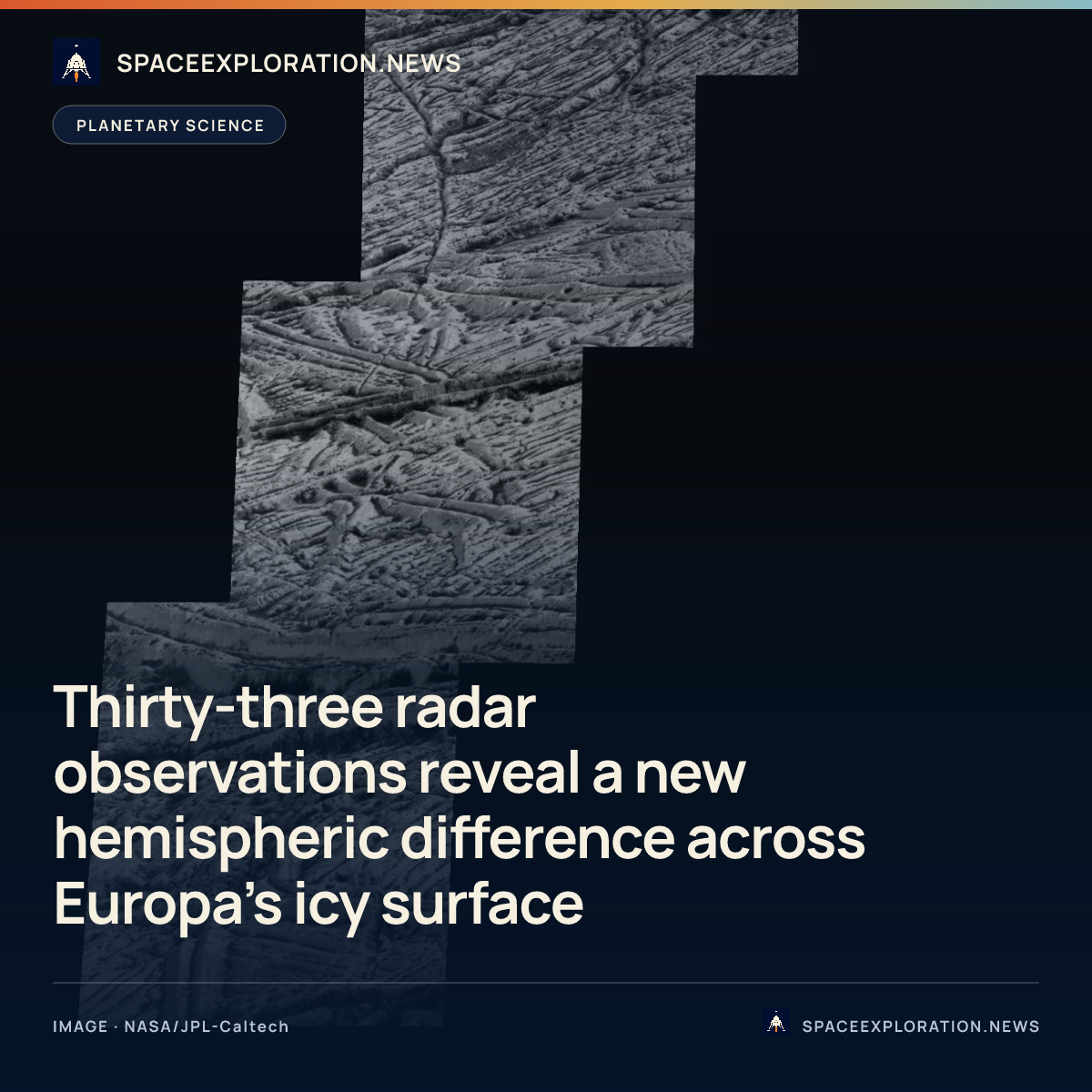
Broad Europa radar survey points to a leading-trailing hemisphere difference
The August 18 preprint combines 33 observations from 2011–2024, supporting coherent backscatter while leaving the source of the hemispheric pattern unsettled.
Add us as a preferred source on Google Add us as a preferred source on Google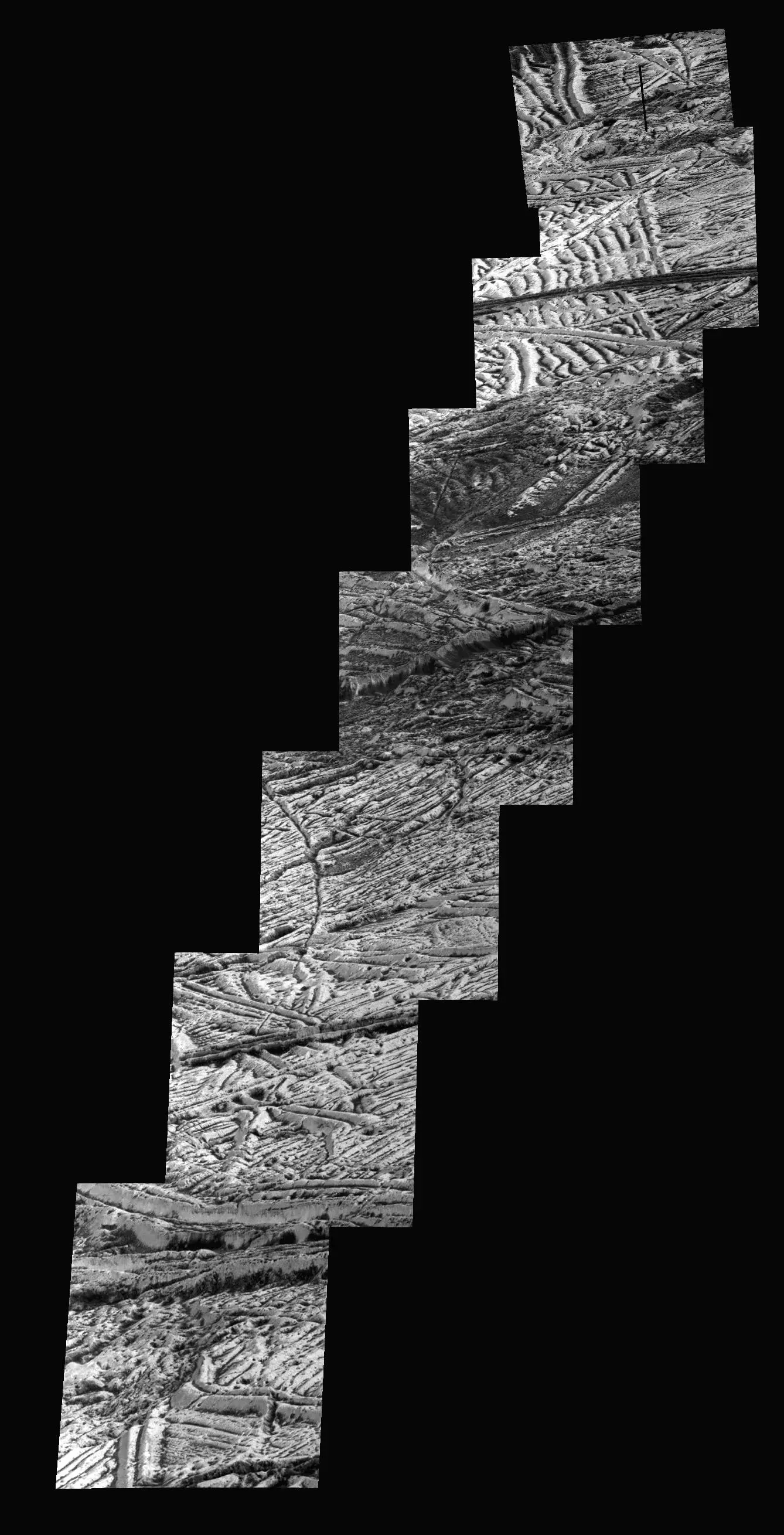
A newly posted radar analysis of Europa finds evidence that echoes from the moon’s leading side differ from those from its trailing side, with the clearest split appearing in circular polarization rather than in total radar brightness. The preprint brings together 33 observing epochs from 2011 to 2024, the broadest coverage of Europa’s longitudes yet reported. Its authors say the same measurements support coherent backscatter within the ice. Neither result identifies a unique surface texture: the echoes average the visible disk, and most of the individual albedo tests did not cross the study’s significance threshold.
Tunhui Xie and seven co-authors posted the first arXiv version on August 18. The record says the paper has been accepted for publication in The Planetary Science Journal, but the journal version was not available through the record during reporting. The numerical results and interpretations in this article come primarily from that paper; Space Exploration .IN has not independently reprocessed the spectra.
A wider sweep around Europa
The observations used NASA’s 70-metre DSS-14 antenna at Goldstone, California, to transmit a roughly 450-kilowatt, right-circularly polarized signal at 8,560 megahertz, a wavelength of 3.5 centimetres. Echoes were recorded at Goldstone and simultaneously at the 100-metre Green Bank Telescope in West Virginia. That produced a monostatic view, with transmitter and receiver together at Goldstone, and a bistatic view, with the receiver displaced to Green Bank. After data-quality exclusions and outlier removal, the authors retained 28 Goldstone epochs and 26 Green Bank epochs.
The longitude coverage is the study’s main advantage. The earlier 1987–1991 Goldstone work used seven observations in its disk-integrated comparison; the new analysis uses 28. Each measurement still combines the echo from the hemisphere facing Earth rather than resolving individual terrain. Sampling many subradar longitudes lets the authors compare broad sides of Europa, but it does not turn the dataset into a new radar map of a ridge, band or patch of ice.
Circular polarization supplies the diagnostic. A smooth, predominantly single-bounce reflector returns most power in the opposite circular sense from the transmitted wave, whereas multiple scattering can preserve more power in the same sense. Goldstone’s mean radar albedos were 0.92 ± 0.11 in the opposite-sense channel and 1.35 ± 0.13 in the same-sense channel. Their ratio was 1.44 ± 0.12; Green Bank produced a similar ratio of 1.46 ± 0.14. Values above one are unusual beside the roughly 0.1 ratios reported for terrestrial planets, and the paper treats the ratio as more robust than absolute albedo because several calibration errors cancel when the two channels are divided.
Where the hemispheres separate
Across all longitudes, the Goldstone albedos and polarization ratio were statistically consistent with constant values. Green Bank’s polarization ratio was the exception, showing variability at the 95% confidence level. The authors then grouped subradar longitudes from 0° to 180° and from 180° to 360° to test the leading and trailing sides directly. Goldstone’s opposite-sense albedo gave p=0.01, while Green Bank’s equivalent result was p=0.06; the same-sense albedos gave p=0.22 and p=0.43. The polarization ratios crossed the threshold at both telescopes, with p=0.02 at Goldstone and p=0.03 at Green Bank.
That mixed outcome is why the result is evidence for a dichotomy, not a settled surface model. The plots suggest higher albedo on the trailing side, and earlier Arecibo maps had placed a radar-dark region near the leading-side equator. The new paper discusses bladed, sublimation-shaped ice structures known as penitentes, surface deposits, radiation-driven sputtering and impact gardening as possible contributors. It also notes that penitentes on Europa remain debated. Disk-integrated statistics cannot choose among those mechanisms or locate the responsible material within either hemisphere.
Coherent backscatter fits, but is not isolated
Coherent backscatter offers an explanation for the unusually strong same-sense echo. In the model, waves travel reciprocal paths through a scattering medium and emerge toward the receiver in phase when the transmitter-target-receiver angle is near zero. Their constructive interference preferentially strengthens the same-sense channel, raising the circular polarization ratio. The Europa measurements have the high albedos and ratios expected from that process, so the authors describe their results as support for the leading explanation for icy-moon radar behaviour. The survey does not, however, directly separate coherent backscatter from every other form of multiple scattering.
The two receiving sites add a geometrical test. Green Bank viewed each echo at a slightly larger transmitter-target-receiver angle than Goldstone. If the observations had reached the descending side of the coherent-backscatter peak, the same-sense intensity should have fallen as that angle increased. The paper found no measurable falloff across angles extending to about 36 arcseconds. It therefore interprets all of the observations as lying inside the peak’s main lobe and sets 36 arcseconds as a lower bound on the peak width, rather than measuring the full width.
Absolute albedo remains a calibration-sensitive part of the analysis. The X-band gain appropriate to Goldstone’s radar feed is not precisely known. One adopted gain makes the new Goldstone averages agree with the older work but leaves Green Bank systematically lower; an alternative gain brings the two telescopes into agreement while making the albedos about 20% lower than the earlier values. The circular polarization ratios barely change under that choice. The hemispheric case therefore leans more heavily on the ratios than on a finely calibrated map of absolute reflectivity.
What the 32-metre bound means
Within the coherent-backscatter model, peak width is related to wavelength and the mean distance that radiation diffuses into the ice before absorption. Applying that relation to a lower width bound of 36 arcseconds gives an upper bound of 32 metres, about 1,000 times the 3.5-centimetre wavelength. This is not a measurement of Europa’s ice-shell thickness, the deepest point reached by every echo or a universal penetration limit for other radar frequencies. It is a model-dependent limit on a mean path-depth parameter for this X-band experiment.
NASA says Europa Clipper’s REASON instrument will use high- and very-high-frequency radar to investigate structure as deep as 30 kilometres in favourable ice, a different wavelength and observing geometry from the ground-based survey. The preprint says its scattering constraints may help interpret future spacecraft radar, but the 32-metre figure cannot be transferred directly to REASON’s sounding depth. Wider-angle bistatic measurements would first need to find the coherent-backscatter peak’s falling edge. Until then, the long survey supports a hemispheric difference and a broad coherent-backscatter peak while leaving the physical cause of the leading-trailing pattern open.
Reporting trail
Primary sources
arXivRadar observations of Europa in 2011–2024: New insights into radar scattering propertiesarxiv.org
arXiv abstract recordRadar observations of Europa in 2011–2024: New insights into radar scattering propertiesarxiv.org
NASA ScienceREASONscience.nasa.gov
NASA ScienceHighest-Resolution Europa Image and Mosaic from Galileoscience.nasa.gov
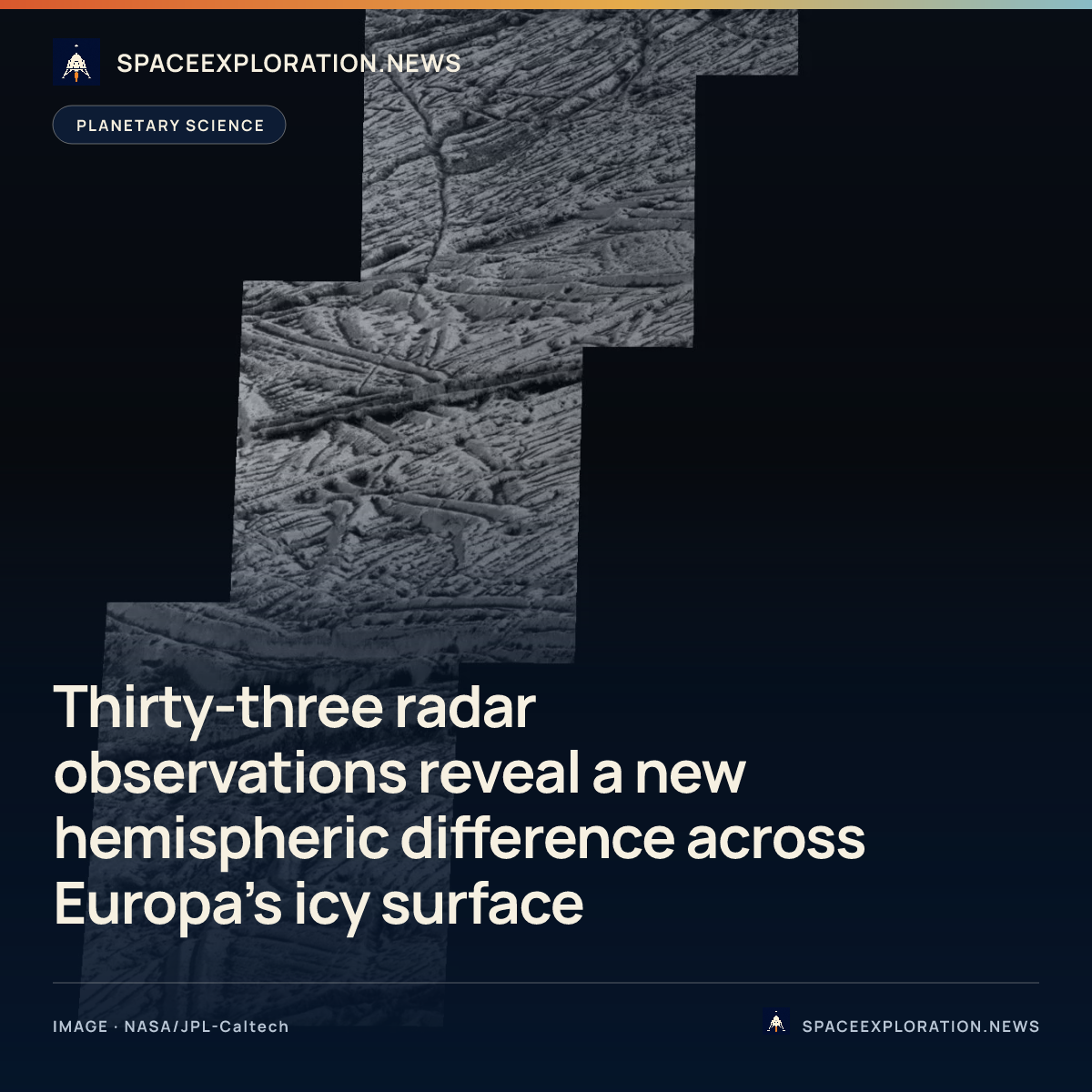
For an image post, download the card and copy this suggested caption.
The August 18 preprint combines 33 observations from 2011–2024, supporting coherent backscatter while leaving the source of the hemispheric pattern unsettled. Read the full report: https://www.spaceexploration.in/news/europa-radar-leading-trailing-hemispheres #SpaceExplorationNews #SpaceNews #SpaceScience