Mars exploration
JAXA sets October 20 launch date for Phobos sample-return mission
MMX is scheduled to leave Tanegashima on H3 Flight 10 at 04:41:03 JST. Launch would begin a five-year mission; arrival, landing, sampling and Earth return all remain ahead.
Add us as a preferred source on Google Add us as a preferred source on Google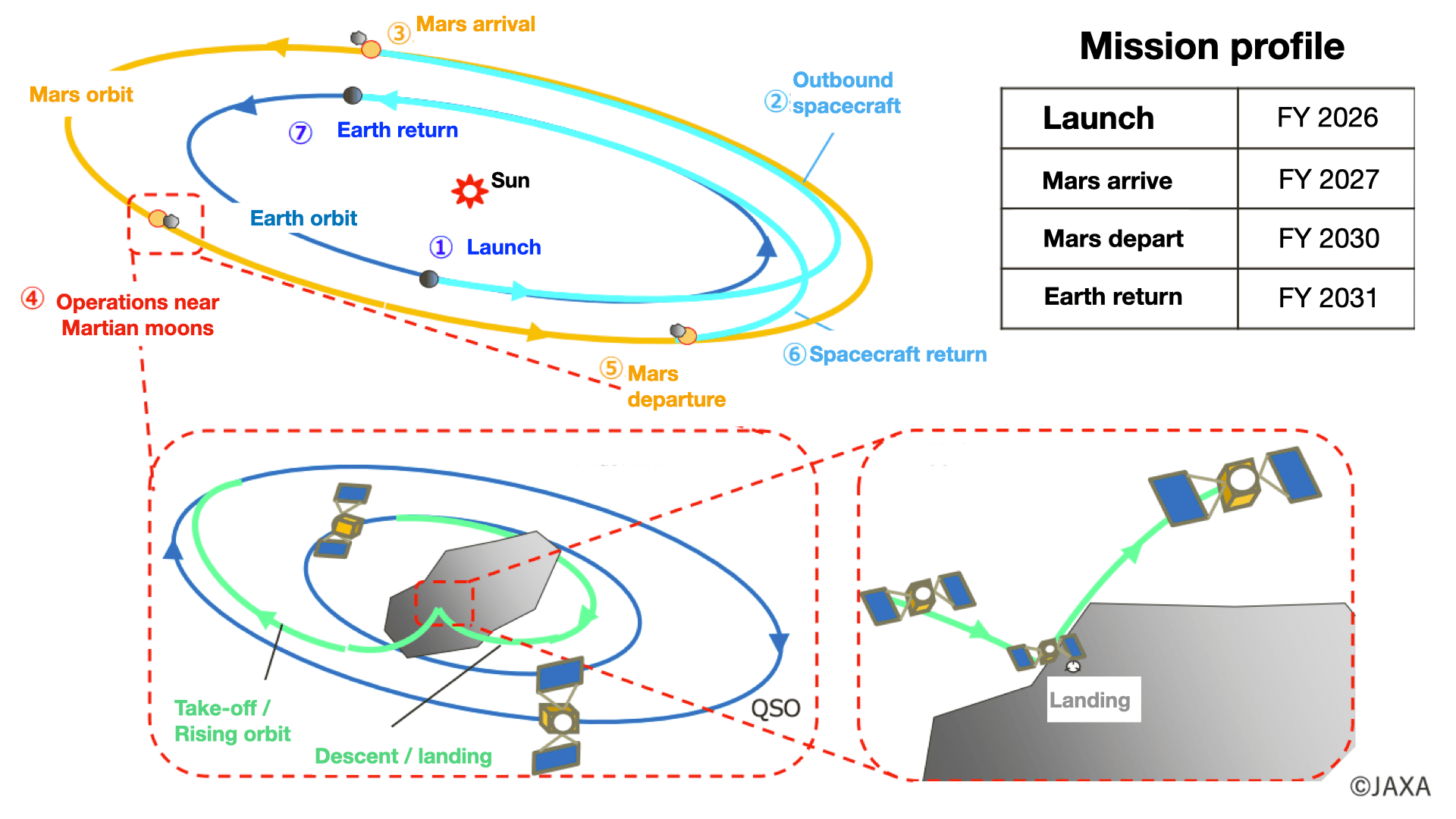
Japan’s Martian Moons eXploration spacecraft is scheduled to launch on October 20, 2026, at 04:41:03 Japan Standard Time aboard H3 Flight 10, the Japan Aerospace Exploration Agency said on August 20. The flight is assigned to the Yoshinobu Launch Complex at Tanegashima Space Center. JAXA also set October 21 through November 7 as a reserved launch period and said the time could change within that period.
The announcement fixes a date and an instantaneous time for MMX after the mission had been described more broadly as a fiscal 2026 launch. It does not report a launch, spacecraft separation or any later mission event. Space Launch Now mirrors the schedule as 19:41:03 UTC on October 19 and labels the window instantaneous, but its update links back to JAXA; the agency remains the scheduling authority. The distinction matters because every scientific objective in the plan depends on a successful flight and years of operations that have not yet occurred.
A five-year chain starts at launch
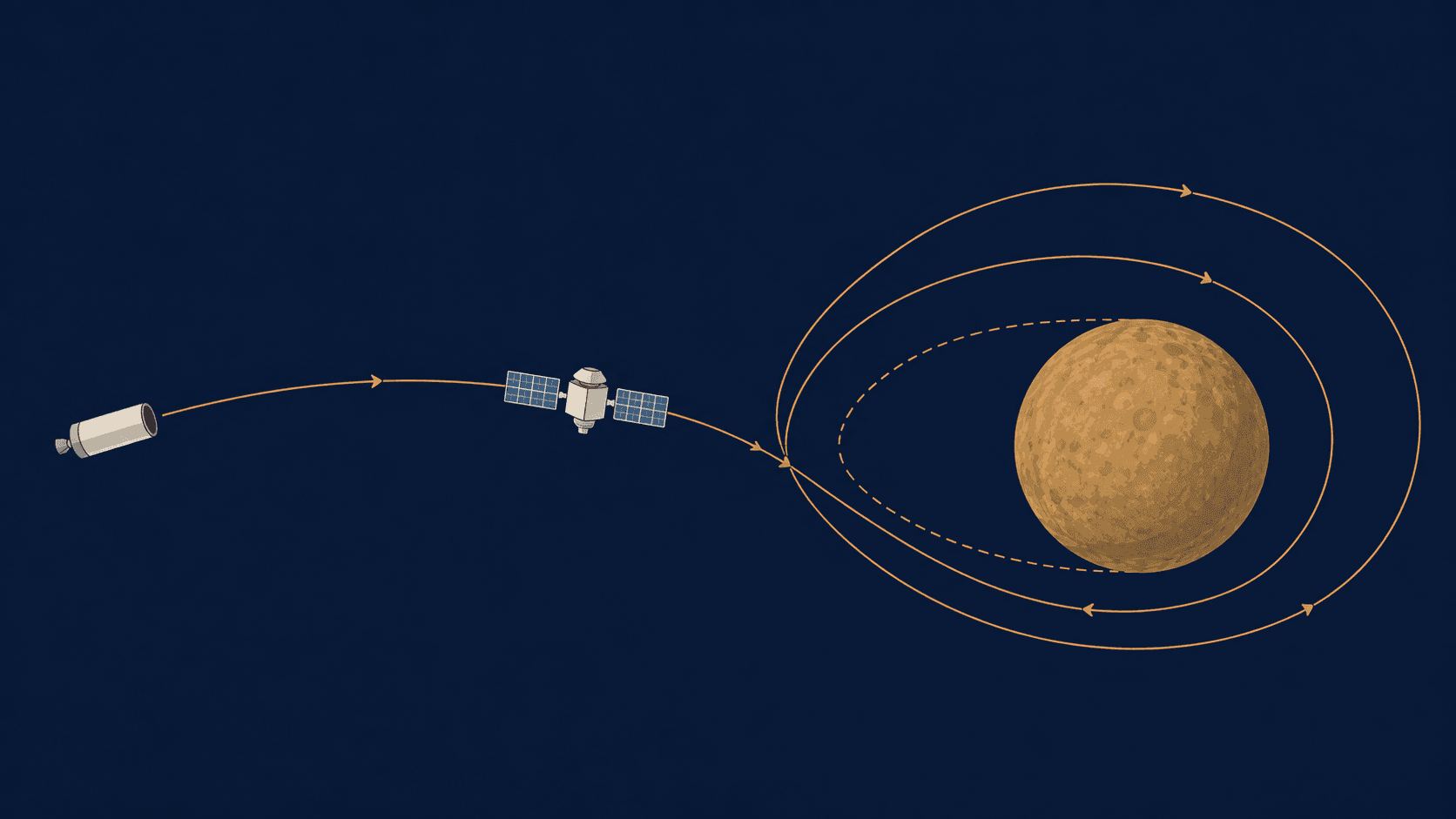
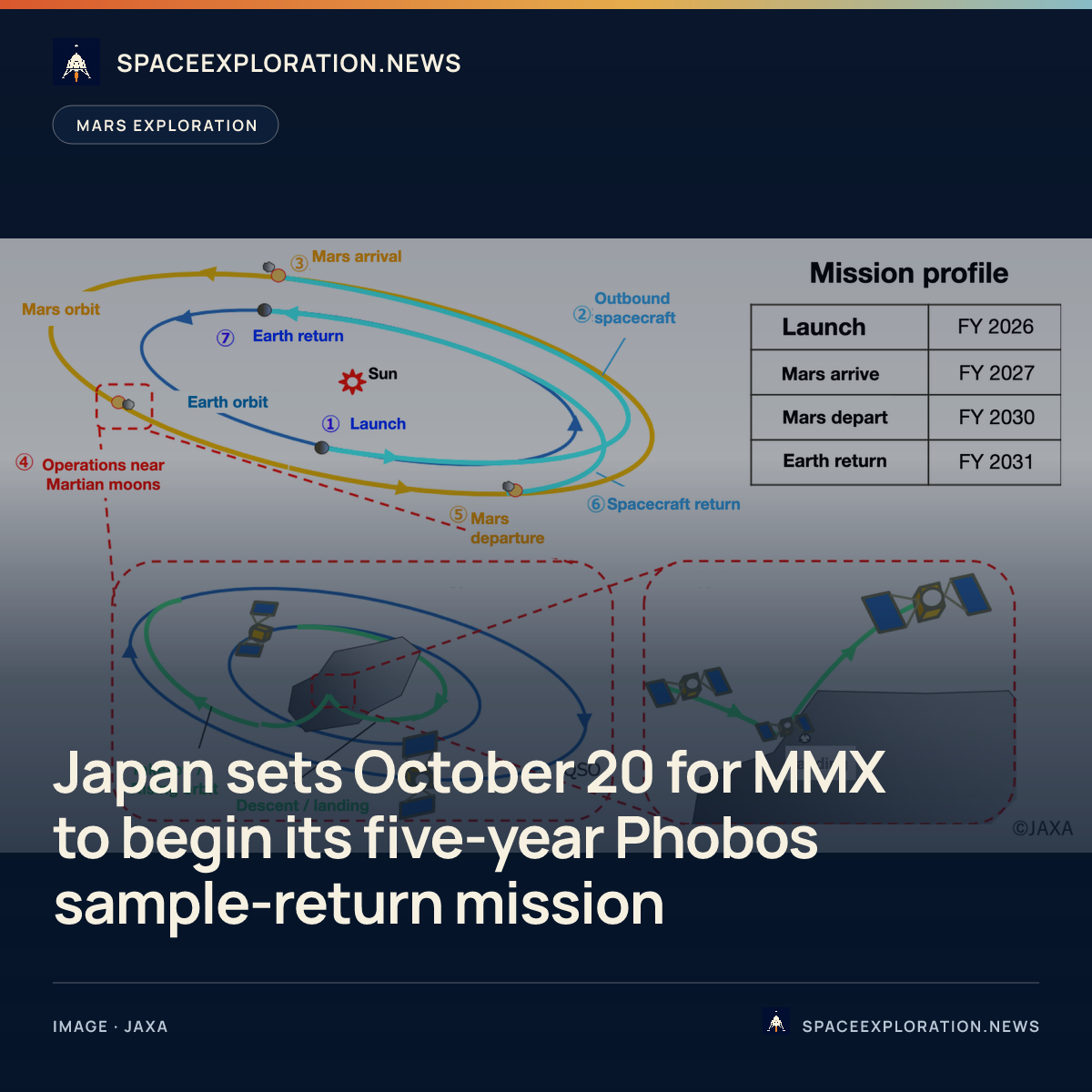
JAXA’s current mission sequence puts MMX at Mars in 2027 after a journey of about one year. The spacecraft is then intended to enter a quasi-satellite orbit around Phobos, moving near the moon while remaining in orbit around Mars. During a planned three-year stay in the Martian system, MMX is to observe Phobos, deploy the IDEFIX rover before the spacecraft’s own landing attempt, collect surface material and observe Deimos. The schedule calls for departure from the Martian system in 2030 and recovery of the return capsule in Australia in fiscal 2031.
The spacecraft combines propulsion, exploration and return modules. JAXA says 11 scientific instruments will support remote sensing, measurements near the moons and selection of a landing site. The mission target is to return more than 10 grams of material from Phobos. Its coring sampler is designed to reach material as deep as 2 centimetres, while a pneumatic sampler contributed by NASA uses pressurised gas to move loose surface material into a container. The sample return capsule is meant to carry material collected by both systems through Earth’s atmosphere.
Those systems define separate future tests of mission success. Reaching Mars would not itself demonstrate a Phobos landing. A landing would not establish that either sampler secured material. Sample collection would still leave departure, the return cruise, capsule separation, atmospheric entry and recovery. JAXA’s published sequence therefore treats the 2031 capsule recovery, not the October launch date, as the final critical phase.
Why Phobos samples matter
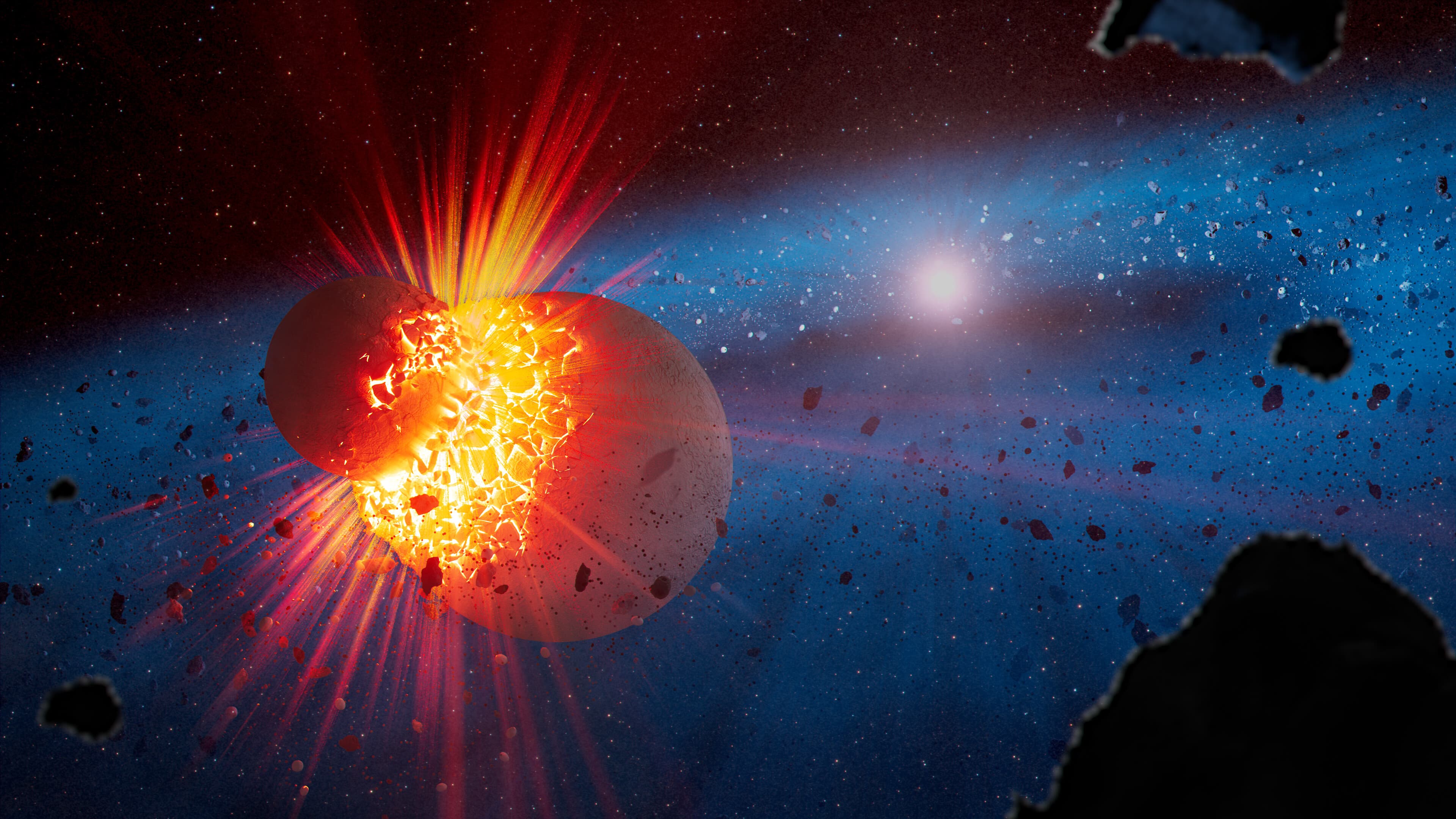
MMX is designed to test two leading explanations for the Martian moons. In one, Phobos and Deimos formed from debris after a large body struck early Mars; in the other, they began as asteroids that Mars captured. JAXA says spacecraft observations and laboratory analysis of returned material are intended to distinguish between those possibilities. The mission would be the first to return samples from the Mars region if the capsule reaches Earth with Phobos material, but that outcome remains a plan rather than a result.
The investigation is broader than the sample alone. MMX is also intended to map the moons’ topography, composition, internal structure and gravity, and to examine the Martian atmosphere and the space environment around the moons. JAXA frames those observations around the origin and evolution of the Mars system and the movement of water and organic material during planetary formation. Remote-sensing data are also operational: the team plans to use them when choosing where the spacecraft will attempt to land and sample.
The new date is preparation, not completion
Assigning H3 Flight 10 a date, time, pad and reserve period is a concrete preparation step because it turns a fiscal-year target into a launch campaign calendar. It is not evidence that MMX has completed launch readiness reviews, lifted off or begun its interplanetary cruise; JAXA’s short scheduling notice does not make those claims. Nor does it move the planned 2027 arrival, Phobos landing and sampling, 2030 departure or 2031 capsule recovery into the completed column.
The precise launch schedule is reported by JAXA, which operates the mission and launch site, and the technical sequence in this account comes from JAXA’s current MMX pages. Space Launch Now provides a secondary listing but cites the Japanese announcement for its August 20 update. The next dated milestone is therefore still the launch attempt at 04:41:03 JST on October 20. If it cannot proceed then, JAXA’s announced reserve runs through November 7, with the launch time subject to change.
Reporting trail
Primary sources
JAXALaunch schedule of the Martian Moons eXploration spacecraft aboard H3 Flight 10global.jaxa.jp
MMX Project, JAXAMMX mission homepage and schedulemmx.jaxa.jp
MMX Project, JAXAMission Overview/Mission Flowmmx.jaxa.jp
MMX Project, JAXAScience and mission instrumentsmmx.jaxa.jp
JAXAH3 Launch Vehicleglobal.jaxa.jp
Space Launch NowH3-24 | Martian Moon eXplorer (MMX)spacelaunchnow.app
For an image post, download the card and copy this suggested caption.
MMX is scheduled to leave Tanegashima on H3 Flight 10 at 04:41:03 JST. Launch would begin a five-year mission; arrival, landing, sampling and Earth return all remain ahead. Read the full report: https://www.spaceexploration.in/news/jaxa-mmx-october-20-launch-date #SpaceExplorationNews #SpaceNews #SpaceMissions