Lunar science
LRO measures 18-metre crater from Falcon 9’s uncontrolled Moon impact
The mark is smaller than two pre-impact academic forecasts. The sharper operational lesson is that uncertainty around the spent stage’s path prompted Danuri’s team to consider a possible close encounter.
Add us as a preferred source on Google Add us as a preferred source on Google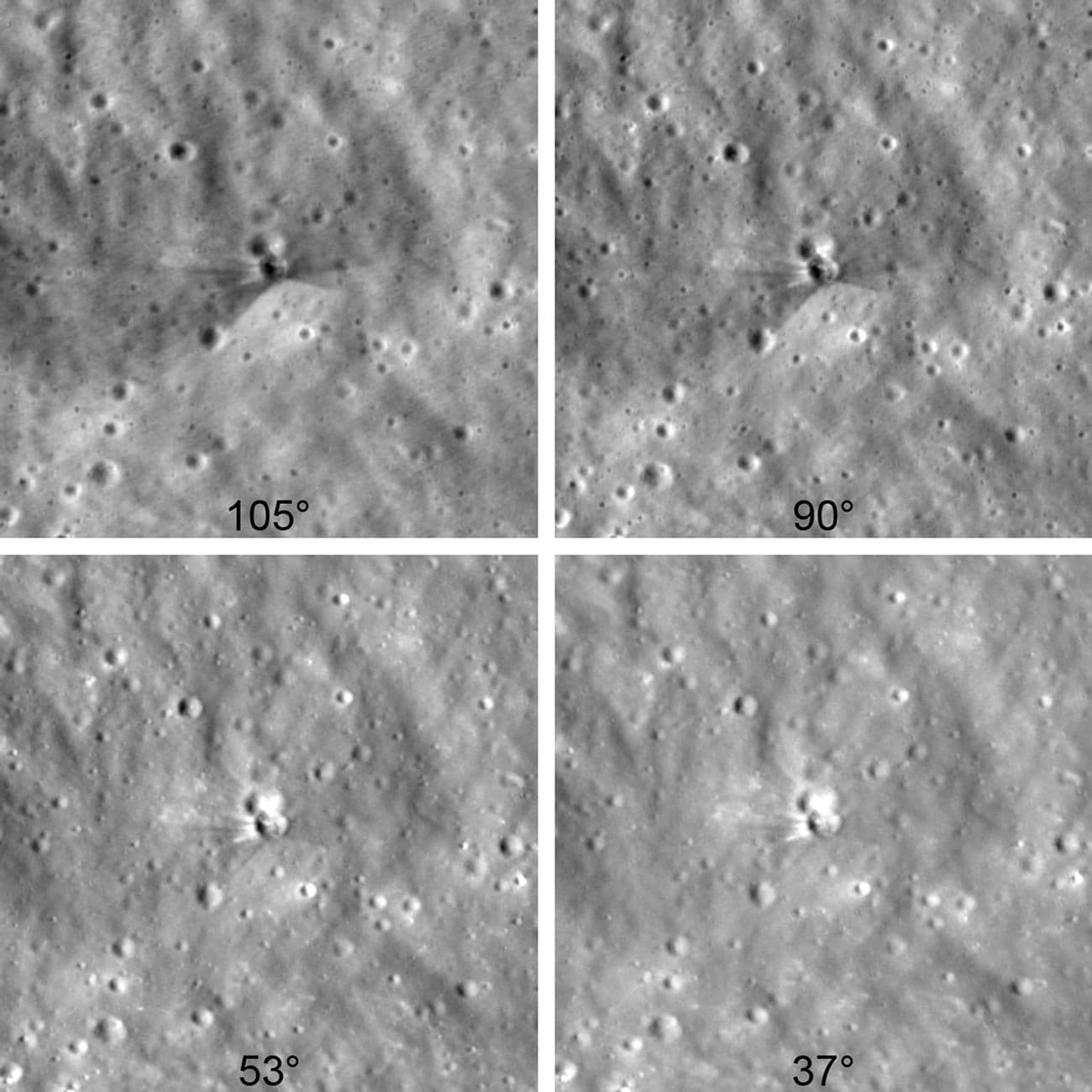
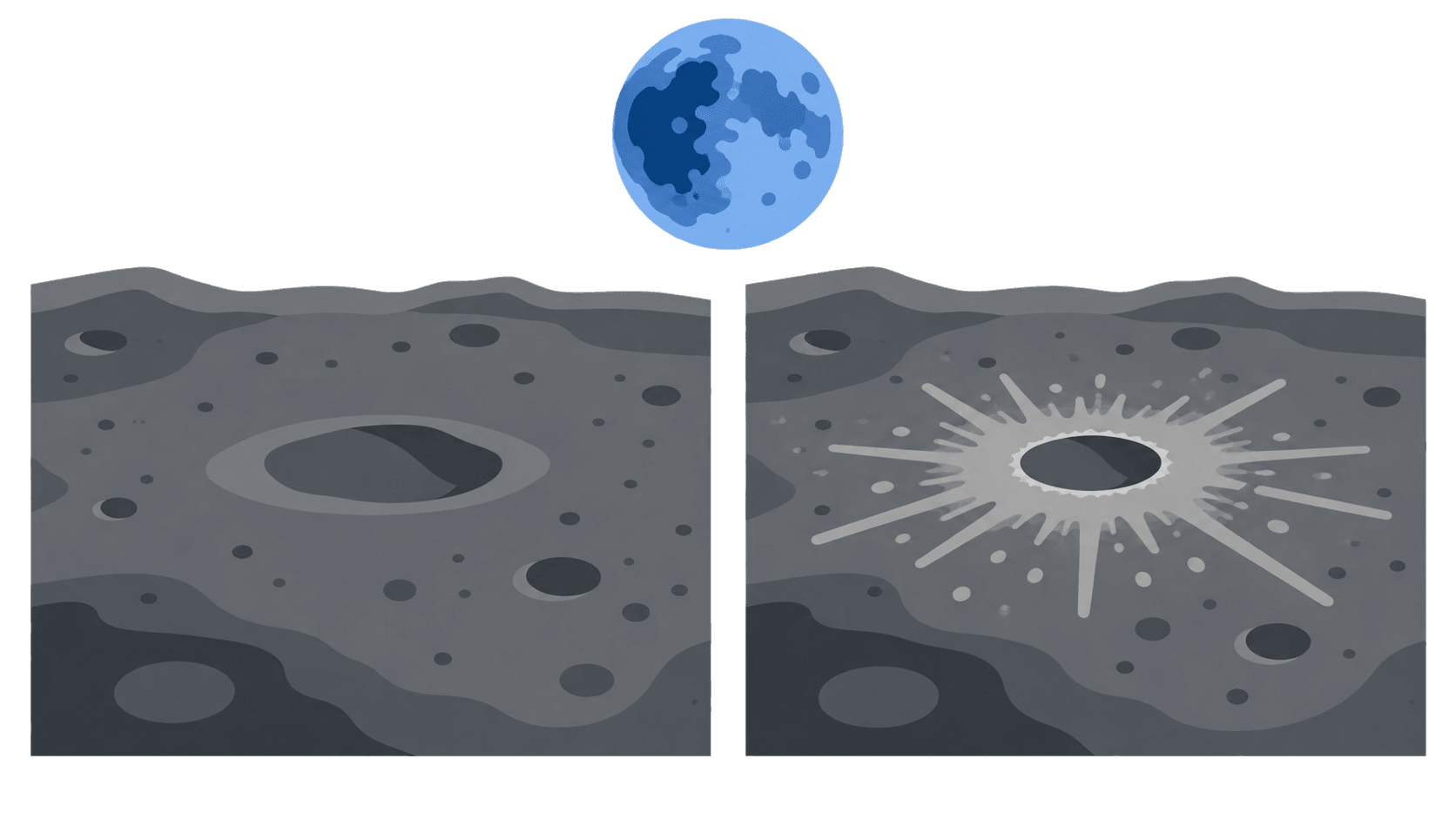
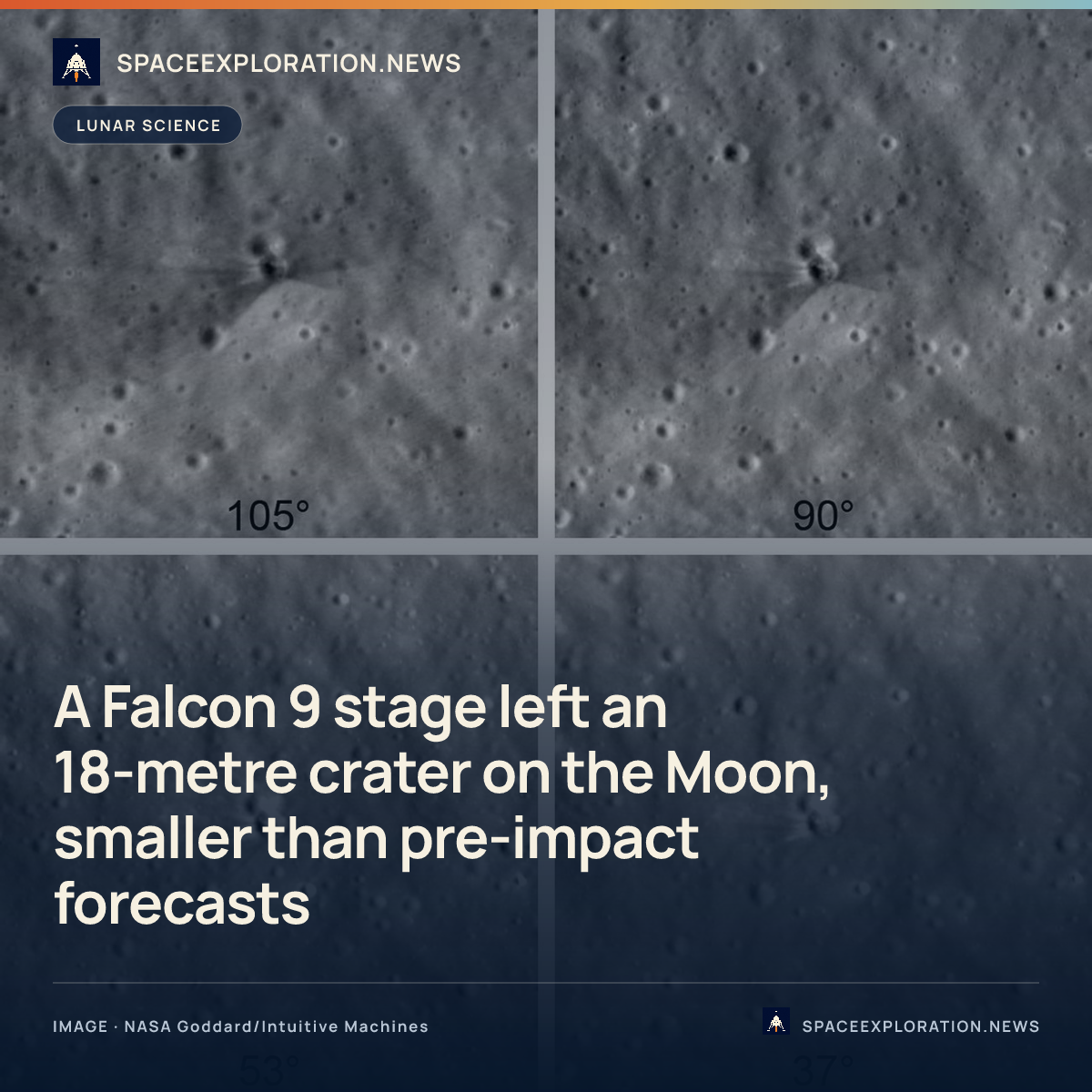
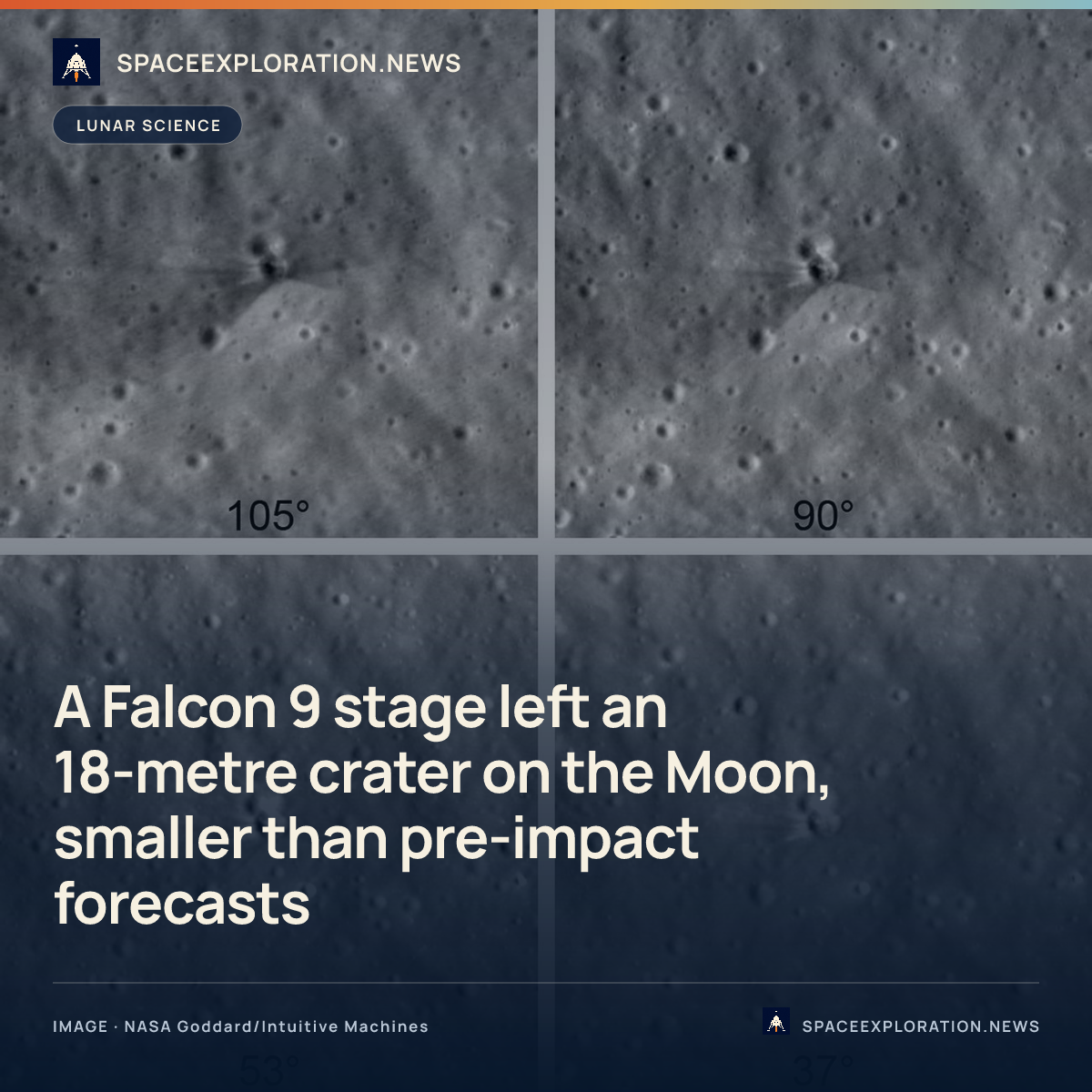
NASA’s Lunar Reconnaissance Orbiter has resolved the crater left by a spent SpaceX Falcon 9 upper stage that struck the Moon at about 06:35 UTC on August 5: 18 metres wide and less than 3 metres deep. The stage arrived at roughly 2.4 kilometres per second. The August 11–12 images turn a predicted collision into a measured impact site, while the tracking campaign around it exposes a separate problem. The stage did not strike a spacecraft or surface installation, but uncertainty in its path was large enough before impact that operators of South Korea’s Danuri orbiter considered a close encounter possible.
LRO’s Narrow Angle Camera found the crater at 19.4759°N, 266.7138°E and an elevation of 511 metres. Engineers tilted LRO during successive passes roughly 96 kilometres above the surface; NASA says the orbiter was moving at about 1.6 kilometres per second and its timing had to be within roughly 10 seconds to keep the target inside the frame. Danuri had imaged the site within hours of the collision and passed refined coordinates to the LRO team, which began its sequence six days later.
What the new crater records
Different illumination and viewing angles show a V-shaped ejecta pattern on the crater’s south side. Lunar Reconnaissance Orbiter Camera scientists say the pattern fits an impact at about 31° above the horizontal. Dark streaks came from roughly the upper 50 centimetres of regolith, material altered over time by solar wind, cosmic rays and micrometeorite impacts; brighter deposits near the rim came from less-weathered material excavated from deeper down.
The rocket’s construction complicates a direct comparison with a compact natural impactor. Most of an empty upper stage is thin tankage, while a much heavier engine sits at one end. The camera team says the stage’s orientation — engine-first, tank-first or sideways — could have changed the crater and ejecta pattern. The images establish the outcome, but they do not yet reveal that attitude at contact.
Pre-impact models did not converge on one size. NASA publicly expected a crater about 18 metres wide and 3.7 metres deep. A July arXiv preprint estimated about 27 metres by 5 metres, while a separate August preprint predicted roughly 40 metres across. LRO’s measured width matches NASA’s estimate but falls below both academic diameter estimates; its shadow measurement only sets an upper bound on depth. That makes the observed crater a calibration case rather than proof that one generic model applies to every spent stage.
A known launch, a difficult object
Catalogued as 2025-010D, the stage came from the January 15, 2025, Ghost Riders in the Sky launch that sent Firefly Aerospace’s Blue Ghost 1 and ispace’s Resilience landers towards the Moon. NASA says solar activity and gravitational forces produced the stage’s unplanned lunar return. Independently, researchers propagated the trajectory backwards to that launch and used visible and near-infrared spectra to distinguish the object from a natural body; their light curves also showed a roughly seven-minute rotation whose period changed during observations.
By late June, Danuri researchers knew the stage was inbound and could pass close to their spacecraft. Eunhyeuk Kim of the Korea Aerospace Research Institute told Space.com that the stage’s trajectory carried large uncertainty while Danuri’s orbit was well known, so his team could not disregard a conjunction. This did not lead to a dedicated avoidance burn: a mid-July manoeuvre already planned for the August 28 lunar eclipse shifted Danuri’s orbital phase and removed the probable encounter. When impact occurred, Danuri was over the south polar region, far from the site.
The eventual ground prediction was much tighter. NASA’s Center for Near Earth Object Studies refined the impact location and provided it to the Korean team; after the crater was found, NASA said the prediction was accurate to about 0.6 miles, or 1 kilometre. Danuri then supplied the coordinates that let LRO target its higher-resolution views. The sequence shows that international tracking and rapid data exchange worked, but only after operators had identified and followed an object whose disposal had not been planned.
The hazard is control, not one crater
Nothing in the new images shows that this impact endangered a current lunar installation. NASA said in advance that it posed no danger to Earth and compared its energy with a natural meteoroid impact expected on the Moon about once every six days. Dean Sladen, an aerospace engineer quoted by Space.com, likewise said high-speed ejecta is not a major threat to today’s isolated missions. Natural impactors remain the larger background that lunar hardware must already tolerate.
The controllable part is different. A pre-impact modelling paper calculated that some resolved ejecta particles could travel almost 1,000 kilometres ballistically, far enough to matter for future astronauts or infrastructure. That was a model forecast, not an observed range: LRO’s released images cover hundreds of metres around the crater and do not establish how far the fastest particles travelled. Sladen argued that designated impact zones or targeted deorbit protocols may be needed as habitats, solar arrays and crews multiply.
NASA draws the same distinction between a lunar impact and an uncontrolled one. Its August 4 notice called controlled lunar-surface disposal an accepted and safe option for some stages, because the endpoint can be predicted and tracked; it described this stage’s return as unplanned. A known impact far from assets can be scheduled around and studied. Hardware whose position or endpoint remains uncertain creates a conjunction problem in orbit and a placement problem on the surface.
Analysis: an 18-metre warning
The crater itself is modest beside the Moon’s natural bombardment. Operationally, however, its dimensions are not the most important measurement. CNEOS’s eventual kilometre-scale accuracy, Danuri’s earlier conjunction concern and LRO’s six-day imaging campaign together show the chain required to turn abandoned hardware into a known hazard with a known endpoint. As lunar traffic grows, maintaining custody of upper stages, exchanging precise trajectories and deliberately choosing disposal sites will matter more than whether a particular collision produces an 18-, 27- or 40-metre crater.
The LRO result closes the first physical question: where the stage hit and how much terrain it excavated. It leaves two limits visible. The stage’s orientation at contact is unresolved, and the farthest ejecta remains modelled rather than measured. Those are now testable against a documented impact whose launch origin, speed, angle, coordinates and final crater are unusually well constrained — a benchmark that researchers say will help identify and characterize the next difficult cislunar object.
Reporting trail
Primary sources
NASA ScienceNASA’s LRO Images Falcon 9 Crater on Moon, Learns New Detailsscience.nasa.gov
Lunar Reconnaissance Orbiter CameraFalcon 9 Impact!lroc.im-ldi.com
NASANASA Will Attempt to Observe Rocket Part’s Lunar Impactnasa.gov
Associated PressBefore-and-after NASA images show crater carved by a SpaceX rocket that slammed into the moonapnews.com
Space.comSpaceX rocket's moon crash highlights 'a tangible operational risk' of lunar settlementspace.com
arXivObservational planning for the 2026 August 5 Falcon 9 Upper Stage lunar impactarxiv.org
arXivPhysical Characterization of Moon Impactor 2025-010Darxiv.org
For an image post, download the card and copy this suggested caption.
The mark is smaller than two pre-impact academic forecasts. The sharper operational lesson is that uncertainty around the spent stage’s path prompted Danuri’s team to consider a possible close encounter. Read the full report: https://www.spaceexploration.in/news/lro-falcon-9-lunar-impact-crater #SpaceExplorationNews #SpaceNews #SpaceScience