Space observatories
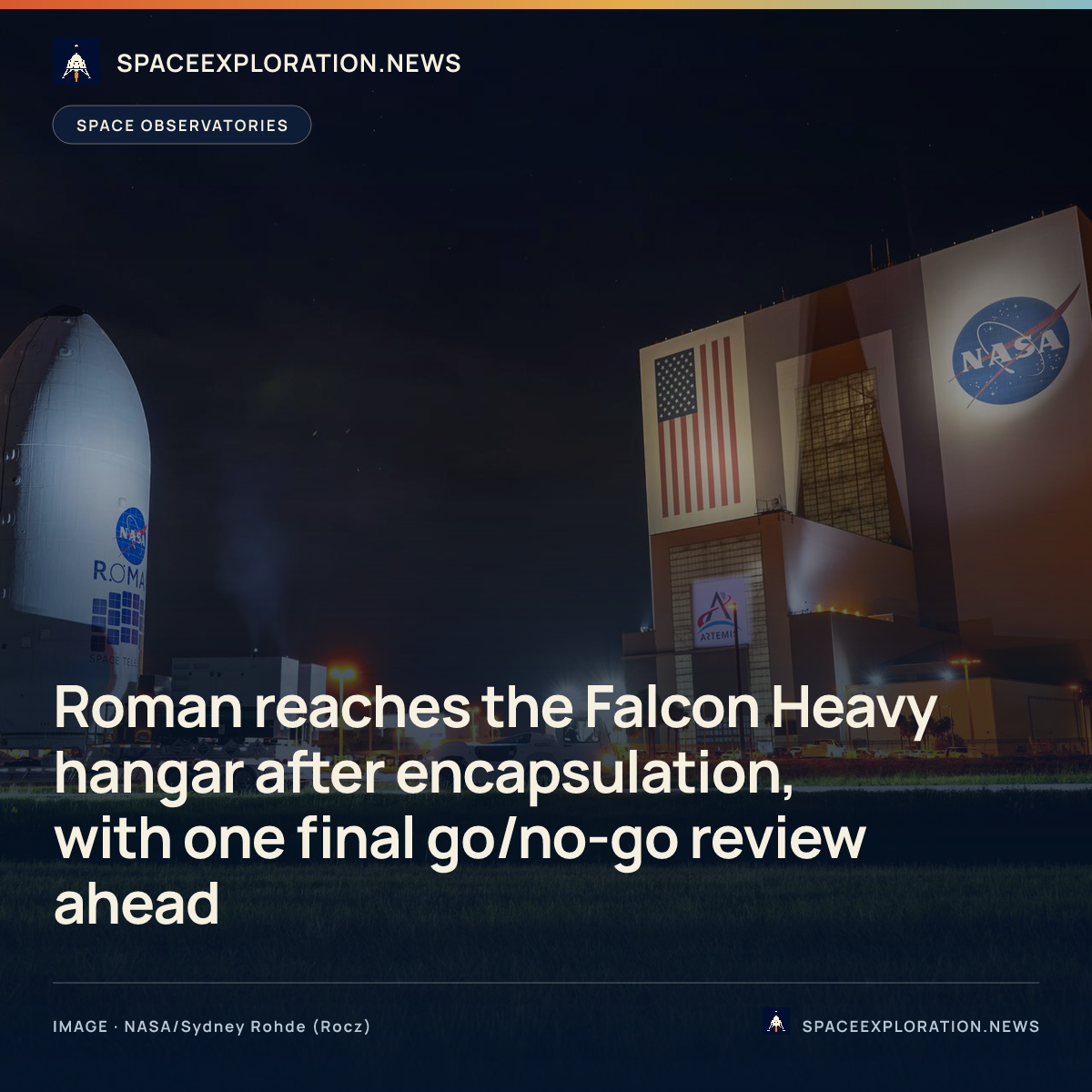
Roman reaches Falcon Heavy hangar after fairing encapsulation
The observatory has completed flight-readiness review, entered Falcon Heavy’s payload fairing and reached the hangar for mating; NASA’s next formal go/no-go review is August 28.
Add us as a preferred source on Google Add us as a preferred source on Google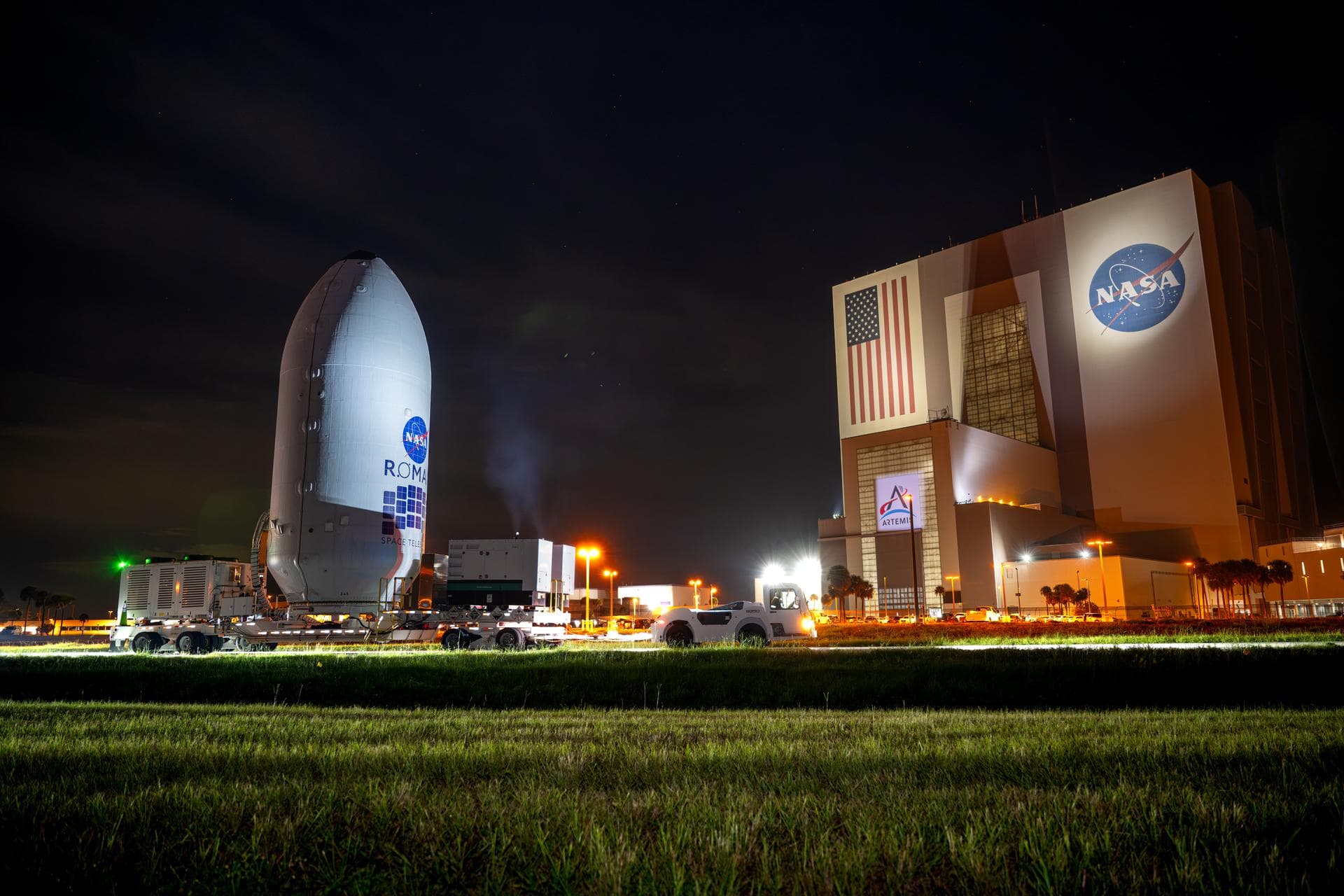
NASA says its Nancy Grace Roman Space Telescope has reached SpaceX’s hangar at Launch Complex 39A after completing flight-readiness review and being enclosed in the Falcon Heavy payload fairing. The telescope is now awaiting mating to the rocket for a launch NASA and SpaceX still target no earlier than 7:26 a.m. EDT on Sunday, August 30, from Kennedy Space Center in Florida. The latest processing update is not a launch result: it moves the observatory from preparation in a NASA facility into the sequence of integration, rollout and final readiness decisions that remains before liftoff.
NASA’s August 25 update says an escorted convoy moved Roman overnight from the Payload Hazardous Servicing Facility to the SpaceX hangar. The observatory had been in prelaunch processing at that facility since June, NASA said. Its team placed Roman inside the two-part fairing on August 21, then transported the enclosed payload toward the launch complex on August 24. The account describes the journey as a monitored ground operation; it does not report a problem with the telescope, fairing or transport.
What the readiness review and fairing change
A flight-readiness review is a management checkpoint, not the final launch authorization. NASA said mission managers from the agency, the Roman mission and SpaceX reviewed mission status at Kennedy on August 21 and certified Roman to begin final launch-preparation activities. The release did not publish a detailed review record or individual subsystem assessments. It did say the next steps were to transport the encapsulated observatory to pad 39A’s hangar, attach it to Falcon Heavy and send the combined vehicle to the launch pad.
Encapsulation puts the spacecraft inside the protective shell that will ride at the rocket’s top. NASA describes Falcon Heavy’s fairing as 43 feet tall and says its ground-support equipment maintains a controlled environment while Roman is moved. During ascent, the fairing is intended to shield the observatory from acoustic vibration, aerodynamic pressure and heating. NASA says the two halves will separate a few minutes after launch, when conditions permit, while Roman continues toward space and the fairing halves return for SpaceX recovery.
The next stated formal checkpoint is NASA’s Launch Readiness Review on Friday, August 28. NASA says that review will include the final go/no-go poll before the planned Sunday launch. Its August 24 media advisory lists a mission-science briefing and a prelaunch news conference for August 29, followed by launch coverage beginning at 6:20 a.m. EDT on August 30. Those times are subject to change during real-time operations, and NASA’s target remains explicitly no earlier than, rather than a guarantee of, the listed liftoff time.
Why a wide infrared survey telescope is nearing launch
Roman is designed as a survey observatory rather than a telescope that concentrates only on a small number of individual targets. NASA says its infrared field of view will be at least 100 times larger than Hubble’s, while retaining sharp imaging. The agency says that combination is intended to let scientists map billions of galaxies, study how galaxies cluster and evolve, and use the resulting observations to investigate dark energy and dark matter. Those are mission goals, not results Roman has already obtained.
For exoplanet science, NASA says Roman is intended both to discover and characterize planets beyond the solar system and to build a statistical census of planetary systems in the Milky Way. Its mission page also says the observatory will be able to block starlight to directly observe some exoplanets and planet-forming disks. That capability sits alongside the wide surveys: one instrument’s broad view is aimed at population-scale measurements, while the mission’s coronagraph is intended for more direct observation of selected planetary systems.
If Roman launches and separates from Falcon Heavy as planned, NASA says it will travel to the second Sun-Earth Lagrange point, known as L2, about one million miles from Earth. NASA gives the mission a five-year primary lifetime and a goal of operating for 10 years, with processed science data to be made public. The agency has not yet reported launch success, separation, arrival at L2 or the start of science operations; each is a later mission milestone.
The public record for this prelaunch account comes from NASA’s updates and media advisory, including the agency’s photo documentation of the transport; SpaceX has not supplied a separate public account in the sources reviewed for this report. NASA’s reports establish the planned sequence, but the August 28 go/no-go poll and real-time weather and operational conditions will determine whether the August 30 opportunity is used.
Reporting trail
Primary sources
NASATeams Complete Flight Readiness Review for NASA’s Roman Telescopescience.nasa.gov
NASANASA’s Roman Telescope Enclosed in SpaceX Falcon Heavy Rocket Fairingscience.nasa.gov
NASANASA’s Nancy Grace Roman Space Telescope Arrives at Hangarscience.nasa.gov
NASANASA Sets Coverage for Roman Space Telescope Launch from Floridanasa.gov
NASANancy Grace Roman Space Telescopescience.nasa.gov
NASA Image and Video LibraryRoman Space Telescope Transport from PHSF to LC 39Aimages.nasa.gov
For an image post, download the card and copy this suggested caption.
The observatory has completed flight-readiness review, entered Falcon Heavy’s payload fairing and reached the hangar for mating; NASA’s next formal go/no-go review is August 28. Read the full report: https://www.spaceexploration.in/news/roman-telescope-fairing-hangar-launch-prep #SpaceExplorationNews #SpaceNews #SpaceMissions